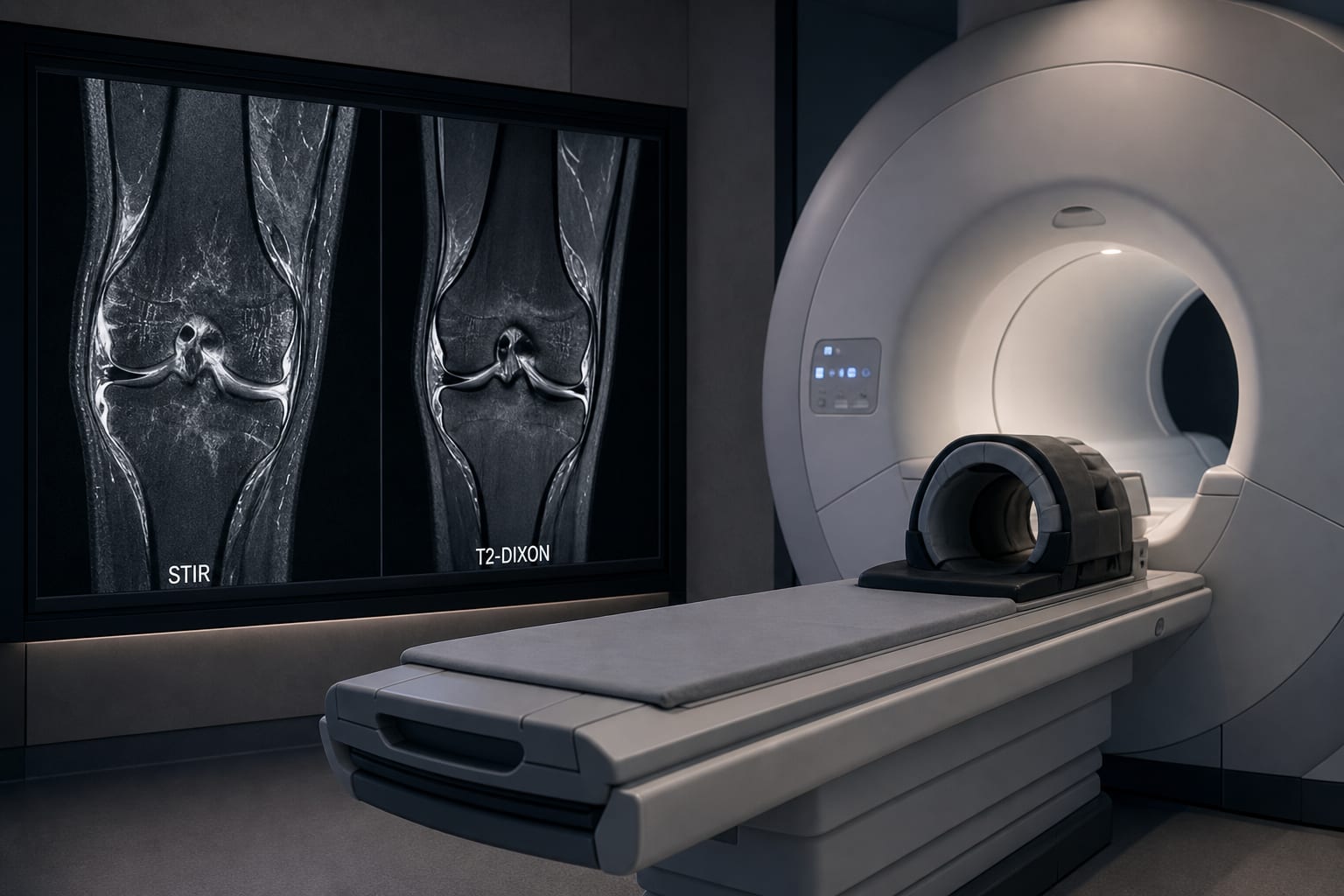
To compare the STIR and T2-Dixon fat-suppression sequences in musculoskeletal MRI and discuss their historical development and clinical adoption.
Approach:
Historical Context: The article discusses the historical development and clinical adoption of STIR and T2-Dixon sequences in MRI, highlighting their unique advantages and challenges.
Technical Comparison: It contrasts the mechanisms of fat suppression used by STIR and T2-Dixon, explaining their performance differences in various clinical scenarios.
Clinical Adoption: The article examines the factors influencing the delayed integration of T2-Dixon into clinical practice and its recent advancements.
Key Findings:
STIR offers excellent fat suppression, high sensitivity for edema detection, and reduced metal artifacts.
T2-Dixon has shown improvements in image quality and is now comparable to STIR for certain applications, particularly in whole-body MRI protocols.
The clinical adoption of T2-Dixon was hindered by technological limitations and inconsistent implementation across different MRI systems, leading to disparities in sequence quality.
Interpretation:
The choice between STIR and T2-Dixon sequences should be guided by specific clinical needs, anatomical regions, and diagnostic questions.
Limitations:
The article does not provide quantitative data comparing the performance of STIR and T2-Dixon.
It lacks a comprehensive analysis of patient outcomes related to the use of these sequences.
Conclusion:
Both STIR and T2-Dixon have distinct advantages and limitations.