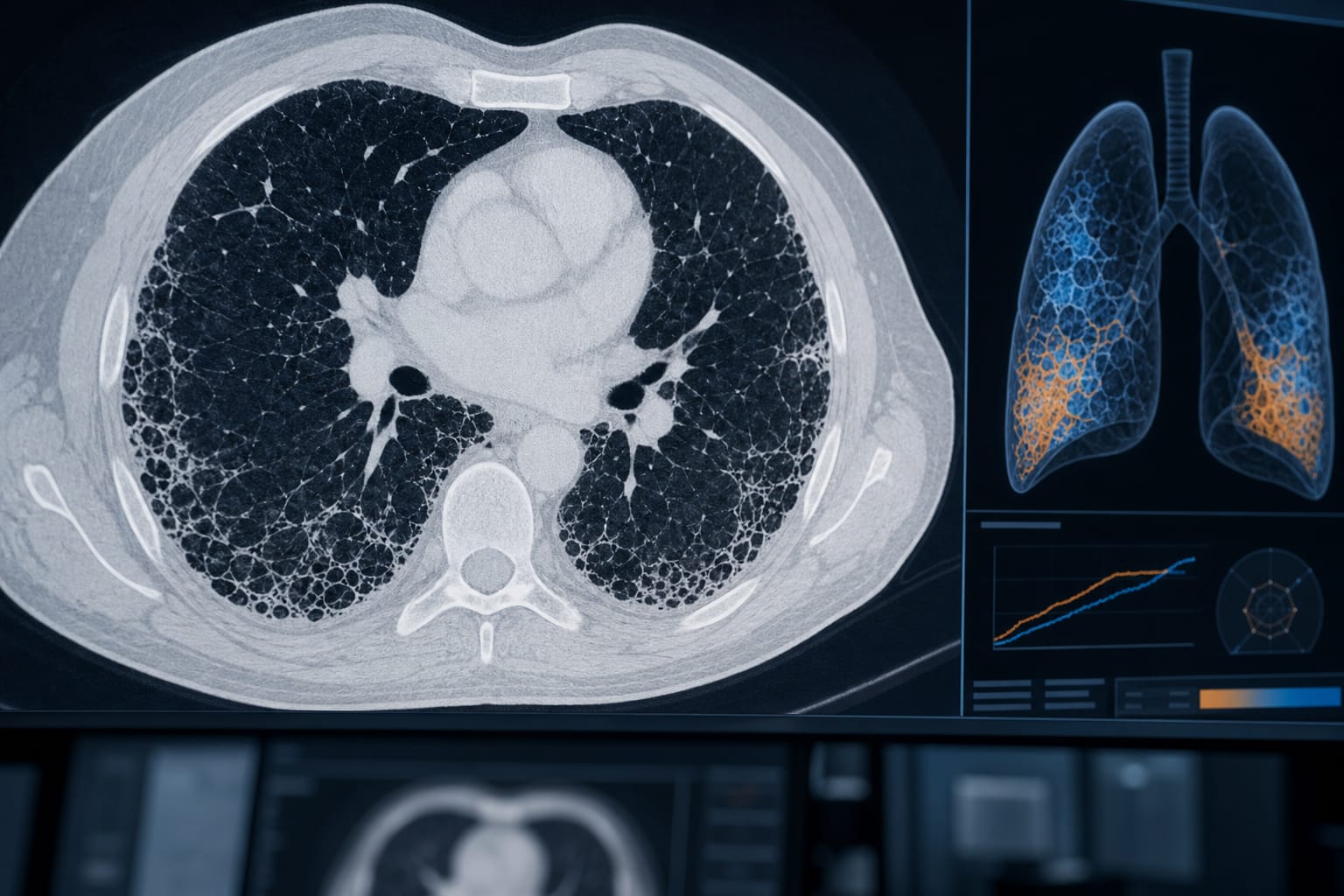
To explore the utility of deep learning-based quantitative CT (QCT) in identifying risk factors for progressive fibrosing interstitial lung disease (PF-ILD) and improving patient outcomes.
Key Findings:
PF-ILD is characterized by a decline in forced vital capacity (FVC) and increased fibrosis on CT, affecting both IPF and non-IPF ILD patients, with significant implications for treatment strategies.
Deep learning-based QCT methods show promise in classifying ILD subtypes and predicting outcomes, potentially leading to personalized treatment approaches.
Visual assessments of CT images exhibit significant variability, highlighting the need for quantitative analysis to standardize evaluations.
Interpretation:
The study underscores the potential of deep learning-based QCT in enhancing the accuracy of PF-ILD risk factor identification and prognostication.
Limitations:
Retrospective design may introduce selection bias and limit the ability to establish causality.
Exclusion of patients with acute exacerbations or significant pleural effusion may limit generalizability.
Conclusion:
Deep learning-based QCT could serve as a valuable tool for identifying risk factors and predicting outcomes in PF-ILD, warranting further investigation to validate these findings.