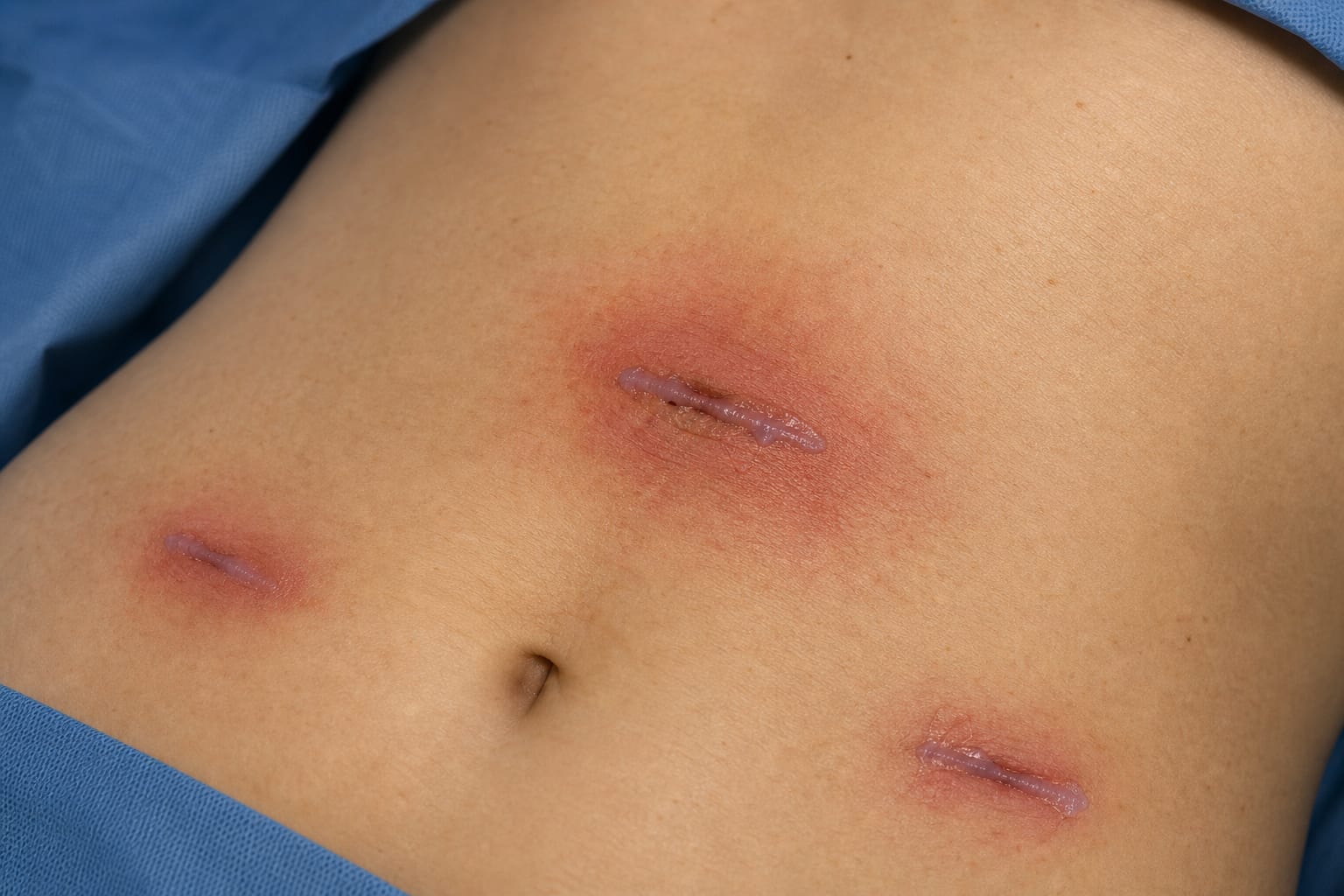
To clarify whether specific tissue adhesive products are associated with higher rates of contact dermatitis in patients undergoing laparoscopic surgery.
Approach:
Study Design: A single-center, intra-patient, randomized controlled trial comparing Dermabond™ (DB) and LiquiBand® (LB) in patients undergoing laparoscopic surgery.
Participants: Adult patients (≥ 18 years) undergoing elective laparoscopic or robotic abdominal surgery were included, while those with known allergies to skin glue or unable to complete follow-up were excluded.
Randomization: Each participant served as their own control, with DB applied to one side of the abdomen and LB to the other, randomly assigned by day of the month.
Outcomes: Primary outcome was the proportion of patients with contact dermatitis within 6 weeks postoperative; secondary outcomes included wound dehiscence and surgical site infection.
Statistical Analysis: Intention to treat analysis and univariate analysis were performed, with the primary outcome analyzed using an exact McNemar’s test.
Key Findings:
A total of 180 patients underwent laparoscopic or robotic abdominal surgery with both adhesives applied.
Female patients were more likely to have a reaction to any glue (15% vs. 2%, p = 0.013).
Interpretation:
The study aims to provide data on the rates of contact dermatitis associated with different tissue adhesives.
Limitations:
The study was conducted at a single center, which may limit generalizability.
No prior studies directly compared DB and LB regarding contact dermatitis rates.
Conclusion:
The study seeks to determine if LB is associated with a higher rate of contact dermatitis compared to DB.
by Julie L. Holihan, Abigail G. Wrather, Claire Lancaster, Kulvinder S. Bajwa, Melissa M. Felinski, Shinil K. Shah, Jonah J. Stulberg, Todd D. Wilson, Erik B. Wilson