MR-guided microwave ablation of liver tumors: outcomes in local tumor control and determinants of treatment success - Summary - MDSpire

MR-guided microwave ablation of liver tumors: outcomes in local tumor control and determinants of treatment success

  • By

  • Vanessa F. Schmidt

  • Philipp Linden

  • Olaf Dietrich

  • Sinan Deniz

  • Daniel Puhr-Westerheide

  • Osman Öcal

  • Moritz L. Schnitzer

  • Florian Obereisenbuchner

  • Matthias Kassube

  • Mingming Wu

  • Luigi Nardone

  • Lars Grenacher

  • Florian Maier

  • Ricarda Seidensticker

  • Moritz Wildgruber

  • Jens Ricke

  • Matthias P. Fabritius

  • Max Seidensticker

  • July 4, 2026

  • 0 min

Share

Objective:

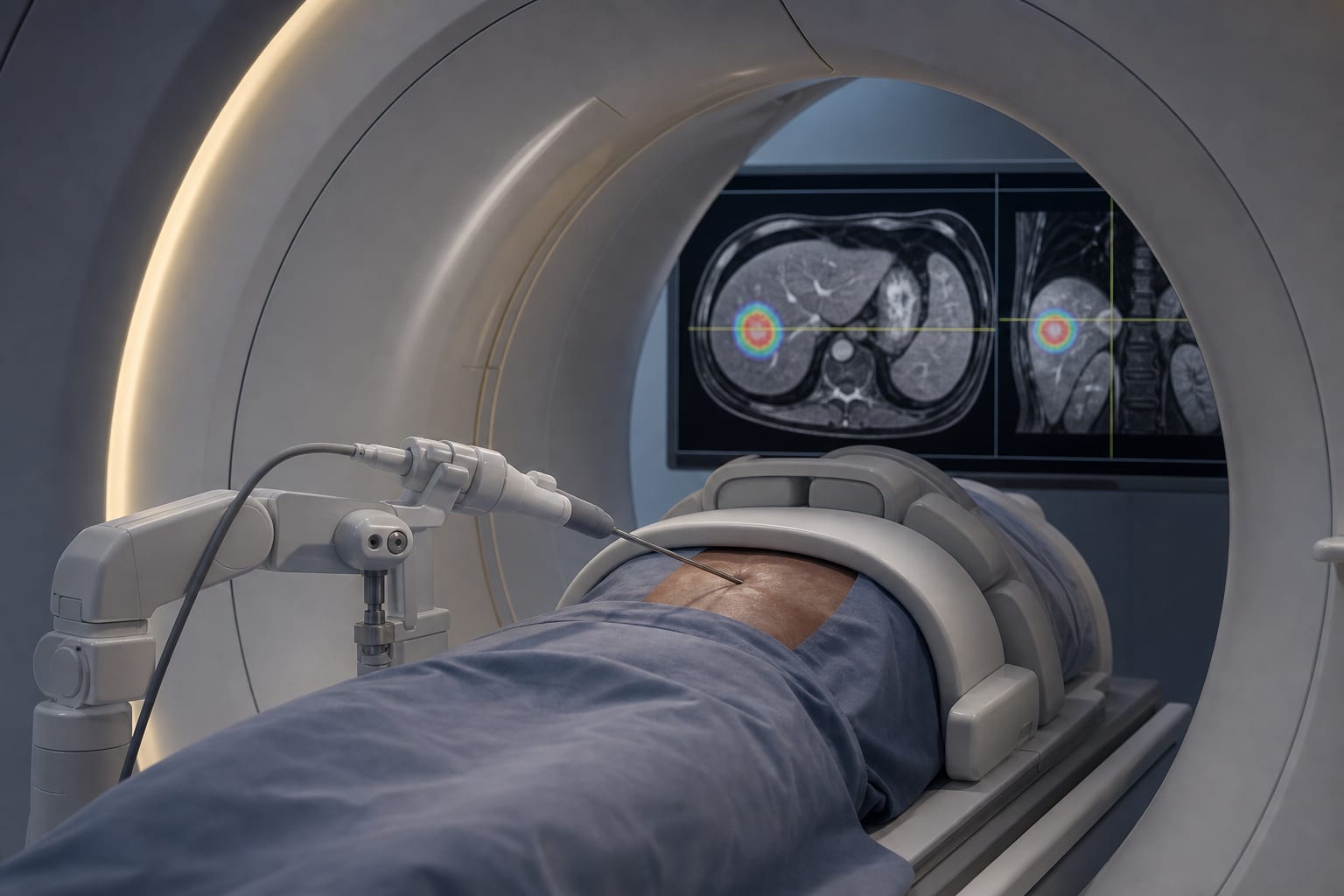
To evaluate outcomes in local tumor control after MR-guided microwave ablation (MWA) of liver lesions and identify determinants of treatment success.

Approach:
  • Study Design: Included patients undergoing MR-guided MWA of histopathologically proven liver malignancies from 09/2021 to 02/2025, with treatment decisions made by a multidisciplinary tumor board.
  • Determinants of Treatment Success: Analyzed clinical and technical parameters influencing local tumor control, including lesion size, tumor type, ablation duration, and proximity to vascular structures.
  • Statistical Analysis: Used descriptive statistics and various tests (Wilcoxon rank sum, Pearson’s chi-squared, Fisher’s exact) for data analysis, with significance set at p < 0.05.
Key Findings:
  • Technical success rate was 95.8%, with complete coverage in 46 out of 48 lesions.
  • Local recurrence was observed in 2.5% of patients during a mean follow-up of 21.0 months.
  • Factors such as lesion size, type, and proximity to vessels influenced treatment outcomes.
Interpretation:

MR-guided MWA demonstrates high technical success rates and identifies specific factors influencing treatment outcomes.

Limitations:
  • Retrospective nature of the study may introduce bias.
  • Limited sample size of 40 patients may affect generalizability.
Conclusion:

MR-guided MWA achieves high rates of local control for liver malignancies, with identifiable factors affecting treatment success.

Original Source(s)

Related Content