Preoperative Cobb angle-guided surgical decision-making between percutaneous kyphoplasty and short-segment fixation with vertebroplasty in stage III Kümmell disease without neurological deficits: a two-center retrospective study - Summary - MDSpire
Conexiant’s news site is now MDSpire News. Learn more
Advertisement
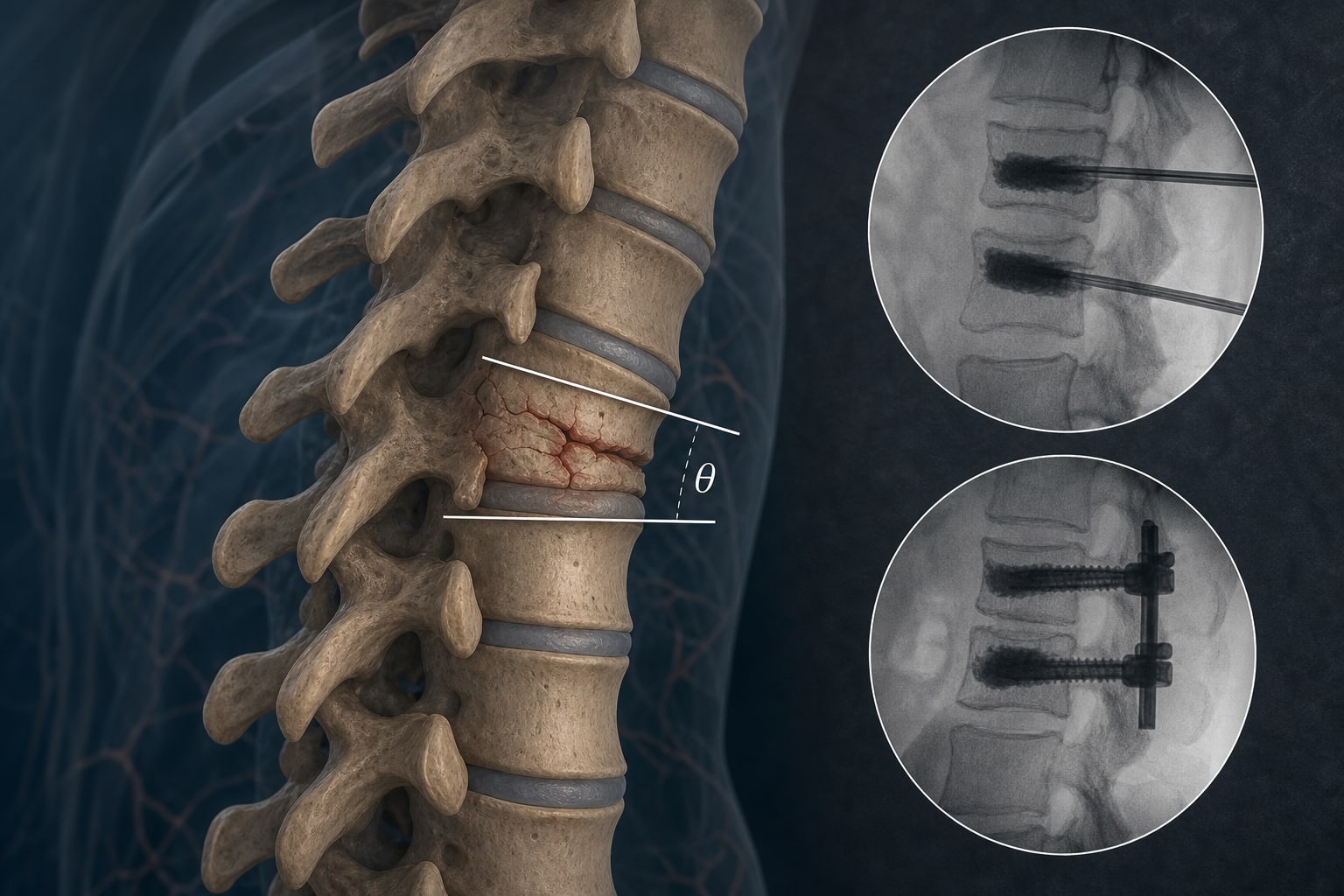
Guiding Surgical Choices in Stage III Kümmell Disease Without Neurological Deficits: A Retrospective Analysis of Preoperative Cobb Angle in Comparing Percutaneous Kyphoplasty and Short-Segment Fixation with Vertebroplasty Across Two Centers
To compare clinical and radiographic outcomes of percutaneous kyphoplasty (PKP) and short-segment fixation with vertebroplasty (SSF+VP) in patients with stage III Kümmell disease (KD) without neurological deficits, and to evaluate the preoperative local Cobb angle for guiding surgical decision-making.
Approach:
Study Design: A two-center retrospective study involving 117 patients who underwent surgery between January 2019 and December 2024.
Patient Groups: 71 patients underwent PKP and 46 underwent SSF+VP.
Data Collected: Perioperative parameters, VAS, ODI, local Cobb angle, Cobb angle loss, cement distribution, and cement leakage were compared.
Analysis Methods: ROC analysis assessed the predictive value of the preoperative Cobb angle for residual mild pain after PKP.
Key Findings:
PKP resulted in shorter operative time, less blood loss, smaller cement volume, and greater early improvement in VAS and ODI compared to SSF+VP.
SSF+VP showed lower VAS at final follow-up and better maintenance of Cobb angle correction.
Cobb angle loss in the PKP group correlated positively with final VAS.
The optimal preoperative Cobb angle cut-off for predicting residual pain after PKP was 25.95°.
Interpretation:
Both PKP and SSF+VP improved pain and function in stage III KD without neurological deficits, with PKP allowing faster early recovery and SSF+VP providing better long-term outcomes in severe kyphosis cases.
Limitations:
The study is retrospective and may have inherent biases related to patient selection and data collection.
The sample size may limit the generalizability of the findings.
Conclusion:
Preoperative Cobb angle-based stratification may assist in guiding individualized surgical selection for patients with stage III KD.
Investigators compared intra-articular microbial profiles and predicted metabolic pathways in patients with hip osteoarthritis and nonarthritic controls.