Clinical efficacy analysis of acupuncture combined with anti-tumor necrosis factor treatment for spleen and kidney yang deficiency type ulcerative colitis - Summary - MDSpire
Advertisement
Clinical efficacy analysis of acupuncture combined with anti-tumor necrosis factor treatment for spleen and kidney yang deficiency type ulcerative colitis
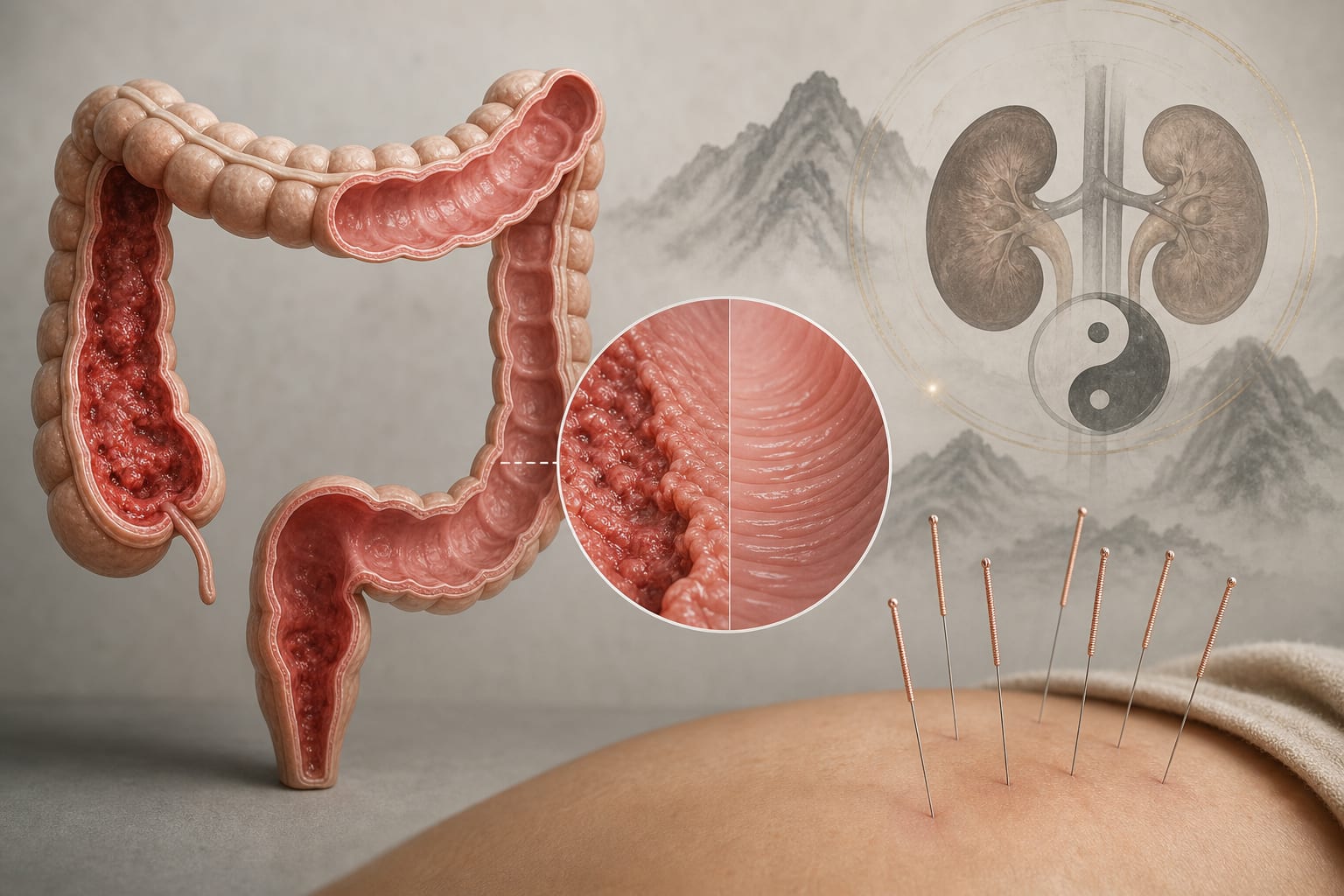
To investigate the clinical effects of acupuncture combined with tumor necrosis factor inhibitors in treating spleen-kidney yang deficiency type ulcerative colitis, with hopes of providing new ideas and methods for UC treatment.
Approach:
Study Design: Retrospective cohort study involving 90 patients diagnosed with spleen and kidney yang deficiency type UC.
Patient Groups: Patients were divided into a control group (n = 48) receiving TNF-α inhibitors and a study group (n = 42) receiving acupuncture in addition to TNF-α inhibitors.
Assessment: Clinical data were collected and assessed at baseline, 6 weeks, and 12 weeks post-treatment, focusing on colectomy rate, clinical remission, mucosal healing rate, and adverse events.
Key Findings:
Mayo scores and TCM syndrome scores significantly decreased in the study group after treatment (P < 0.05).
Colectomy rate was lower in the study group (7.14%) compared to the control group (20.8%), RR = 0.34, 95% CI:0.11–1.05, p = 0.042.
Clinical remission rate was higher in the study group (19.1%) compared to the control group (8.3%), RR = 2.30, 95% CI:0.78–6.75, p = 0.038.
Mucosal healing rate was significantly higher in the study group (38.1%) compared to the control group (20.8%), RR = 1.83, 95% CI:1.02–3.29, p = 0.041.
No severe adverse reactions occurred in either group, with no significant difference in adverse events (30.9% vs. 29.2%, RR = 1.06, 95% CI:0.57–1.98, p = 0.835).
Interpretation:
Acupuncture combined with TNF-α inhibitors may improve clinical symptoms and mucosal healing rates in patients with spleen-kidney yang deficiency type UC, while reducing colectomy rates without increasing adverse events.
Limitations:
Retrospective design may introduce bias.
Small sample size may limit generalizability.
Lack of long-term follow-up data.
Conclusion:
The study demonstrates that acupuncture combined with TNF-α inhibitors can effectively improve patients’ clinical symptoms and mucosal healing rates, while also reducing short-and medium-term colectomy rates without increasing the incidence of adverse events.