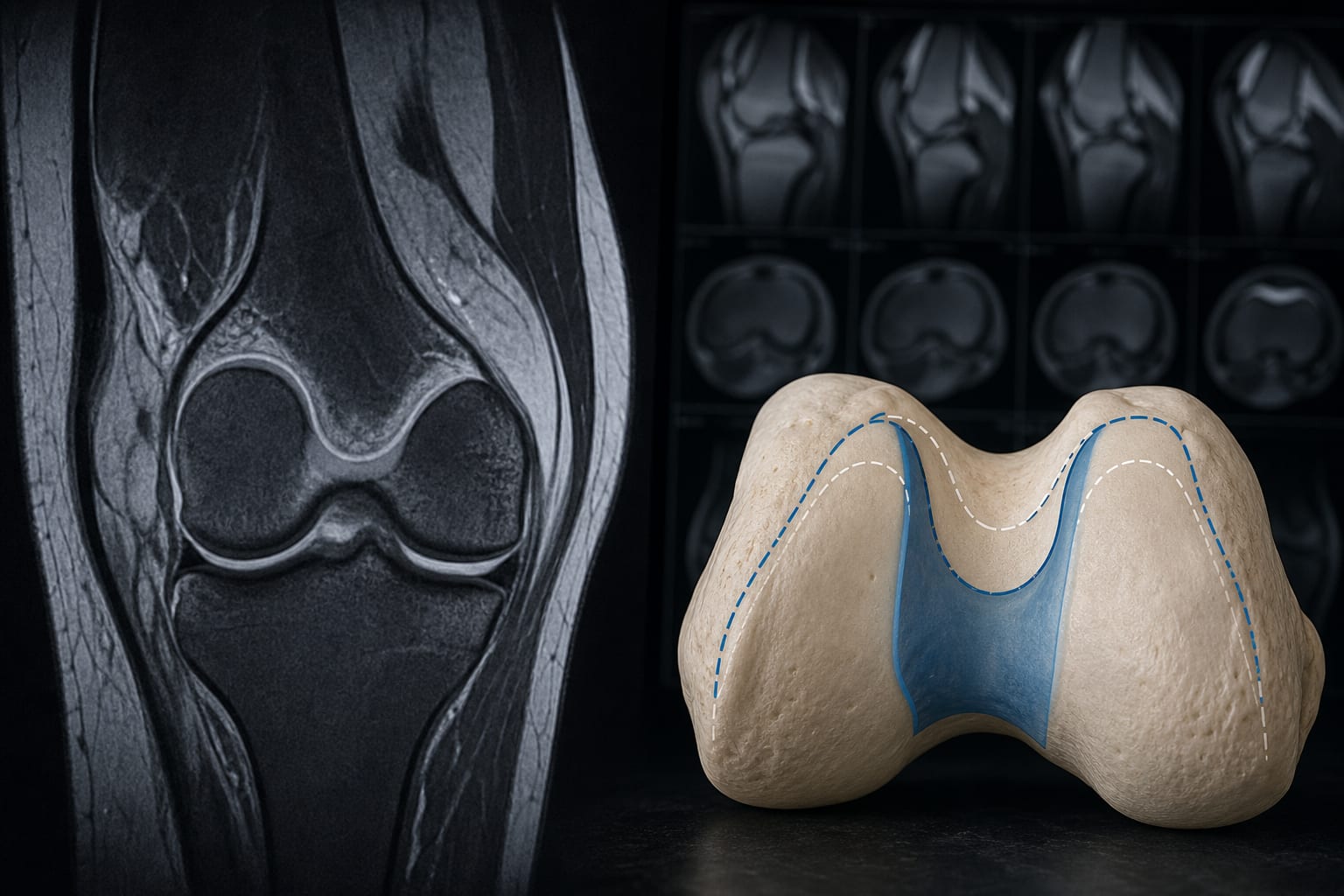
To evaluate postoperative improvements in trochlear morphology and identify factors associated with trochlear development in surgically treated children under 10 years old with habitual patellar dislocation.
Approach:
Study Design: Retrospective review of clinical data from patients younger than 10 years with habitual patellar dislocation treated between 2017 and 2023.
Measurement Techniques: MRI was used to measure femoral sulcus angle, relative trochlear depth, lateral trochlear inclination, and trochlear facet angle.
Statistical Analysis: Paired t-test and Fisher's exact test compared pre- and postoperative differences; GLMM logistic regression identified influencing factors.
Key Findings:
Postoperatively, the femoral sulcus angle significantly decreased (t = 8.756, P < 0.001), while relative trochlear depth, lateral trochlear inclination, and trochlear facet angle significantly increased (Z = −3.857, t = −6.957, t = −7.790; all P < 0.001).
Preoperatively, 2 knees had normal trochlear development and 22 had trochlear dysplasia; postoperatively, 10 knees normalized and 14 had persistent trochlear dysplasia (P = 0.008).
Preoperative age was significantly different between prognosis groups (F = 7.341, P = 0.015) and correlated positively with postoperative trochlear dysplasia (r = 0.497, P = 0.014).
Interpretation:
Smaller preoperative age and sulcus angle, along with larger relative trochlear depth and lateral trochlear inclination, correlate with better postoperative outcomes; preoperative age is an independent risk factor for poor trochlear development.
Limitations:
Small sample size of 19 cases.
Retrospective design may introduce bias.
Conclusion:
Trochlear morphology significantly improves postoperatively in children under 10 years old with habitual patellar dislocation.