Replantation of amputated fingertips: reconstruction of circulation via proximal subungual arch artery or nail bed vein anastomosis - Summary - MDSpire
Advertisement
Replantation of amputated fingertips: reconstruction of circulation via proximal subungual arch artery or nail bed vein anastomosis
To evaluate the outcomes of a surgical approach for replantation of distal fingertip amputated tissue when the palmar digital artery is unavailable for anastomosis.
Approach:
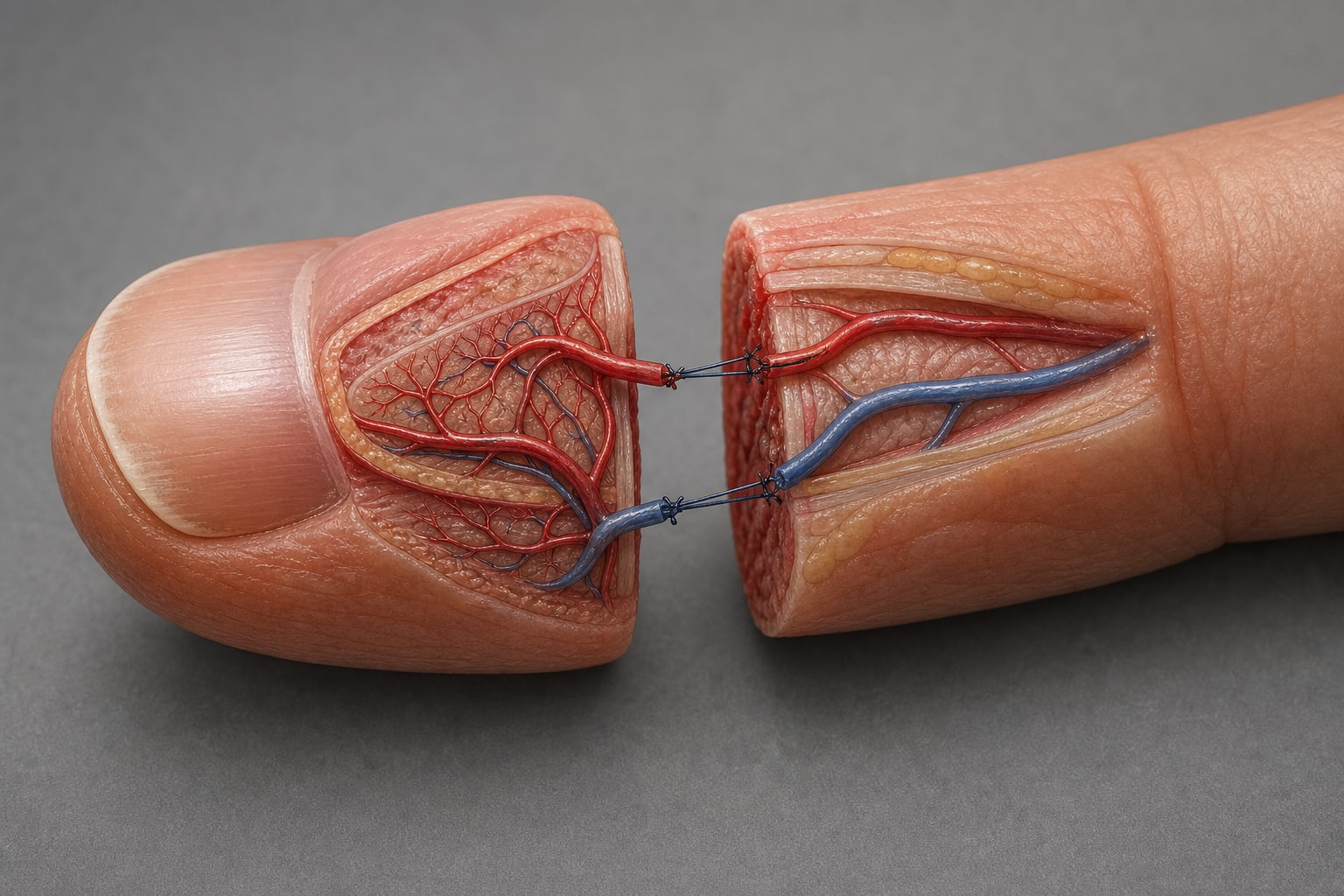
Surgical Method: Anastomosis of the proximal subungual arch artery as an alternative to the palmar digital artery for arterial supply, and standard anastomosis of the dorsal subcutaneous vein for venous drainage.
Alternative Method: When the dorsal subcutaneous vein is unavailable, anastomosis of the proximal nail bed vein is performed to restore venous drainage.
Key Findings:
All 12 replanted digits survived with no cases of vascular crisis, wound infection, fracture nonunion, or tissue necrosis.
Mean warm ischemia time was 4.75 hours, and mean operative time was 1.97 hours.
Function scores of the affected fingers ranged from 11 to 15, with an average of 12.5.
Interpretation:
The proximal subungual arch artery and nail bed vein can be anastomosed to restore blood flow in distal fingertip amputations lacking standard vessels.
Limitations:
Small sample size of 12 patients limits generalizability.
Follow-up duration varied, with a mean of 12.17 months.
Conclusion:
This approach effectively improves the replantation rate and survival rate of distal fingertip amputated tissue.