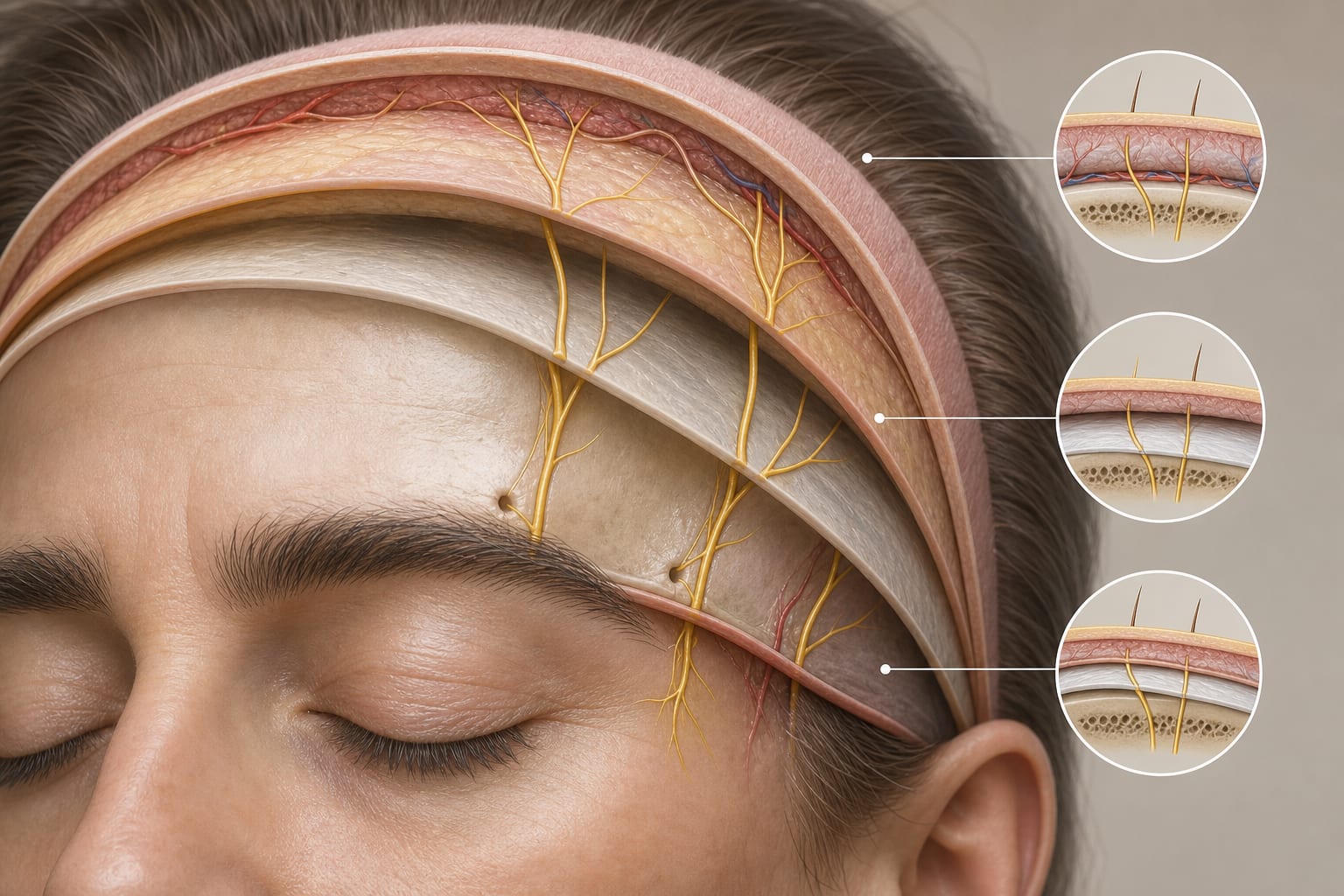
To provide a comprehensive comparison of supraperiosteal, subperiosteal, and combined dissection approaches in endoscopic brow lifts, focusing on anatomical insights, surgical outcomes, and clinical evidence.
Approach:
Literature Review: A narrative review based on a structured literature search from January 1990 to May 2026, focusing on anatomy-guided selection of dissection planes.
Key Findings:
Three principal dissection planes are employed: supraperiosteal, subperiosteal, and combined supra–subperiosteal.
Each approach has distinct anatomical relationships, surgical exposure, biomechanical lifting mechanisms, and risks of neurovascular injury, particularly involving the deep branch of the supraorbital nerve.
Recent anatomical and clinical studies suggest that supraorbital nerve tension plays a critical role in limiting brow elevation.
Anatomical variability in the course of the supraorbital nerve complicates surgical standardization and impacts brow elevation.
Interpretation:
The review synthesizes available anatomical and clinical evidence regarding the differences among the dissection approaches in terms of safety, mobility, exposure, and clinical indications.
Limitations:
The review is based on non-systematic literature and does not perform a formal risk-of-bias assessment or meta-analysis.
Most available evidence is anatomical, cadaveric, technical, retrospective, or derived from animal models.
Conclusion:
The review does not claim universal superiority for any single plane but aims to inform on the trade-offs among the techniques.