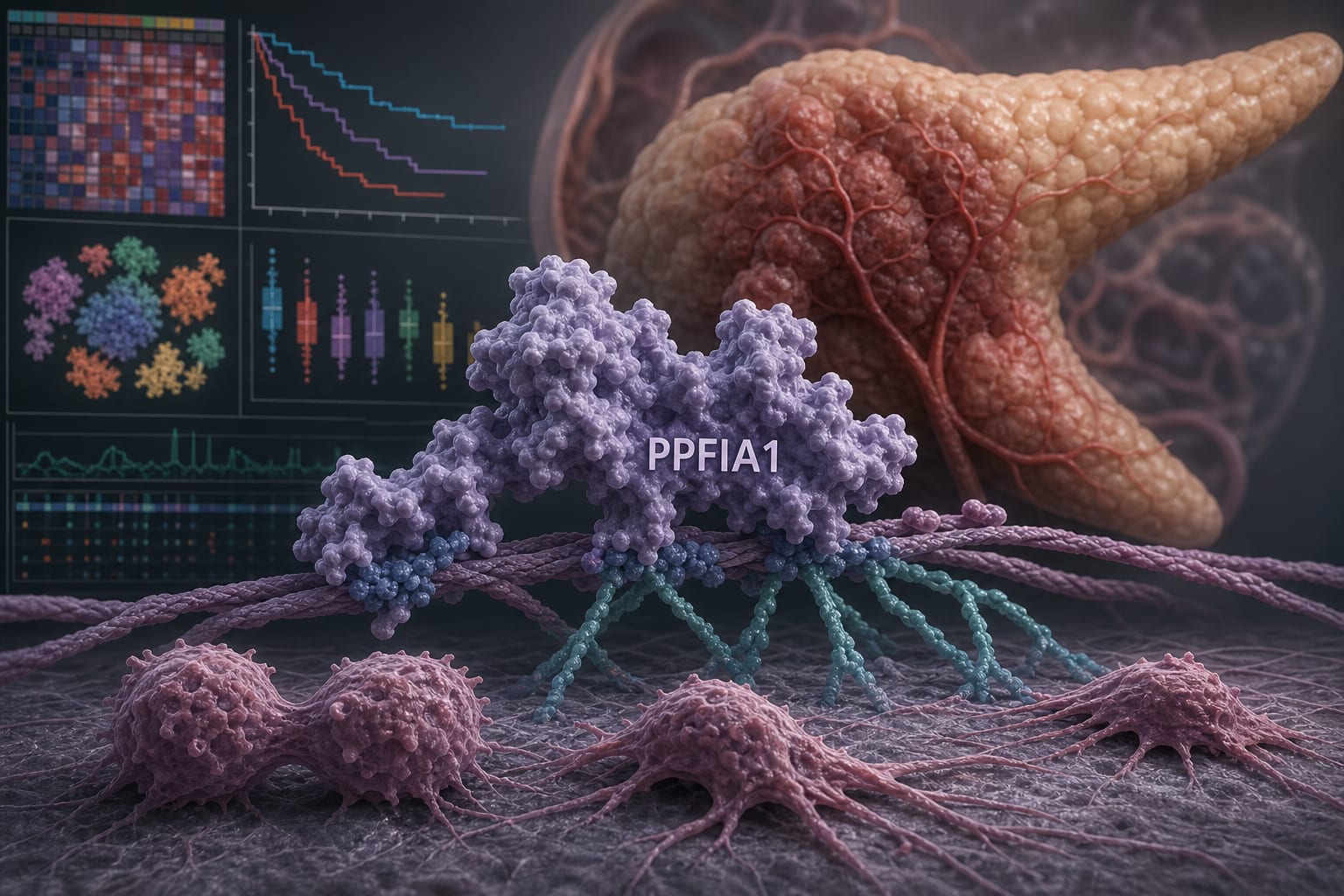
Unraveling the role of PPFIA1 in cancer: a comprehensive multi-omics analysis and functional validation from pan-cancer to pancreatic cancer
By
Shu Li
Hailin Jiang
Xiaojia Li
Tingting Jiang
Keping Xie
July 8, 2026
Objective: To explore the expression, prognostic implications, and functional roles of PPFIA1 across various cancers, with a focus on pancreatic cancer.
Approach: Data Integration: Utilized pan-cancer datasets (TCGA, GTEx, TISCH) to assess PPFIA1 expression, genomic alterations, and pathway enrichment.Survival Analysis: Conducted Kaplan-Meier survival analysis and Cox regression to evaluate prognostic significance.External Validation: Validated findings in pancreatic cancer using external cohorts (GSE28735, GSE52452).Functional Analysis: Performed ShRNA-mediated knockdown in pancreatic cancer cell lines to assess proliferation, migration, and invasion.Key Findings: PPFIA1 is overexpressed in pancreatic adenocarcinoma compared to non-tumor tissue. High PPFIA1 expression correlates with poor prognosis in pancreatic cancer. Genomic alterations include amplifications in head/neck cancers and mutations in endometrial carcinoma. GSEA analysis indicates activation of mitotic spindle assembly and EMT pathways in pancreatic cancer. Knockdown of PPFIA1 reduces proliferation, migration, invasion, and tumor growth in pancreatic cancer models. Interpretation: PPFIA1 is associated with significant prognostic value and an oncogenic role in pancreatic cancer, particularly related to EMT-related phenotypes.
Limitations: The study primarily relies on publicly available datasets, which may have inherent biases. Functional validation was limited to specific pancreatic cancer cell lines. Conclusion: Further investigation of PPFIA1 is warranted based on its observed roles in pancreatic cancer.