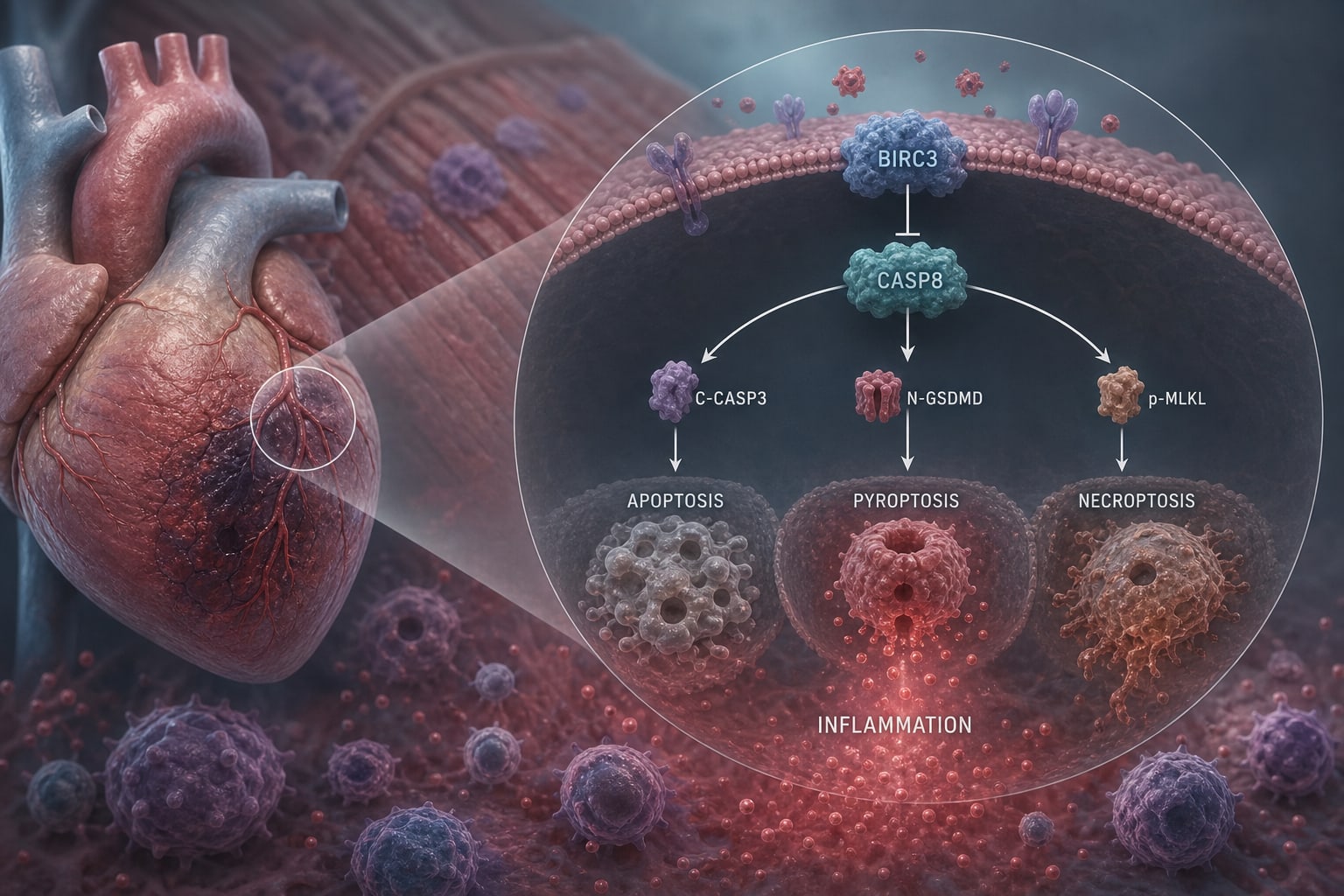
To investigate the activation of PANoptosis during myocardial ischemia/reperfusion (I/R) injury and explore the regulatory mechanisms involving the BIRC3-CASP8 axis.
Approach:
Experimental Models: Utilized rat I/R and H9c2 OGD/R models, employing transmission electron microscopy, immunofluorescence, and molecular markers (C-CASP3, N-GSDMD, p-MLKL).
Gene Transfer and Inhibition: Dissected the functional hierarchy of the BIRC3-CASP8 axis using AAV-mediated gene transfer and pharmacological inhibitors.
Key Findings:
I/R injury induces PANoptosis with interdependent crosstalk.
BIRC3 upregulation inhibits CASP8, promoting pyroptosis and necroptosis.
BIRC3 silencing redirects cell death towards apoptosis, preserving membrane integrity and reducing inflammatory mediator release.
Interpretation:
The BIRC3-CASP8 axis serves as a switch between destructive and silent death modes in cardiomyocytes.
Limitations:
The study primarily used animal models, which may not fully replicate human pathophysiology.
Further research is needed to explore the clinical applicability of targeting the BIRC3-CASP8 axis.
Conclusion:
Leveraging the BIRC3-CASP8 axis to shift PANoptosis towards an apoptosis-dominant phenotype may reduce inflammation and collateral injury.
An ensemble electrocardiogram model classified derived diastolic dysfunction risk phenotypes and stratified heart failure–related death risk across external cohorts, according to findings presented at ASE 2026.