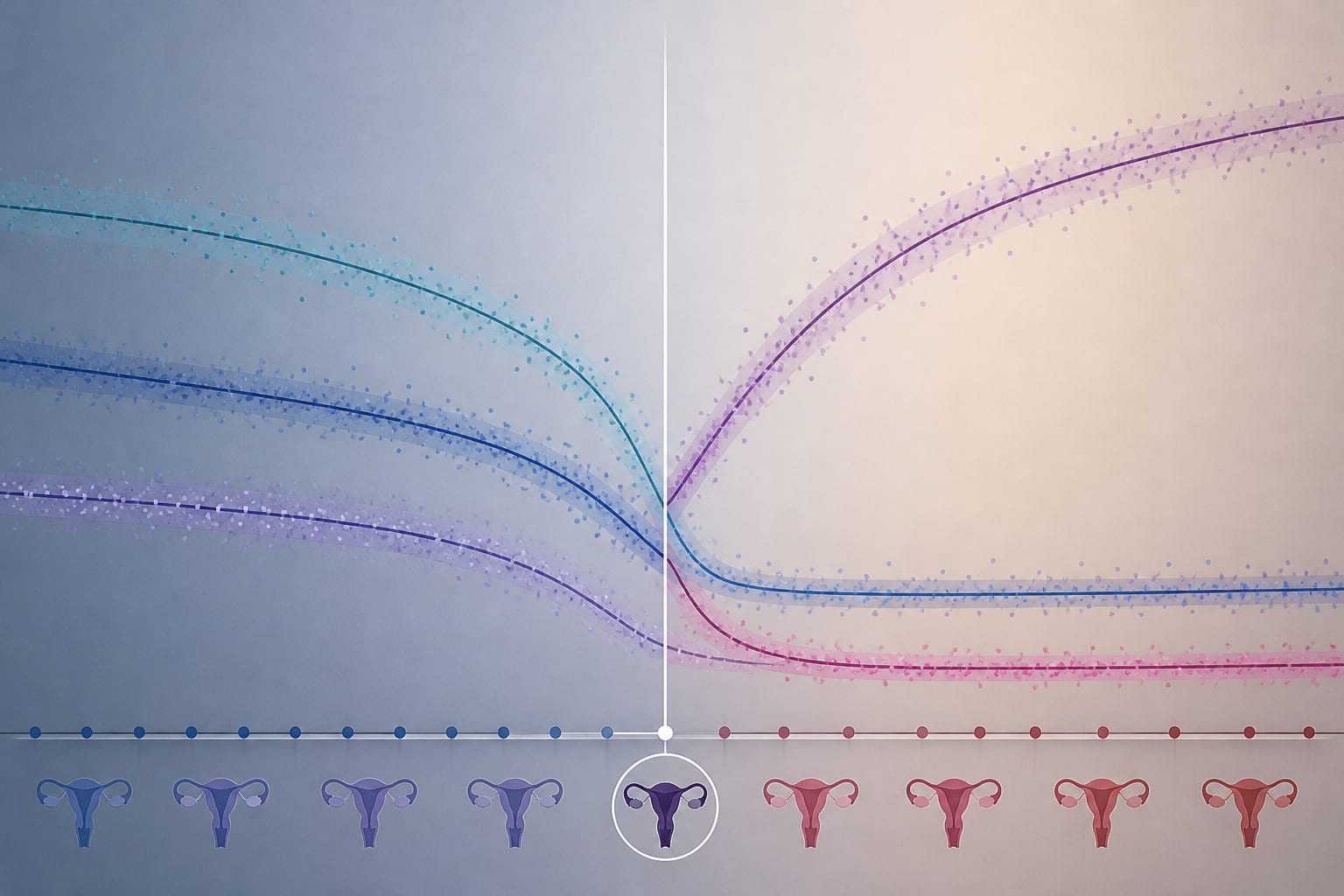
To characterize changes in laboratory measures in relation to the final menstrual period (FMP), addressing limitations in sample size and temporal resolution of prior menopause research.
Approach:
Datasets: Analyzed cross-sectional laboratory data from NHANES (1999–2022) and Clalit, an Israeli health insurer dataset covering about 1.3 million women aged 30–70 years (2004–2024).
Analysis: Developed a deconvolution method to estimate laboratory-test trajectories relative to time from FMP, using the known distribution of FMP ages. The method estimates population mean trajectories, not individual FMP timing.
Comparisons: Compared menopause-associated changes in female individuals with age-aligned changes in male individuals; excluded nonpregnant individuals with medications or diagnoses statistically affecting each test.
Key Findings:
A statistically significant menopause-associated jump was detected in 52 of 90 laboratory tests in female individuals, with magnitudes of 0.1–1.4 standard deviations.
Detected changes spanned multiple systems, including hepatic, hematologic, renal, skeletal, lipid, serum chemistry and osmolality measures.
Estradiol, anti-Müllerian hormone and follicle-stimulating hormone each showed changes of at least 0.5 standard deviations.
No corresponding jumps around the age aligned to menopause were detected in male individuals; their test values changed gradually.
The analysis reports that hormonal alterations begin more than a decade before menopause and that menopause-associated jumps appear normalized by hormone replacement therapy.
Interpretation:
The authors report a broad, step-like shift in laboratory measures around the FMP in female individuals, rather than a change limited to reproductive hormones.
Limitations:
The analysis is cross-sectional and estimates population mean trajectories rather than individual menopause timing.
The supplied context ends before the full results and discussion, so further findings and qualifications are unavailable.