Association of a novel meibomian gland dysfunction composite score with corneal nerve parameters and ocular surface symptoms in dry eye disease - Summary - MDSpire
Conexiant’s news site is now MDSpire News. Learn more
Advertisement
Correlation of a New Composite Score for Meibomian Gland Dysfunction with Corneal Nerve Metrics and Ocular Surface Symptoms in Patients with Dry Eye Disease
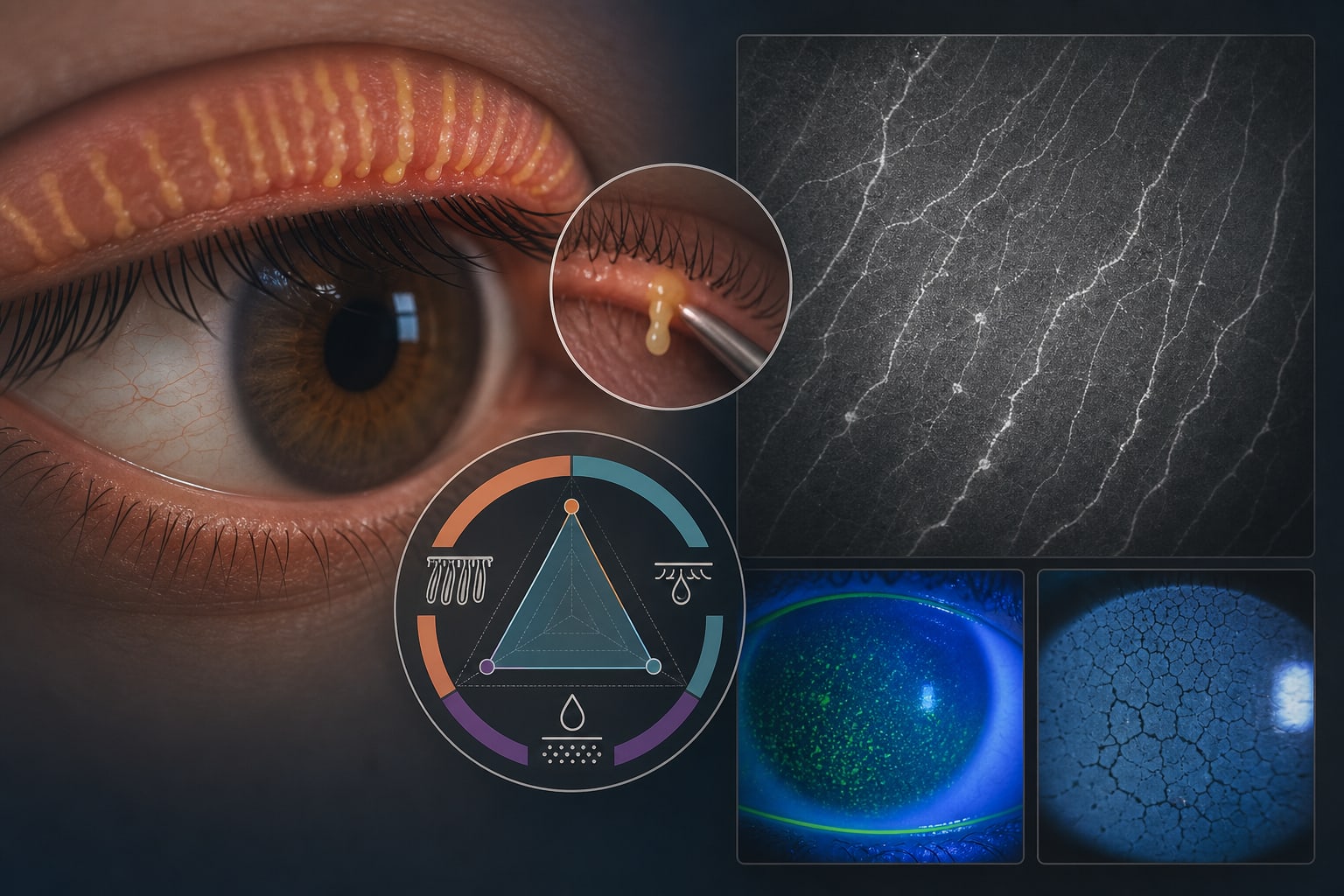
To construct a composite meibomian gland dysfunction (MGD) score and investigate its associations with corneal nerve parameters, subjective symptoms, and ocular surface signs in patients with dry eye disease (DED).
Approach:
Study Design: Cross-sectional study including 137 DED patients (274 eyes).
MGD Composite Score Calculation: Score (0–9) based on gland dropout, expressibility, and meibum quality.
Assessment Methods: Corneal nerve parameters assessed by in vivo confocal microscopy; symptoms evaluated using OSDI and visual analogue scale.
Statistical Analysis: Correlation and partial correlation analyses performed.
Key Findings:
MGD composite score positively correlated with OSDI (r = 0.769, p < 0.01).
MGD composite score negatively correlated with corneal nerve fiber length (CNFL) (r = −0.709, p < 0.01).
OSDI strongly correlated with CNFL (r = −0.868, p < 0.01).
Patients with higher MGD grades exhibited significantly shorter nerve length, more microneuromas, worse TBUT, higher CFS, and greater symptom scores (all p < 0.05).
Microneuroma count correlated positively with pain, asthenopia, blurred vision, and photophobia.
Interpretation:
The MGD composite score effectively reflects disease severity, and corneal nerve length is associated with the relationship between MGD signs and subjective symptoms.
Limitations:
Cross-sectional design limits causal inferences.
Single-center study may affect generalizability.
Conclusion:
The study provides insights into the structural basis for symptom-sign discordance in DED.
More than 300 professionals gathered for three days of innovation, education, and collaboration, highlighting the latest advances in ophthalmic technology and clinical practice