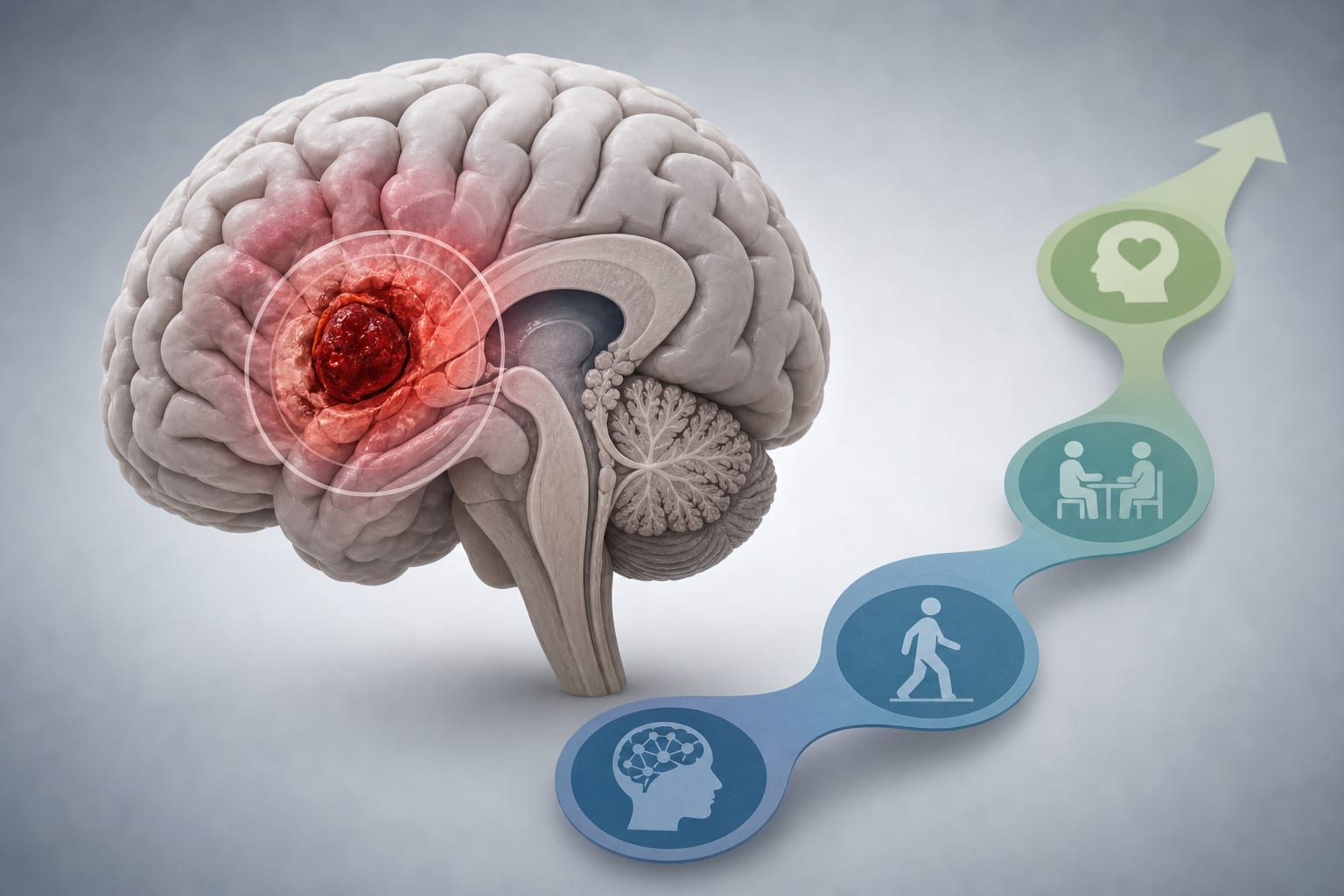
Impact of rehabilitation trajectory on affective and cognitive impairment after intracerebral hemorrhage: a cohort study - Summary - MDSpire

Impact of rehabilitation trajectory on affective and cognitive impairment after intracerebral hemorrhage: a cohort study

  • By

  • Qiuyi Jiang

  • Guangyao Shi

  • Hongli Zhang

  • Shouyue Wu

  • Chunyang Liu

  • Jian Zhang

  • Enzhou Lu

  • Chao Yuan

  • Yanchao Liang

  • Lu Wang

  • Guang Yang

  • June 10, 2026

  • 0 min

Share

Objective:

To examine the impact of rehabilitation trajectories within 12 months on cognitive impairment, depression, and anxiety in supratentorial ICH patients with small hematomas.

Approach:
    Key Findings:
    • 1,563 patients divided into early rehabilitation (75.5%) and late rehabilitation (24.5%).
    • Late rehabilitation linked to higher prevalence of cognitive impairment (OR 1.40) and depression (OR 1.96), but not anxiety.
    • Subgroup analysis indicated males, smaller hematoma volumes, greater distances from the third ventricle, and higher education levels were more prone to impairments in the late rehabilitation group.
    Interpretation:

    Remove unsupported conclusions about early rehabilitation.

    Limitations:
    • Study focused on patients with small hematomas, limiting generalizability.
    • Potential biases in self-reported measures of cognitive and affective impairments.
    Conclusion:

    Revise to reflect only findings from the study without unsupported claims.

Original Source(s)

Related Content