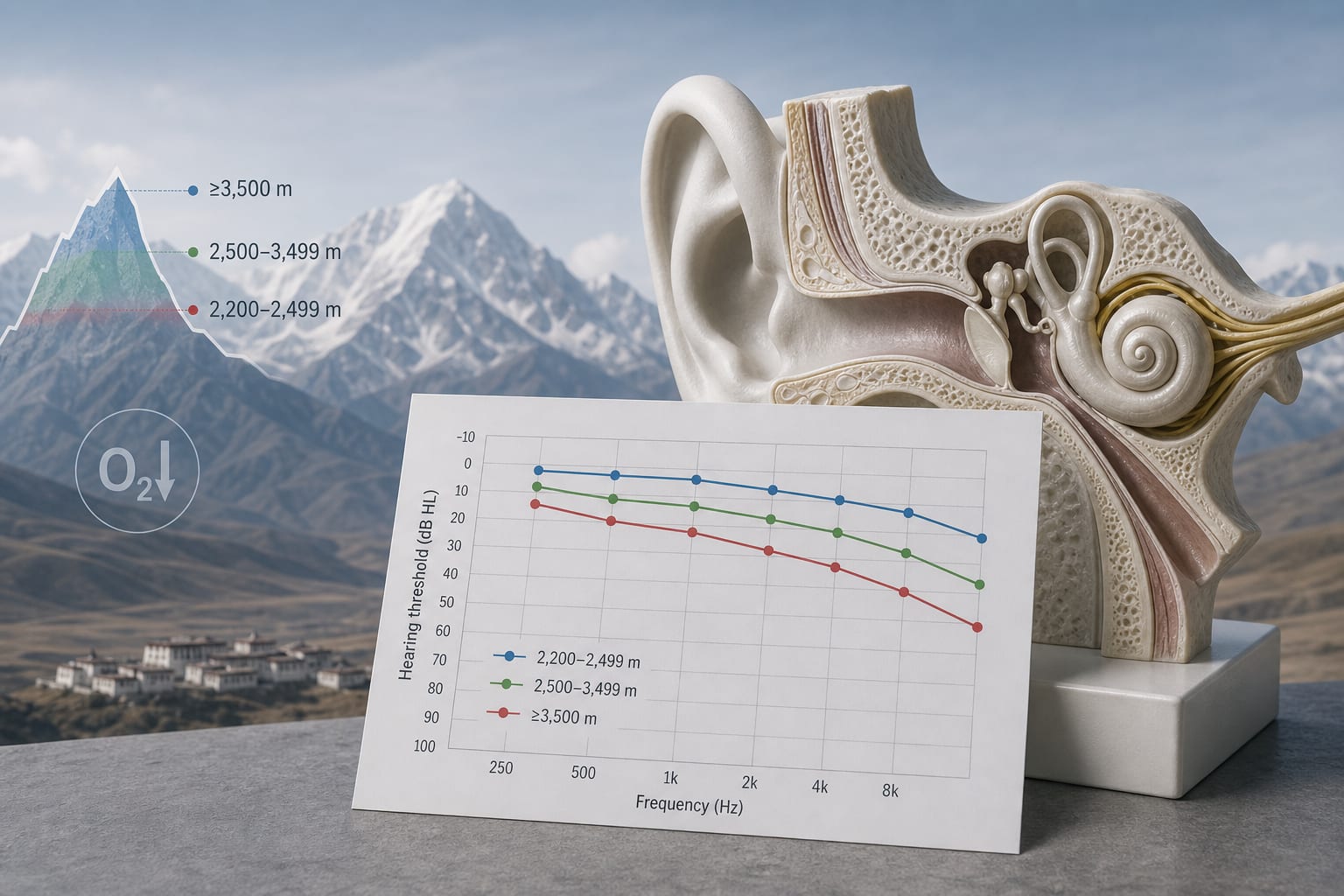
To investigate the association between long-term residential altitude strata and characteristics of pure-tone hearing thresholds in plateau residents aged 50 years or younger.
Approach:
Key Findings:
Unadjusted analyses showed significant differences in hearing thresholds at higher frequencies, indicating a potential impact of altitude.
In fully adjusted models, only PTA at 8 kHz remained statistically significant between lower- and middle-altitude strata, highlighting a specific frequency of concern.
No stable linear trend was supported in continuous-altitude models, suggesting complexity in the relationship.
Interpretation:
Hearing-threshold differences were more pronounced at higher frequencies in unadjusted analyses; after adjustment, the most robust association was observed at 8 kHz, indicating a need for targeted interventions.
Limitations:
The study focused on residents aged 50 years or younger, limiting generalizability to older populations and necessitating further research.
Potential confounding factors, such as environmental noise exposure and individual health conditions, may not have been fully accounted for despite adjustments.
Conclusion:
The study highlights the need for further research on the impact of altitude on auditory function, particularly in long-term residents, and suggests exploring the effects on older populations.