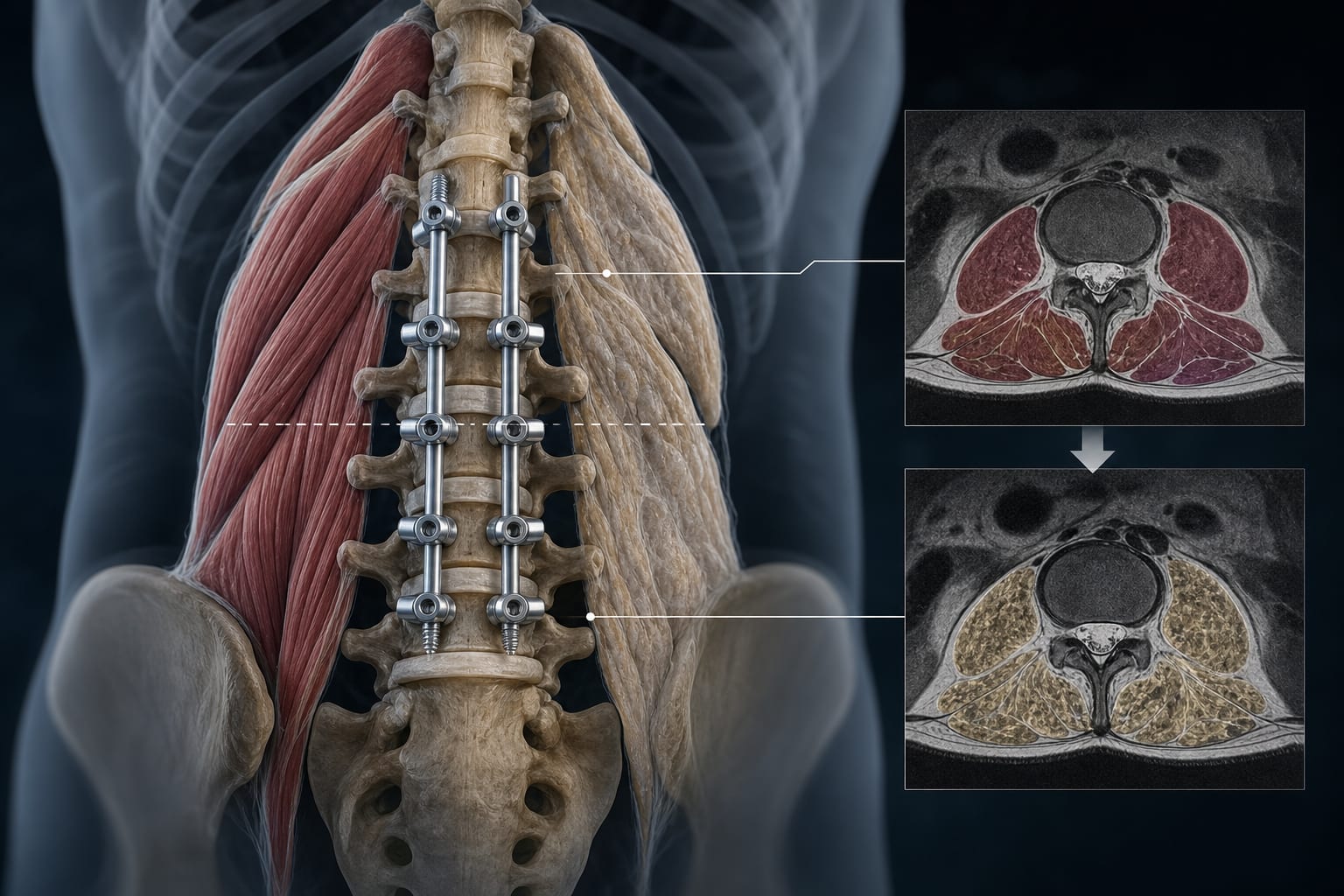
To evaluate a PVM degeneration-guided selective fusion strategy in patients with degenerative lumbar scoliosis (DLS) to reduce surgical invasiveness and enhance specific clinical outcomes such as pain relief and functional improvement.
Key Findings:
No cases of PJK or PJF were observed.
Mean fusion length was 4.3 segments, with fusion-degeneration concordance achieved in 86.4% of patients.
Significant improvement in coronal and sagittal alignment post-operatively, maintained at final follow-up.
Correction loss at final follow-up was 1.0°, corresponding to a maintenance rate of 88.2% for radiographic correction.
Greater number of degenerated PVM segments negatively associated with ODI improvement rate; fusion-degeneration concordance positively associated with ODI improvement.
Interpretation:
Selective fusion guided by PVM degeneration patterns represents a shift to biology-guided surgical planning for DLS, achieving excellent outcomes with reduced surgical trauma and junctional complications, which may influence future surgical strategies.
Limitations:
Observational study design without a comparator cohort.
Limited sample size of 22 patients, which may affect the generalizability of the findings.
Conclusion:
The PVM degeneration-guided selective fusion strategy shows promise in achieving satisfactory clinical and radiographic outcomes in DLS.