Venoarterial extracorporeal membrane oxygenation provides flow, not afterload: reframing left ventricular afterload during peripheral VA ECMO - Summary - MDSpire
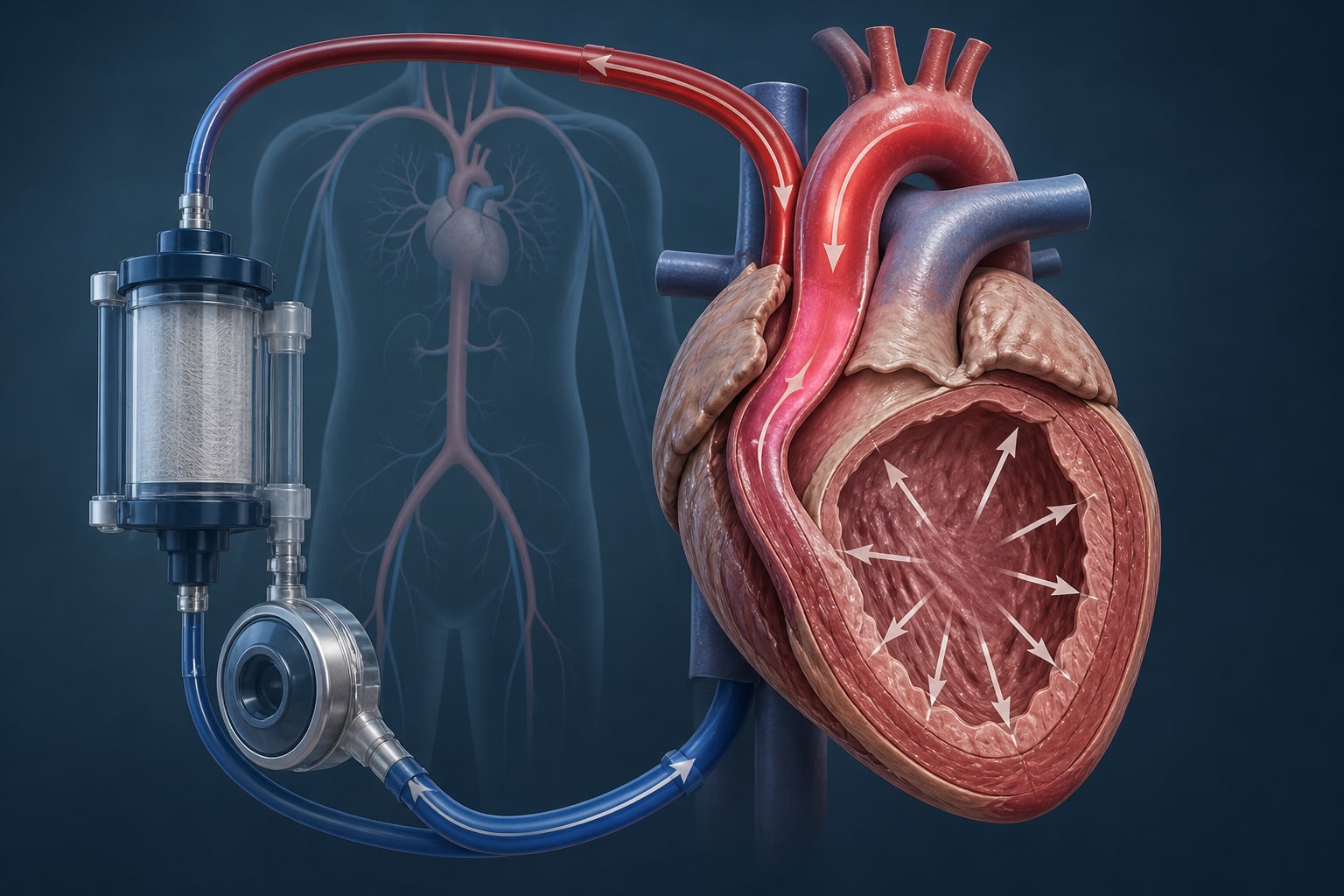
To examine whether retrograde VA ECMO flow itself increases LV afterload and to distinguish flow from the arterial pressure and wall-stress components relevant to unloading decisions.
Approach:
Flow and dynamic pressure: The article estimates dynamic pressure from mean aortic flow velocity using q = 1/2ρv².
Pressure and vascular resistance: It uses a simplified pressure–flow–resistance framework to explain how extracorporeal flow may affect arterial pressure.
Clinical and research implications: It discusses pressure optimization before unloading decisions and proposes standardizing pressure load in future comparisons.
Key Findings:
Under the stated assumptions—5 L/min through a 2.5 cm aorta, blood density 1060 kg/m³, and mean velocity 0.17 m/s—the estimated dynamic pressure is 0.11 mmHg.
The article argues that retrograde flow direction alone does not establish increased LV afterload; the pressure response depends substantially on vascular resistance and tone.
Increased extracorporeal flow may raise arterial pressure when resistance remains high, but may restore perfusion without raising pressure when resistance falls.
MAP, effective arterial elastance, and myocardial wall stress describe different aspects of loading; the article cautions against treating them as interchangeable.
The article retains established unloading indications, including LV distension, pulmonary congestion, impaired aortic valve opening, intracardiac stasis, and absent pulsatility.
Interpretation:
The authors propose optimizing arterial pressure before selecting an unloading strategy, while emphasizing that this does not make mechanical unloading unnecessary. They retain established unloading indications and state that pressure optimization should precede, not replace, consideration of unloading.
Limitations:
The dynamic-pressure calculation is simplified and non-pulsatile.
The pressure–flow–resistance framework is simplified; VA ECMO drainage reduces preload, native and extracorporeal flows interact nonlinearly, systemic vascular resistance is dynamic, and pump flow can vary with pressure despite constant speed settings.
The article notes that many studies increased MAP alongside VA ECMO flow, limiting assessment of flow effects under matched MAP conditions.
Conclusion:
The article concludes that retrograde flow direction alone does not establish increased LV afterload. The pressure response to VA ECMO flow depends on vascular resistance and tone, while measures such as MAP, effective arterial elastance, and myocardial wall stress describe different aspects of loading. It proposes standardizing MAP when comparing unloading strategies.
November 3, 2026 | Gennaro Giustino, MD, structural interventional cardiologist at Atlantic Health, describes the UNICORN technique as a strategy used selectively in patients whose anatomy raises concern.