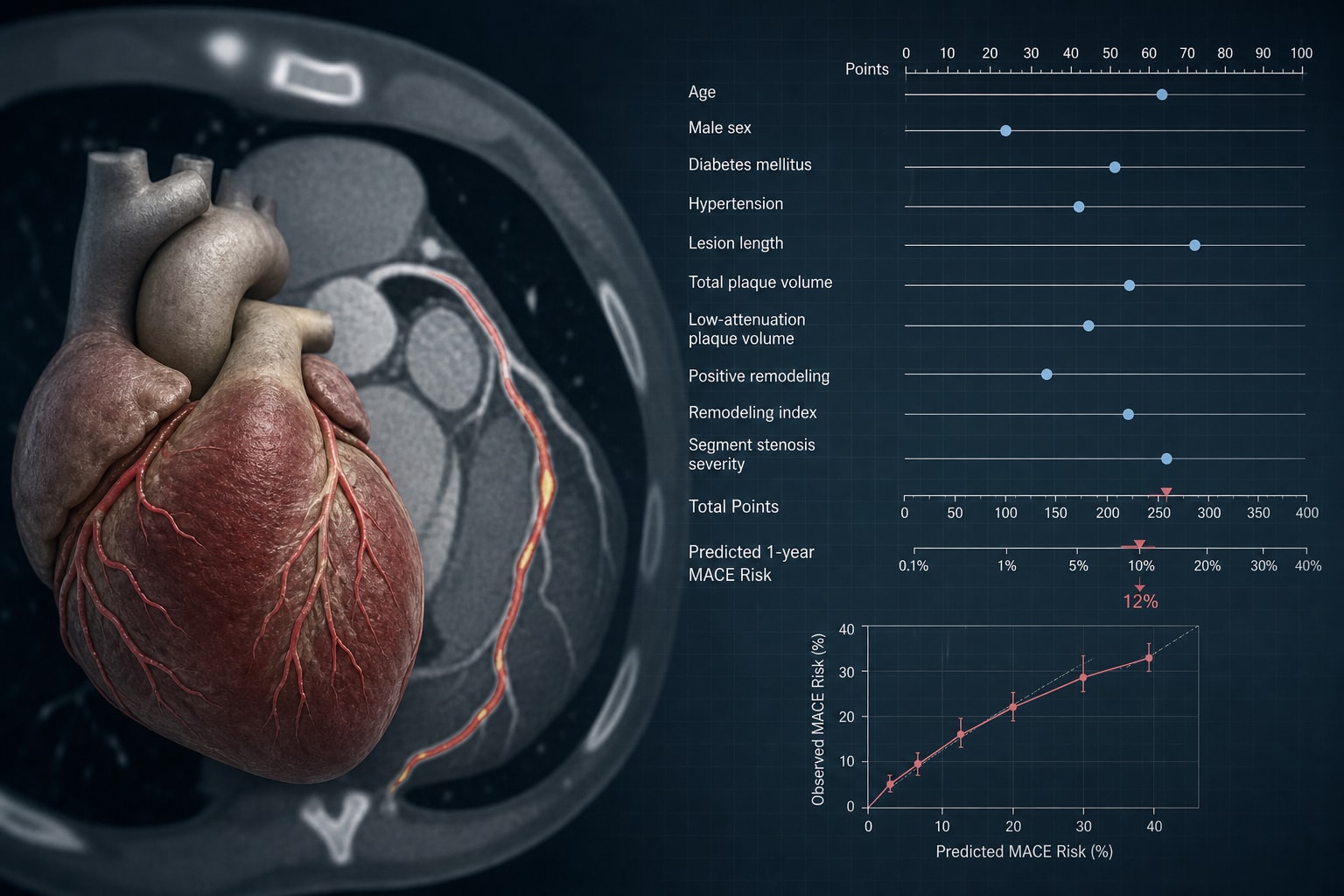
To identify factors influencing major adverse cardiovascular events (MACE) in patients with coronary artery disease (CAD) and develop a nomogram-based risk prediction model using quantitative parameters from coronary computed tomography angiography (CCTA).
Approach:
Study Design: Retrospective analysis of clinical data from 280 CAD patients, followed by external validation in an independent cohort of 288 patients.
Data Analysis: Comparison of baseline characteristics and CCTA-derived parameters, identification of independent predictors via multivariable logistic regression, and construction of a nomogram.
Validation: Internal validation using Bootstrap resampling and external validation in an independent cohort.
Key Findings:
Significant differences in age, cardiac function, smoking history, hypertension, and various CCTA-derived parameters between MACE and non-MACE groups (P < 0.05).
Independent risk factors for MACE included severe stenosis, longer plaque length, larger fibrous plaque volume, and elevated plaque burden, coronary artery calcium score, perivascular fat attenuation index, and myocardial mass/volume ratio.
The combined model achieved an AUC of 0.936, outperforming individual indicators, with external validation confirming an AUC of 0.932.
Interpretation:
The nomogram based on CCTA-derived quantitative parameters demonstrates high predictive accuracy for MACE in CAD patients.
Limitations:
Short follow-up duration.
Predominance of soft endpoints, such as rehospitalization, rather than hard outcomes.
Conclusion:
The study provides a proof-of-concept for a risk prediction model, warranting further long-term prospective studies.