To assess the musculoskeletal status, its prognostic relevance and association with tumor aggressiveness in NET patients.
Approach:
Study Design: Cross-sectional study involving 41 patients with grade 1, 2, or 3 gastroenteropancreatic and lung NETs, compared with 47 healthy controls matched for age, sex, and BMI.
Assessment Method: Musculoskeletal health was assessed using dual-energy X-ray absorptiometry (DXA) scan.
Key Findings:
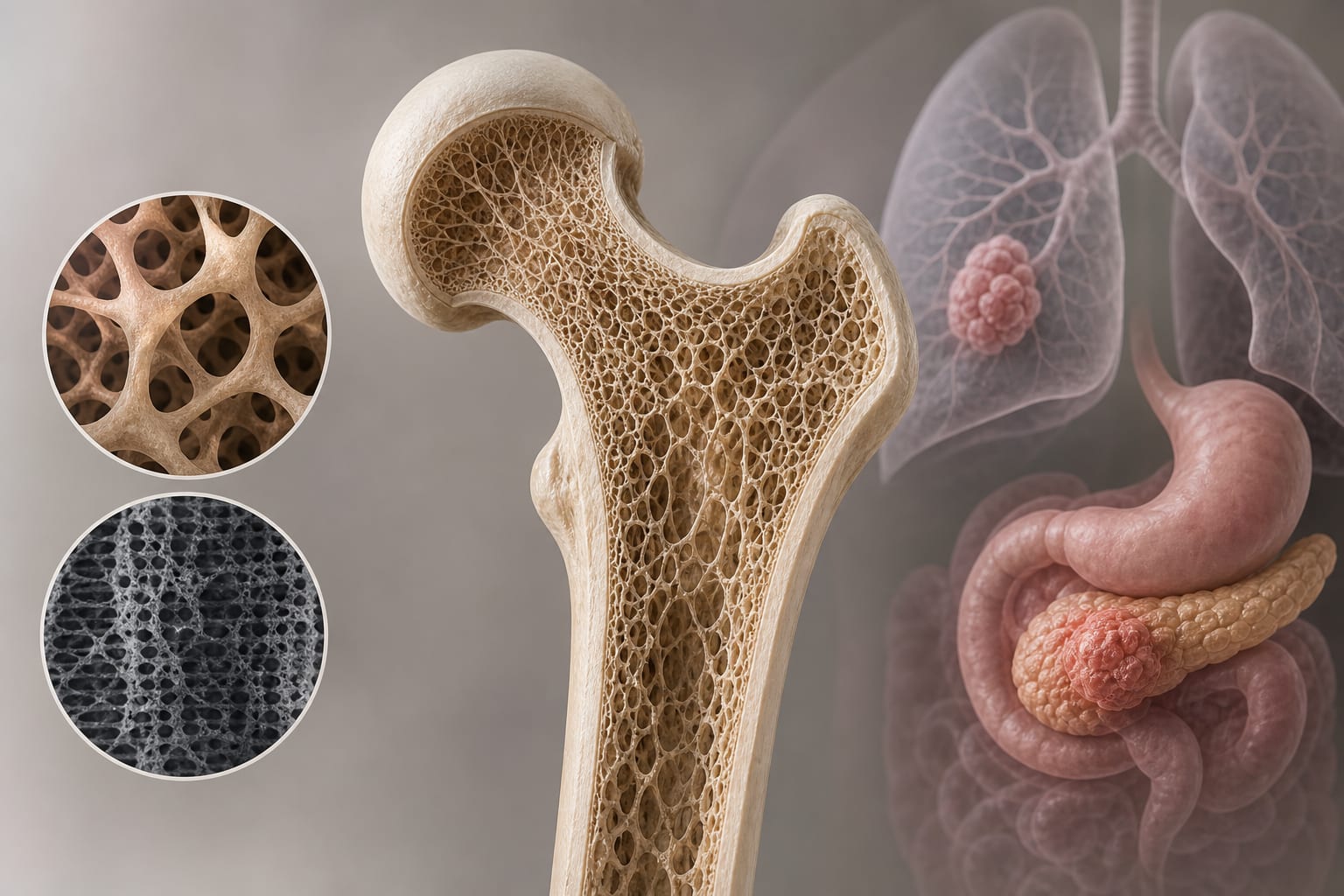
In the NET group, 71% had degraded trabecular bone score (TBS), 59% exhibited osteopenia at the femoral neck, 68% had hypovitaminosis D, and 37% showed low relative skeletal muscle index (RSMI) indicative of sarcopenia. Advanced-stage NETs correlated with lower bone mineral density (BMD) and vitamin D levels. Higher 25(OH)D levels and BMI were associated with longer progression-free survival (PFS).
Interpretation:
NET patients experience significant musculoskeletal impairment, with deterioration in trabecular microarchitecture evident despite normal BMD compared to healthy controls.
Limitations:
Small sample size of 41 patients limits generalizability.
Retrospective design may introduce bias.
Conclusion:
Findings require validation in larger prospective studies.
by Andrea Casabella, Iderina Hasballa, Anna Arecco, Mara Boschetti, Leonardo Della Sala, Davide Demontis, Alberto Sulli, Lara Vera, Alessandro Veresani, Diego Ferone, Sabrina Paolino, Manuela Albertelli