Differentiating Ischemic From Nonischemic T-Wave Inversion Using a Multimodal Vision-Language Model With Reinforcement Learning (ECG-R1): Development and Validation Study - Summary - MDSpire
Conexiant’s news site is now MDSpire News. Learn more
Advertisement
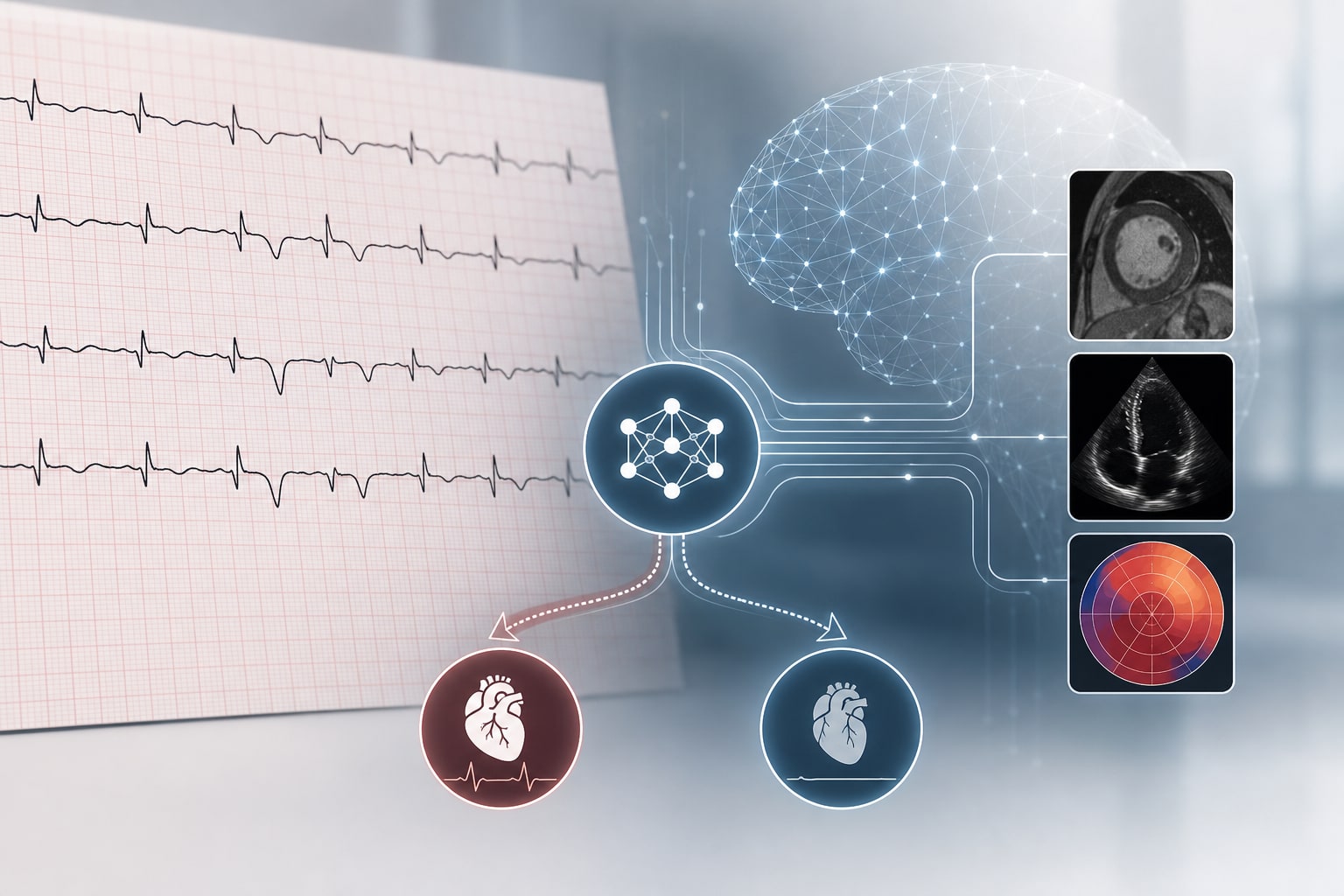
Distinguishing Between Ischemic and Nonischemic T-Wave Inversion Through a Multimodal Vision-Language Model Enhanced by Reinforcement Learning (ECG-R1): A Study on Development and Validation
To develop and validate ECG-R1, a multimodal vision-language model enhanced by reinforcement learning, for accurately distinguishing between ischemic and nonischemic T-wave inversion in clinical settings.
Approach:
Key Findings:
ECG-R1 achieved an in-domain accuracy of 75.21% in distinguishing true-positive from false-positive ischemic cases.
The model demonstrated a sensitivity of 82.55% and an AUC-ROC of 84.18%.
In out-of-domain evaluations, ECG-R1 maintained a 72.93% accuracy and an AUC-ROC of 81.56%.
Interpretation:
ECG-R1 provides a transparent reasoning trace alongside reliable diagnostic assessments.
Limitations:
The study utilized a retrospective design with deidentified data, which may limit the generalizability of findings.
The model's performance in real-world clinical settings requires further validation.
Conclusion:
ECG-R1 offers a promising tool for clinical decision-making in emergency settings.
National survey findings suggest many US adults report making health decisions based on social media despite widespread concerns about the accuracy of health information shared to the platforms.
Federal prosecutors allege that a Florida physician and research staff fabricated clinical trial records that were submitted into database systems used to evaluate investigational drugs.