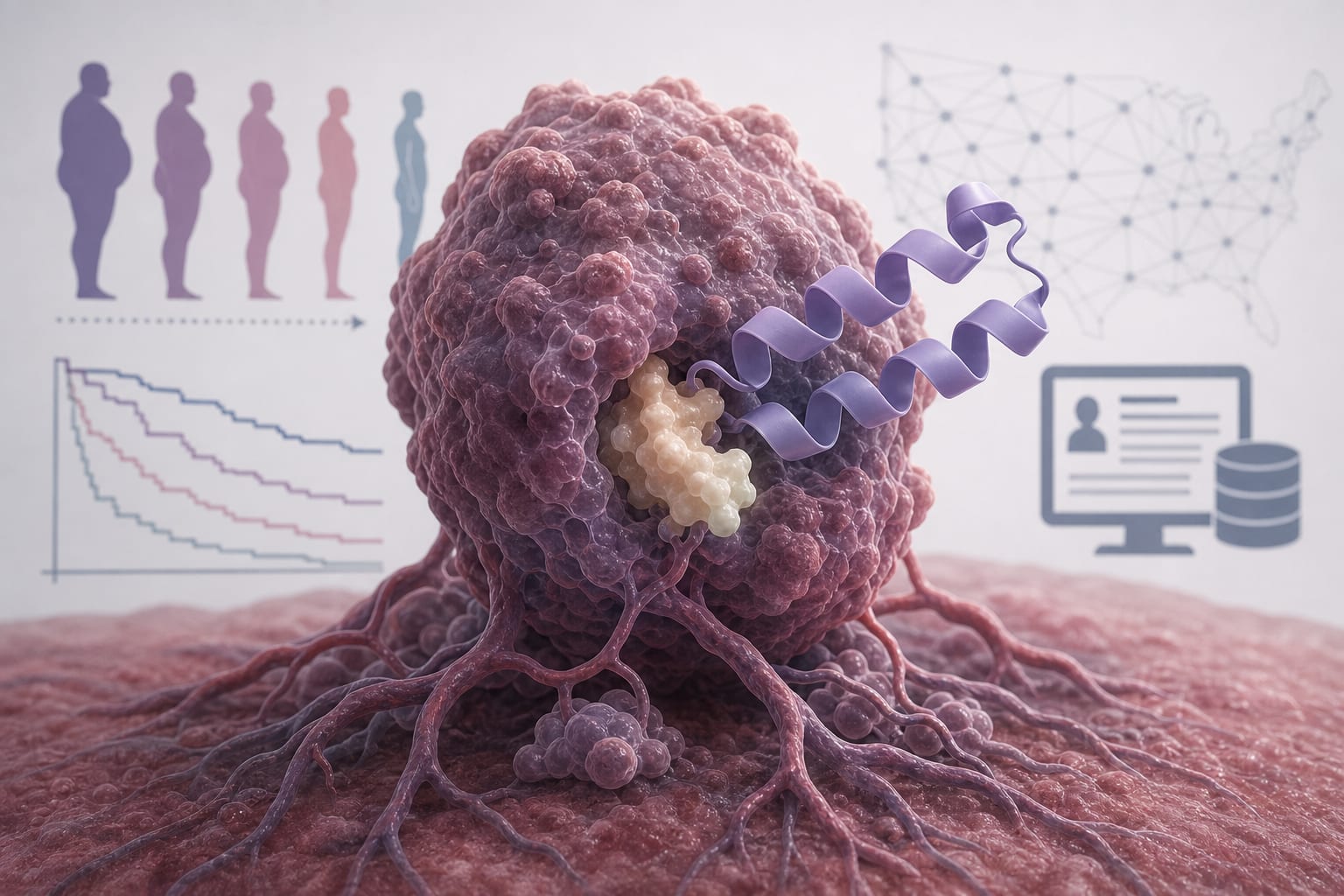
To evaluate the association between initiating GLP-1 receptor agonists (GLP-1 RAs) and obesity-related cancer (ORC) incidence compared with other glucose-lowering therapies, across levels of baseline type 2 diabetes (T2D) severity.
Approach:
Design and population: A cohort study using PCORnet electronic health record data emulated five active-comparator, new-user trials among adults with T2D and no prior ORC who initiated a GLP-1 RA or a comparator after a 365-day washout.
Comparators and severity: Comparators were metformin, insulin, an SGLT2 inhibitor, a DPP4 inhibitor, and a sulfonylurea. Baseline T2D severity was categorized as low, moderate, or high based on documented complications.
Analysis: Propensity-score weighting and adjusted regression models estimated 3- and 5-year ORC risks, risk differences (RDs), and hazard ratios (HRs). Severity comparisons were exploratory.
Key Findings:
Across 3-year analyses, GLP-1 RA initiation was associated with lower ORC risk than insulin (RD, −1.25%; HR, 0.62) and sulfonylureas (RD, −1.14%; HR, 0.67).
At 5 years, the RD versus insulin was −1.67%; HRs were 0.61 versus insulin and 0.75 versus sulfonylureas.
Estimates versus metformin, SGLT2 inhibitors, and DPP4 inhibitors were closer to the null and were not consistently different.
The clearest pattern was among adults with lower T2D severity. In the high-severity group, the 3-year RD favored SGLT2 inhibitors (1.61%; 95% CI, 0.17% to 2.89%).
Interpretation:
The authors reported lower ORC incidence with GLP-1 RAs than with insulin or sulfonylureas, particularly among adults with lower T2D severity. They stated that the findings do not justify selecting glucose-lowering therapy to prevent cancer and that established metabolic, cardiovascular, and kidney benefits should remain the basis for treatment decisions.
Limitations:
Retrospective, single-system EHR data may limit generalizability and leave residual confounding or incomplete treatment-group overlap despite weighting.
Exposure and outcome misclassification, broad severity categories, and sparse events in some strata may affect estimates.
Treatment pathways differed: insulin was often initiated later in T2D, while SGLT2 inhibitor prescribing was influenced by cardiorenal indications.
Many GLP-1 RA initiators entered the cohort recently, so 5-year estimates relied disproportionately on earlier initiators.
Conclusion:
The study found lower ORC incidence associated with GLP-1 RA initiation versus insulin or sulfonylureas, but did not establish treatment superiority for cancer outcomes.
by Jesús Gibran Hernández-Pérez, Omer Abdelgadir, Luisa Torres-Sánchez, Jing Chen, Jaime P. Almandoz, Lindsay G. Cowell, Sarah E. Messiah, David S. Lopez