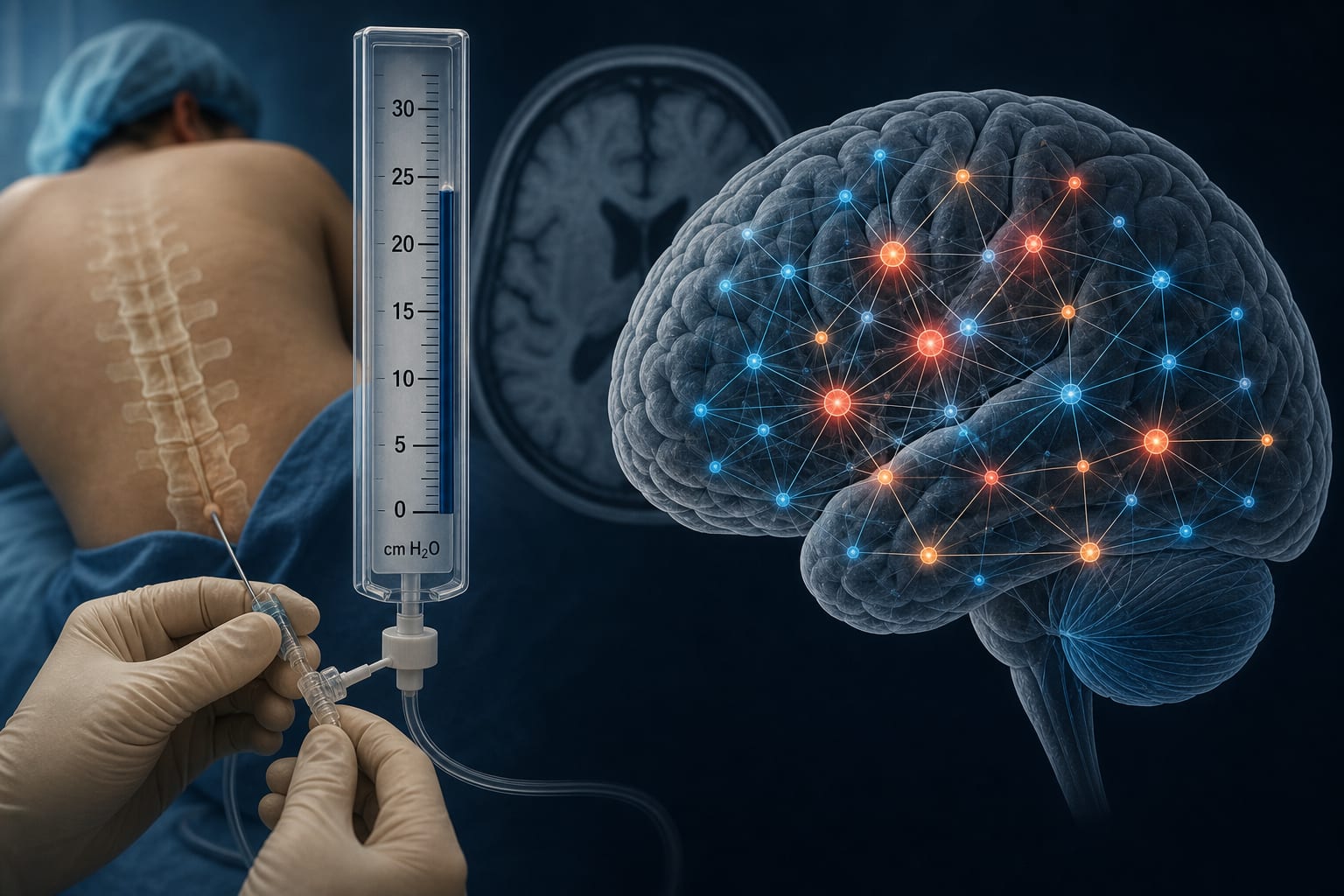
To investigate whether lumbar puncture (LP) opening pressure mediates delirium in herpes simplex virus (HSV) encephalitis by hypothesized reduction of degree centrality (DC) in key brain regions.
Approach:
Key Findings:
22 out of 55 patients (40%) developed delirium.
The delirium group had higher LP opening pressure (23.5 ± 4.8 cmH₂O vs. 15.5 ± 3.2 cmH₂O; p < 0.001) and lower Glasgow Coma Scale scores.
Elevated LP opening pressure (≥20 cmH₂O) increased delirium odds (OR 1.86; 95% CI 1.58–2.11; p < 0.001).
Degree centrality was reduced in the delirium group in specific brain regions (right amygdala, right hippocampus, left insula, left precuneus; all p < 0.05).
LP opening pressure inversely correlated with DC in several regions and DC inversely correlated with DRS scores.
Interpretation:
These exploratory findings suggest that LP opening pressure may be partially associated with delirium in HSV encephalitis through reduced degree centrality in limbic and default mode network hubs, warranting further validation.
Limitations:
Study is exploratory and hypothesis-generating.
Findings require validation in larger, longitudinal studies.
Sample size may limit the generalizability of the findings.
Conclusion:
The study highlights ICP management and DC as potential imaging biomarkers for delirium risk stratification and prevention.
Plasma proteomic models of more than 40 cell types were associated with incident Alzheimer's disease, amyotrophic lateral sclerosis, cancer, and mortality across three large cohorts.