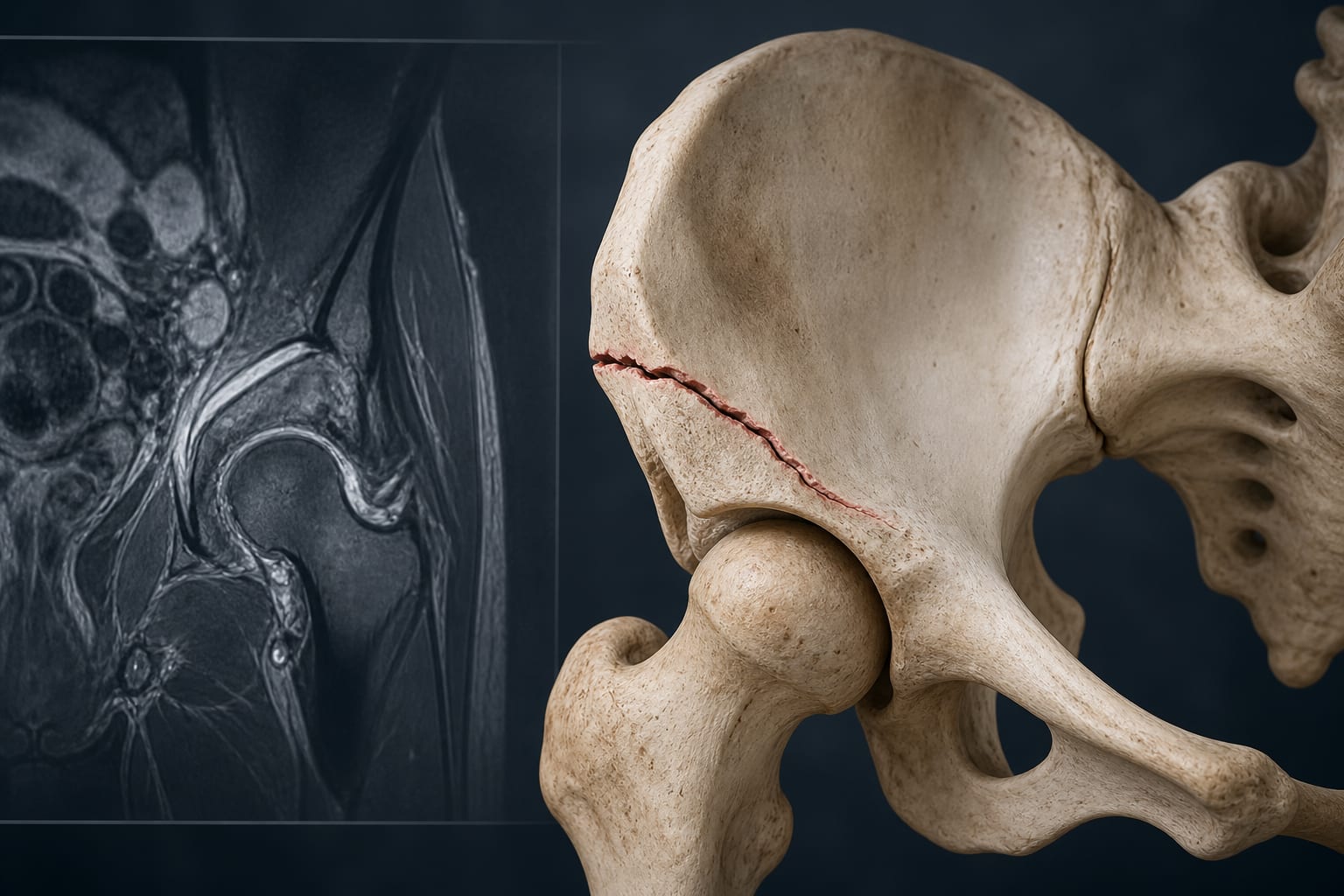
To describe pediatric superior acetabular-region avulsions that the authors consider a possible counterpart to adult superior acetabular wall fractures.
Approach:
Study context: The authors refer to a 16-year multicenter analysis of pediatric pelvic-region avulsion fractures.
Diagnostic and treatment discussion: They summarize management and imaging considerations for reflected-head (RH) avulsions, distinguishing them from anterior inferior iliac spine (SIAI) avulsions.
Key Findings:
The analysis identified 9 avulsions in the superior acetabular region at the origin of the rectus femoris reflected head; 83 SIAI fractures had no acetabular extension.
All 9 RH avulsions were treated conservatively because displacement was no greater than 1 cm. Four occurred in football players, three in runners, and two in participants in other sports.
No complications, non-union, or post-traumatic femoroacetabular impingement occurred in this small series.
The authors report that combined pelvic-ring and superior acetabular-wall injuries are extremely uncommon in children; none occurred in their group.
Interpretation:
The authors propose that pediatric RH avulsions may represent a counterpart to “pure” superior acetabular wall fractures and emphasize that they differ in etiology from SIAI avulsions.
Limitations:
The RH-avulsion series included only 9 patients.
The letter reports no combined pelvic-ring and superior acetabular-wall injuries in the described group.
Conclusion:
The authors describe RH avulsions as a distinct pediatric injury pattern and discuss clinical assessment, radiography, and MRI; they state that MRI should be preferred to low-dose CT in pediatric patients.