The aMAP score improves discrimination of prognostic models in hepatocellular carcinoma after radiofrequency ablation
-
By
-
Luchang Fan
-
Yiyan Zhang
-
Jianmin Ding
-
Yan Zhou
-
Jun Li
-
Qiong Wu
-
Shuqin Cheng
-
Fengmei Wang
-
Xiang Jing
-
June 17, 2026
-
Objective:
To assess the utility of the aMAP score specifically for predicting recurrence in HCC patients after radiofrequency ablation (RFA).
Approach:
Key Findings:
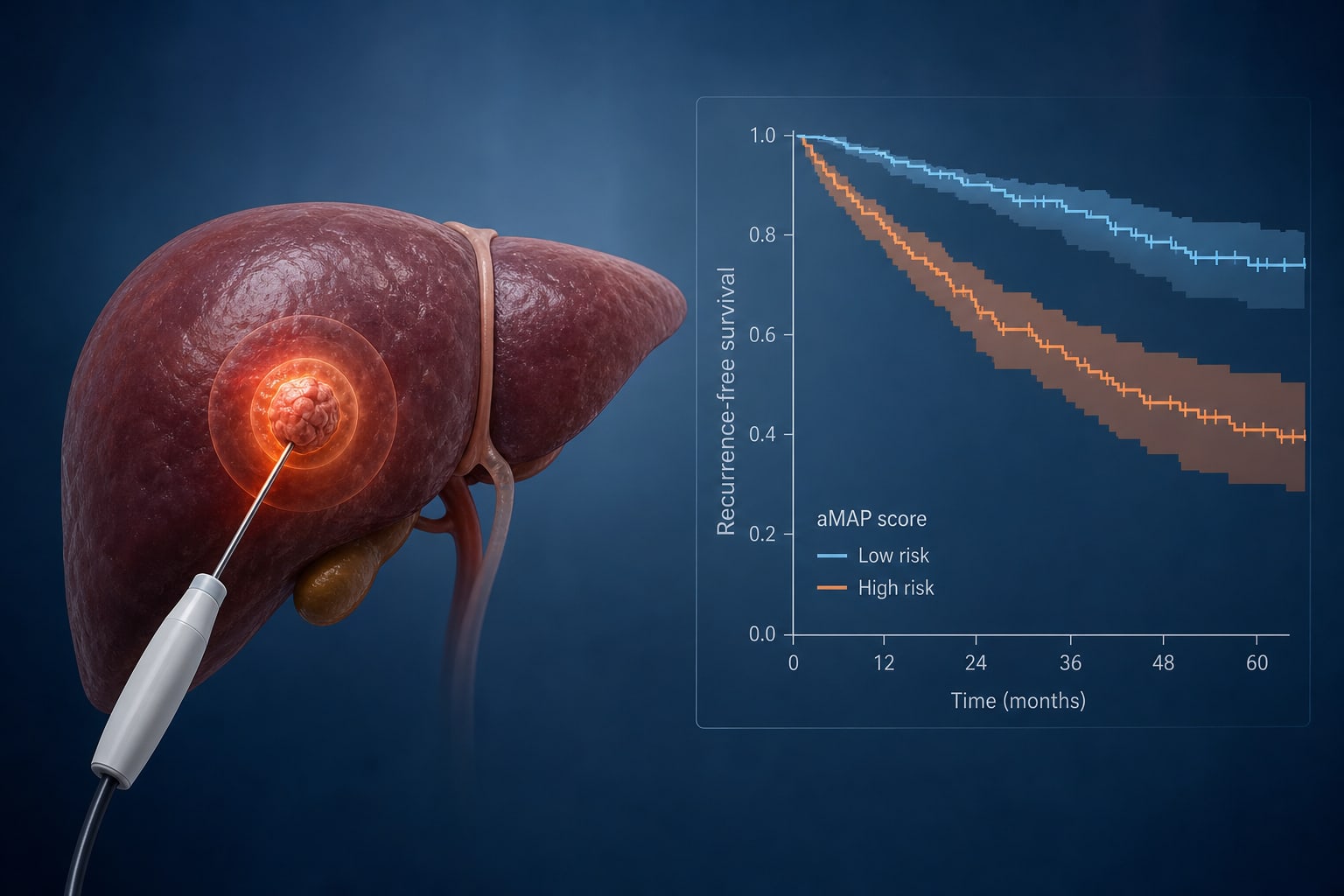
- 197 patients (56.3%) had a low aMAP score (≤ 63.55) and 153 patients (43.7%) had a high aMAP score (> 63.55).
- Patients with low aMAP scores exhibited significantly longer recurrence-free survival (RFS) (p = 0.016).
- The aMAP score is an independent prognostic factor for RFS (HR = 1.40, p = 0.028).
- Incorporation of the aMAP score into a tumor-related characteristics model improved predictive accuracy (IDI 2.6%, p = 0.036; NRI 15.9%, p = 0.036).
Interpretation:
The aMAP score is a potentially useful predictor for HCC patients undergoing RFA, significantly enhancing the predictive accuracy of existing models.
Limitations:
- Retrospective design may introduce bias, affecting the reliability of the findings.
- Single-center study limits generalizability to broader populations.
- Exclusion of certain patient groups may impact the applicability of results.
Conclusion:
The aMAP score improves the predictive accuracy for recurrence in HCC patients post-RFA.