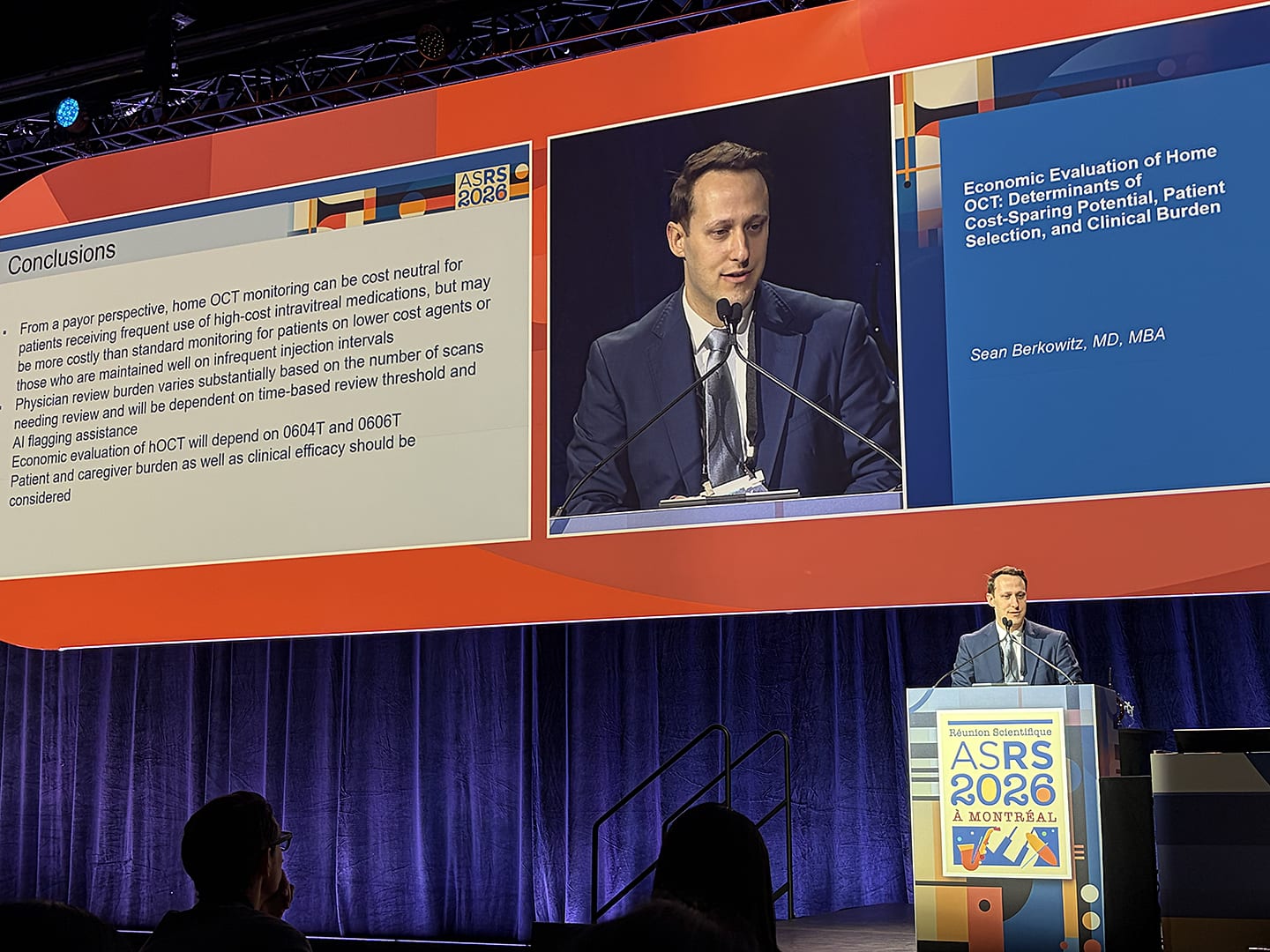
To evaluate payer costs, break-even conditions, and physician workload associated with home OCT monitoring for wet AMD.
Approach:
Economic Analysis: A modeling study was conducted to compare the 1-year economic profile of home OCT monitoring with standard office-based management for neovascular age-related macular degeneration (nAMD), incorporating Medicare reimbursement rates and drug costs.
Key Findings:
Home OCT was not cost-effective for patients receiving bevacizumab or ranibizumab at any injection interval.
Cost neutrality for home OCT was achievable with higher-cost agents only if it enabled fewer injections annually.
For aflibercept 2 mg, cost neutrality required reducing treatment by 6 injections annually; for faricimab, 5 injections; and for aflibercept 8 mg, 4 injections.
Reviewing every submitted home OCT scan for 100 patients would require approximately 20.7 hours of physician review each week, which could be reduced to 0.77 hours by limiting review to the latest scan.
Interpretation:
The economic feasibility of home OCT monitoring is influenced by treatment regimens, physician workload, and reimbursement rates.
Limitations:
The model did not incorporate patient or caregiver burden or potential clinical benefits of home monitoring.
Economic value may evolve with changes in reimbursement for home OCT.
Conclusion:
The study highlights the importance of considering various factors in assessing the economic viability of home OCT.