Development and validation of a clinical prediction model for postcontrast acute kidney injury in patients with postoperative acute kidney injury of acute Stanford type A aortic dissection - Summary - MDSpire
Advertisement
Development and validation of a clinical prediction model for postcontrast acute kidney injury in patients with postoperative acute kidney injury of acute Stanford type A aortic dissection
To identify independent risk factors for postcontrast acute kidney injury (PC-AKI) in patients with postoperative AKI (PO-AKI) following acute Stanford type A aortic dissection (ATAAD), and to develop a prediction model for clinical use.
Approach:
Study Design: This retrospective cohort study enrolled 604 PO-AKI patients from January 2014 to December 2024 at Nanjing Drum Tower Hospital who underwent postoperative contrast-enhanced CTA.
Model Development: Three variable-selection strategies (backward stepwise AIC, LASSO, and XGBoost-SHAP) were used; a multivariable logistic regression model was constructed and validated through bootstrap resampling.
Key Findings:
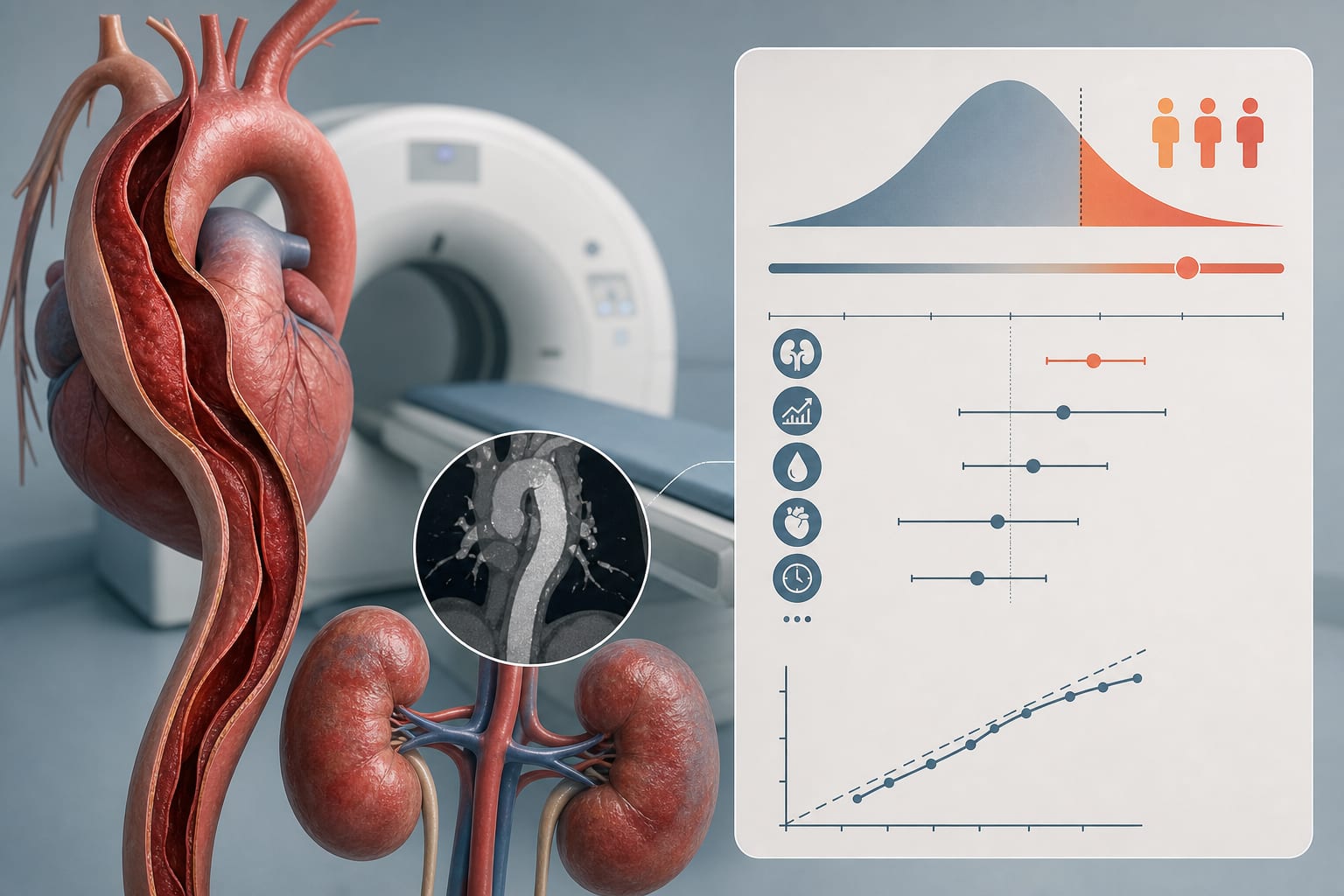
PC-AKI incidence was 9.8% (59/604), with significant recovery-dependent stratification: 3.5% in fully recovered PO-AKI vs. 52.5% in unrecovered PO-AKI.
Independent predictors included PO-AKI stage 3 (OR = 3.144, 95% CI: 1.41–7.06) and unrecovered PO-AKI before first CTA (OR = 25.212, 95% CI: 12.57–53.49).
The model exhibited good discrimination (AUC=0.848, 95% CI: 0.78–0.91) and calibration (Brier=0.057).
PC-AKI was associated with prolonged ICU stay (RR = 1.521, 95% CI: 1.19–1.97) and incomplete renal recovery at discharge (OR = 2.554, 95% CI: 1.30–4.86).
Interpretation:
Dynamic PO-AKI recovery and advanced AKI stage are associated with PC-AKI risk in post-ATAAD patients.
Limitations:
External validation of the prediction model is needed before clinical deployment to ensure its applicability in broader settings.
Conclusion:
The internally validated model may aid individualized risk stratification before contrast procedures in this high-risk subgroup.