Screening of serum biomarkers for coronary artery calcification using DIA quantitative proteomics and construction of a regression model - Summary - MDSpire
Advertisement
Screening of serum biomarkers for coronary artery calcification using DIA quantitative proteomics and construction of a regression model
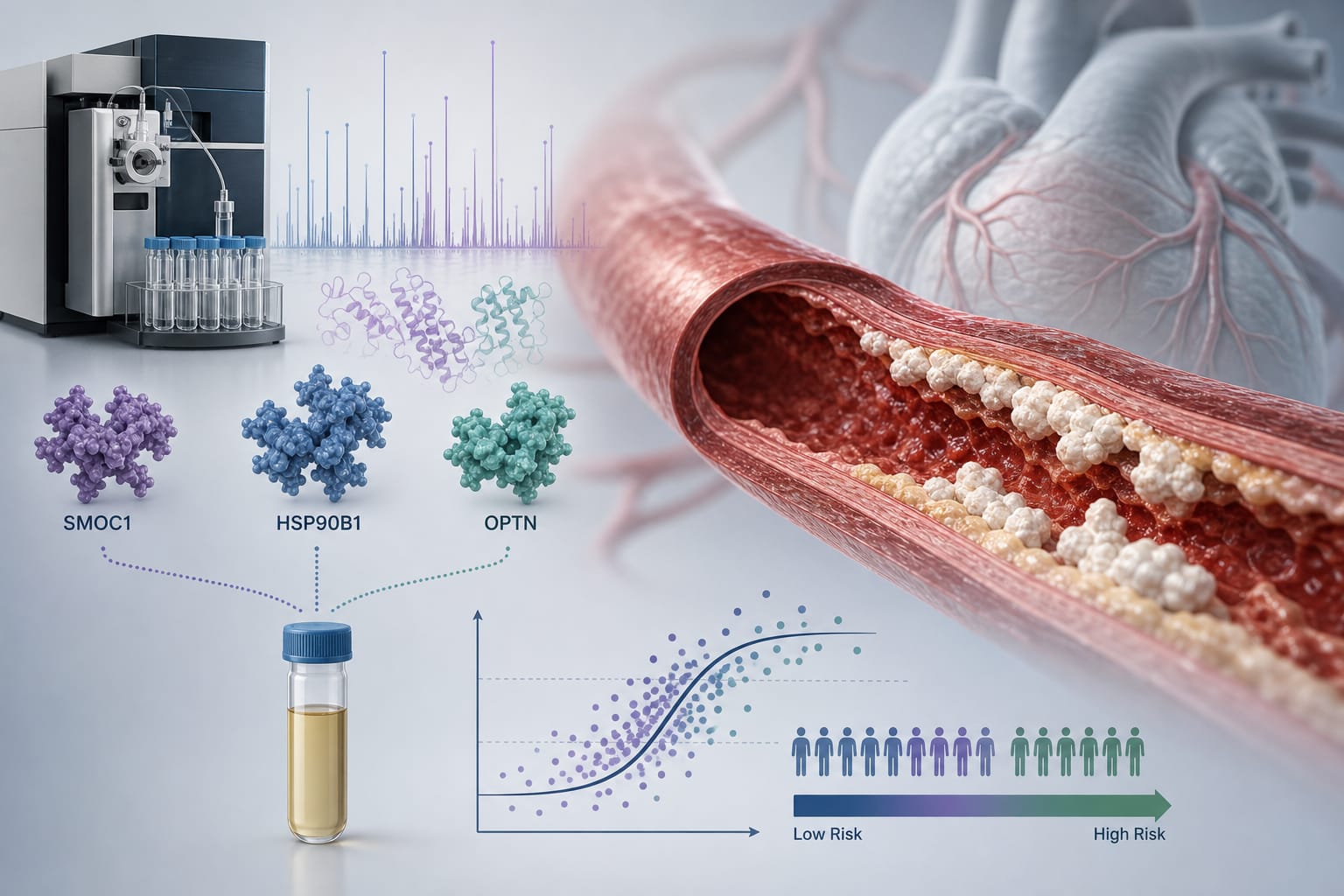
To explore the value of SMOC1, HSP90B1, and OPTN as potential serum biomarkers for coronary artery calcification (CAC) and construct an individualized risk prediction model, highlighting their clinical significance.
Key Findings:
39 differentially expressed proteins were identified (18 upregulated and 21 downregulated), with statistical significance noted.
SMOC1 (upregulated), HSP90B1 (downregulated), and OPTN (downregulated) were identified as candidate proteins.
The AUC of the logistic regression model for predicting CAC was 0.894, significantly higher than the baseline model (AUC = 0.845).
Calibration curves showed good agreement between predicted and observed probabilities.
Interpretation:
The study identifies SMOC1, HSP90B1, and OPTN as potential serum biomarkers for CAC and demonstrates the effectiveness of a nomogram model that incorporates these biomarkers along with clinical indicators, suggesting its utility in clinical practice.
Limitations:
The study's findings may not be generalizable beyond the enrolled patient population; further validation in diverse cohorts is needed to confirm the predictive model's applicability.
Conclusion:
SMOC1, HSP90B1, and OPTN are potential serum biomarkers for coronary artery calcification (CAC). A nomogram model incorporating these biomarkers and clinical indicators performs well in predicting CAC.