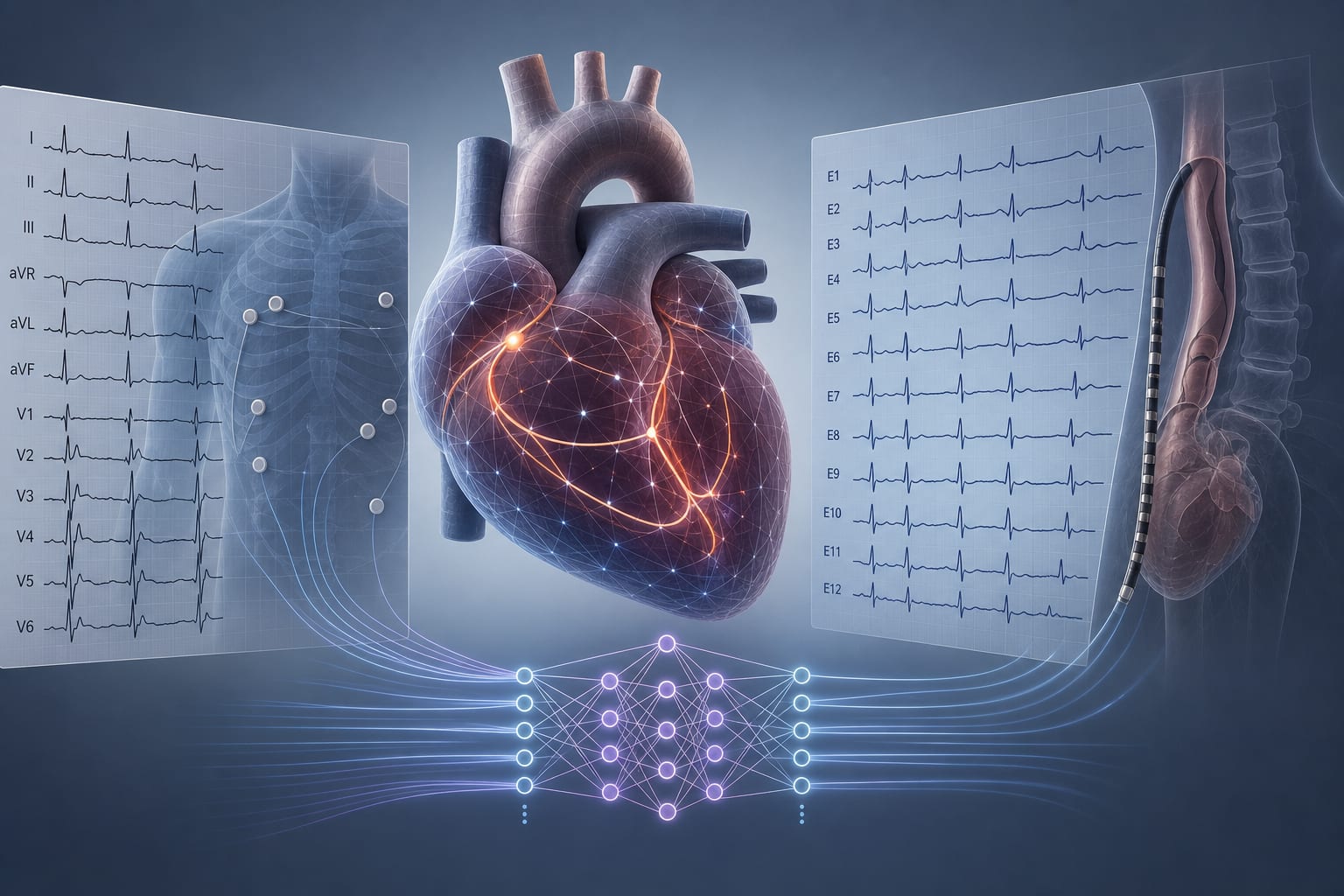
To develop an efficient deep learning model based on surface and esophageal ECG for the identification and classification of paroxysmal supraventricular tachycardia (PSVT), specifically targeting slow-fast atrioventricular nodal re-entrant tachycardia (S-F AVNRT), orthodromic atrioventricular reentrant tachycardia involving the left accessory pathway (AVRT-L), and orthodromic atrioventricular reentrant tachycardia involving the right accessory pathway (AVRT-R).
Approach:
Key Findings:
The deep learning model demonstrated high accuracy and stability in classifying PSVT types.
The model was trained on a dataset split at the patient level to prevent data leakage.
Interpretation:
The integration of surface and esophageal ECG data with deep learning may enhance the accuracy of PSVT classification.
Limitations:
The study is retrospective and may have inherent biases.
The model's performance needs validation in larger, diverse populations.
Conclusion:
The study presents a novel deep learning approach for PSVT classification, potentially improving diagnostic accuracy.