A differentiated effector T cell repertoire defines a functionally high-risk group of smoldering myeloma patients - Summary - MDSpire

A differentiated effector T cell repertoire defines a functionally high-risk group of smoldering myeloma patients

  • By

  • Ross S. Firestone

  • Anish K. Simhal

  • Theresia Akhlaghi

  • Jung Hun Oh

  • Devin McAvoy

  • Kylee H. Maclachlan

  • Juan-Jose Garces

  • Sham Mailankody

  • Hani Hassoun

  • Urvi A. Shah

  • Neha Korde

  • Carlyn R. Tan

  • Sridevi Rajeeve

  • Hamza Hashmi

  • Alexander M. Lesokhin

  • Kinga Hosszu

  • Francesco Maura

  • Joseph O. Deasy

  • Saad Z. Usmani

  • Malin Hultcrantz

  • May 1, 2026

  • 0 min

Share

Objective:

To identify T cell signatures predictive of early progression to active multiple myeloma in patients with smoldering multiple myeloma (SMM), highlighting their potential clinical significance.

Key Findings:
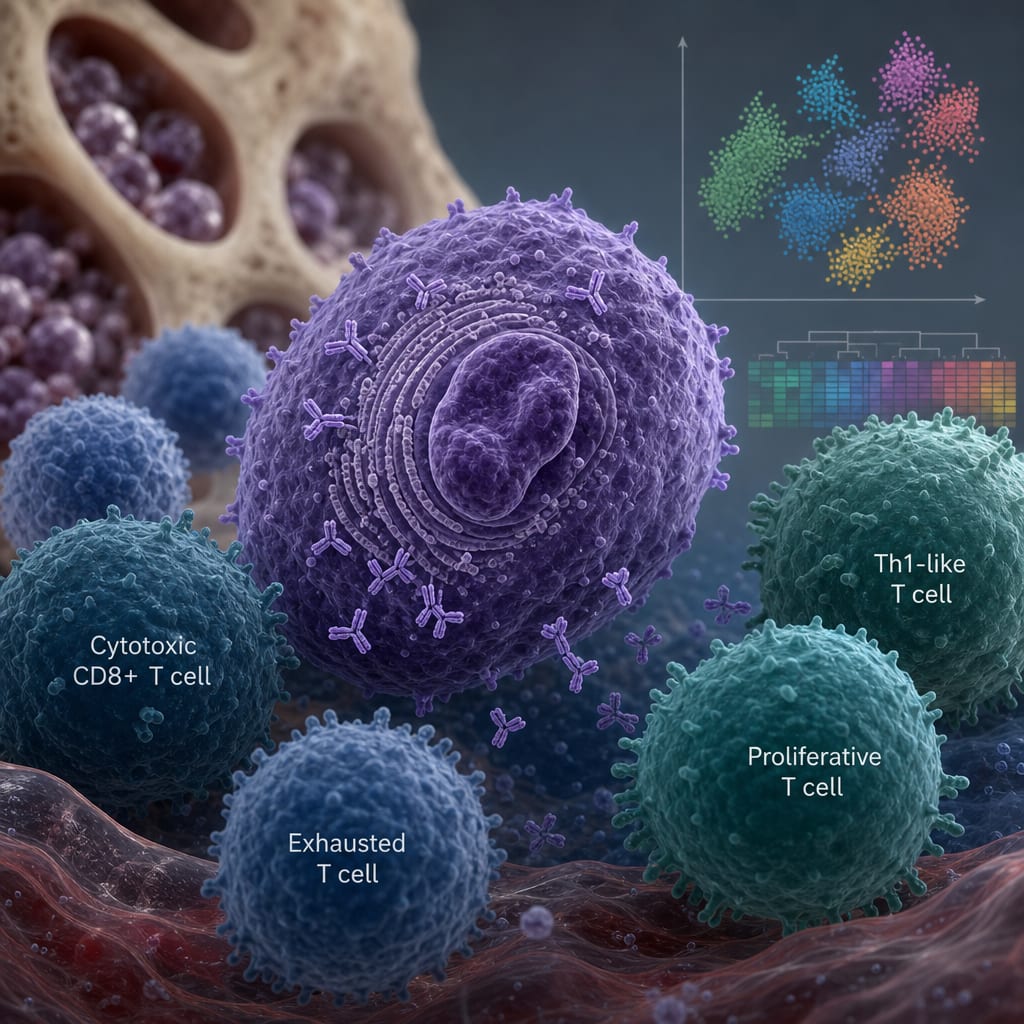
  • SMM patients with early progression had a significant enrichment of CD8+CD45RA+CD62L-CCR7- T effector cells (TEMRA) compared to non-progressors, indicating a potential biomarker.
  • Increased markers of inflammation (e.g., IL-18, MMP-1) were found in early progressors, suggesting a link between inflammation and progression.
  • The random forest model achieved 75% accuracy in predicting progression status, demonstrating the model's potential utility in clinical settings.
Interpretation:

Distinct T cell profiles, particularly the presence of exhausted effector T cells, may serve as biomarkers for identifying high-risk SMM patients likely to progress to active myeloma, with implications for early intervention.

Limitations:
  • Small sample size may limit generalizability of findings, necessitating caution in interpretation.
  • Study conducted at a single institution, potentially affecting external validity and applicability to broader populations.
Conclusion:

The study highlights the potential of T cell profiling in stratifying SMM patients for early intervention, emphasizing the need for further research in larger cohorts to validate these findings.

Original Source(s)

Related Content