Independent risk factors for clinically significant acute poisoning in children presenting to the emergency department: a 4-year cohort study of 2,345 cases - Summary - MDSpire
Advertisement
Independent risk factors for clinically significant acute poisoning in children presenting to the emergency department: a 4-year cohort study of 2,345 cases
To elucidate the epidemiological evolution of pediatric acute poisoning and identify independent clinical and demographic risk factors for clinically significant poisoning (PSS ≥ 2).
Approach:
Study Design: Retrospective cohort study of 2,345 children (<18 years) with acute poisoning from 2021 to 2024.
Data Handling: Multiple imputation was used for missing data.
Statistical Analysis: Multivariable logistic regression identified independent risk factors; model discrimination and calibration were assessed using AUC-ROC and Hosmer-Lemeshow test.
Key Findings:
The poisoning spectrum shifted from agricultural chemicals to psychotropic drugs (18.5%–31.2%).
Clinically significant poisoning occurred in 422 patients (18.0%).
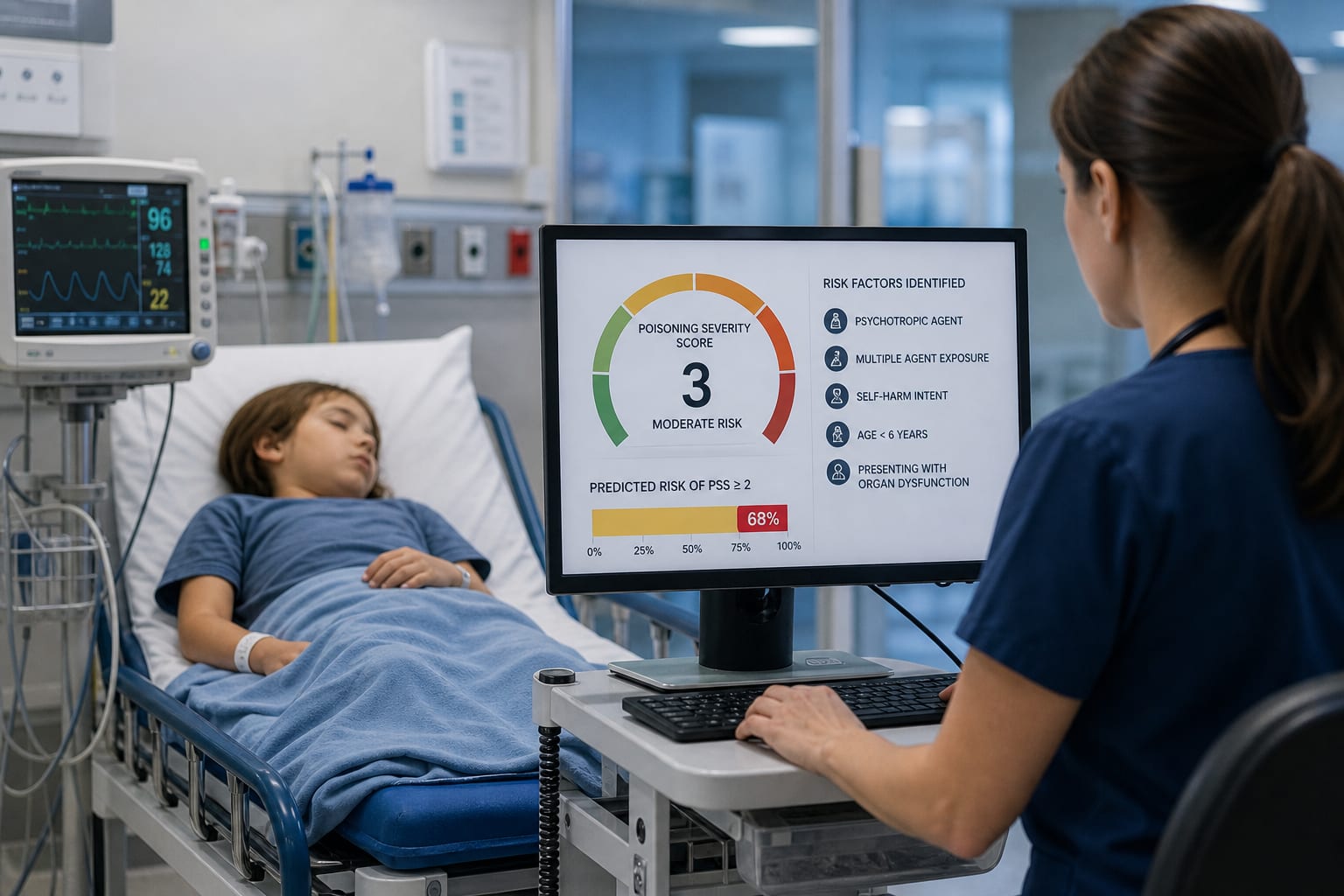
Independent risk factors for moderate-to-severe outcomes included: age >12 years (aOR 2.34), intentional self-harm (aOR 3.12), pre-hospital delay >6 h (aOR 2.78), multiple-agent exposure (aOR 2.15), exposure to agricultural herbicides (aOR 5.45), and exposure to psychotropic drugs (aOR 3.86).
The model achieved an AUC-ROC of 0.892 (95% CI: 0.864–0.920).
Clinically significant poisoning was associated with acute organ dysfunctions and required PICU admission (71.1%) and blood purification (44.1%).
Mortality was 1.2% (28/2,345), occurring exclusively in the PSS ≥ 2 group.
Interpretation:
Limitations:
The study is retrospective and conducted at a single center, which may limit generalizability.
Potential biases in data collection and reporting may exist.