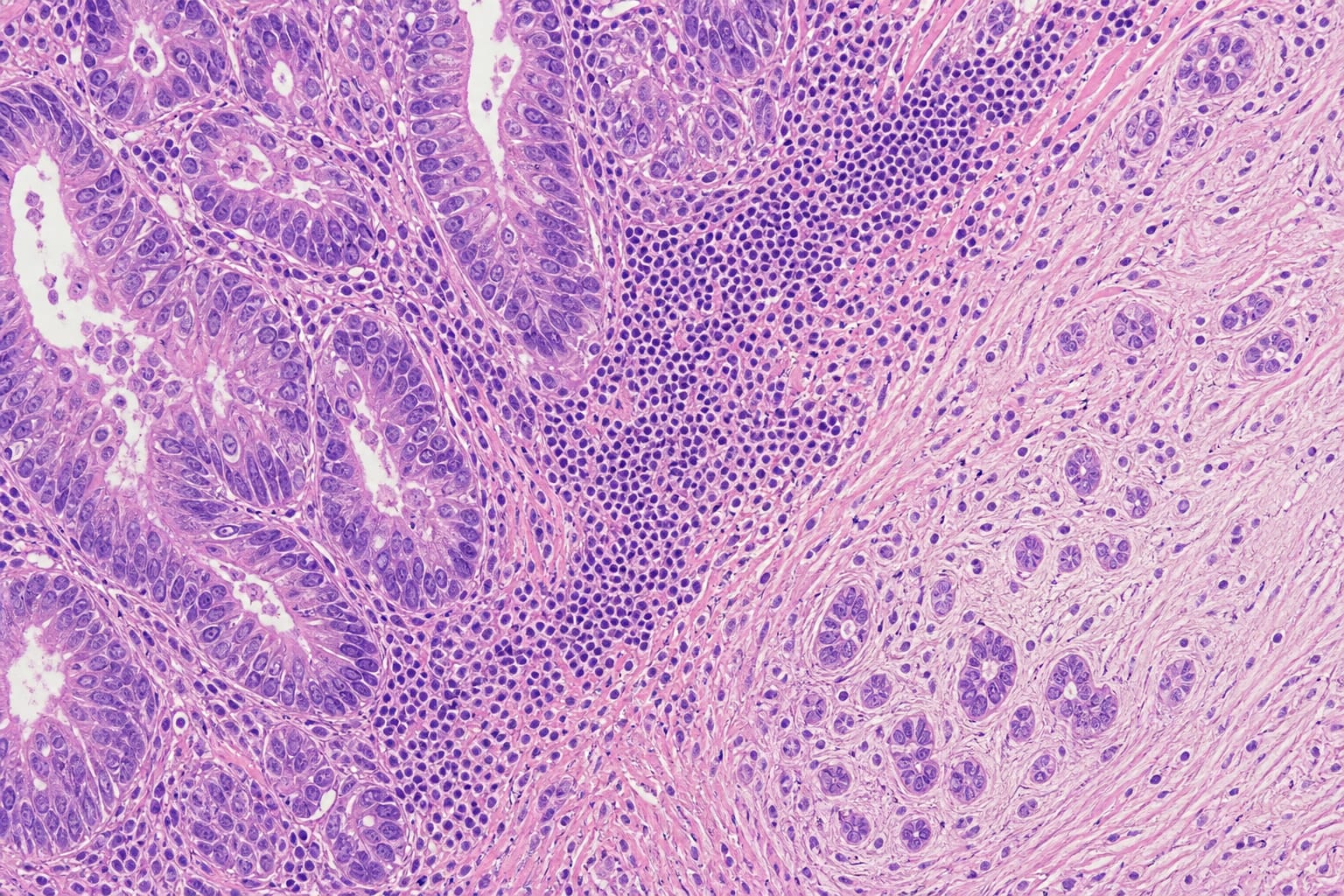
To investigate the prognostic value and treatment-outcome associations of standardized stromal tumor-infiltrating lymphocytes (sTILs), tumor-stroma ratio (TSR), and tumor budding (TB) in patients with advanced colorectal cancer (aCRC) treated with immune checkpoint inhibitors (ICIs).
Approach:
Study Design: A retrospective multicenter study involving 210 patients with pathologically confirmed aCRC who received PD-1/PD-L1–based immunotherapy.
Assessment Method: H&E-stained sections were independently assessed by two blinded pathologists.
Endpoints: Primary endpoint was progression-free survival (PFS); secondary endpoints included objective response rate (ORR) and overall survival (OS).
Statistical Analysis: Survival outcomes were analyzed using Kaplan–Meier estimates and Cox proportional hazards models.
Key Findings:
High sTILs (≥20%) were associated with a significantly higher ORR (47.2% vs. 15.2%, P<0.001).
Patients with low stromal content (TSR ≥50%) had longer median PFS (10.8 vs. 5.2 months; HR 0.48, 95% CI 0.35–0.66, P<0.001).
In the pMMR subgroup, high sTILs and low TSR identified an immune-active phenotype with an ORR of 38.5% versus 6.1% in patients without these features.
High sTILs and high-grade tumor budding were confirmed as independent prognostic factors for PFS (HR 0.47, 95% CI 0.26–0.84, P=0.011; HR 2.03, 95% CI 1.39–2.96, P<0.001).
Interpretation:
Standardized assessment of routine H&E-stained histopathological features provides prognostic and outcome-stratifying information in ICI-treated patients with aCRC.
Limitations:
The study is retrospective and may be subject to selection bias.
The sample size reflects the total eligible population within the defined enrolment period rather than a prospectively calculated target.
Conclusion:
These cost-effective biomarkers may complement molecular testing, particularly for stratifying pMMR patients in real-world immunotherapy settings.