Accuracy of Artificial Intelligence in Diagnosing Obstructive Sleep Apnea Using Photoplethysmography: Systematic Review and Meta-Analysis - Takeaways - MDSpire
Coming Soon: Introducing MDSpire News. Learn more
Conexiant’s news site is now MDSpire News. Learn more

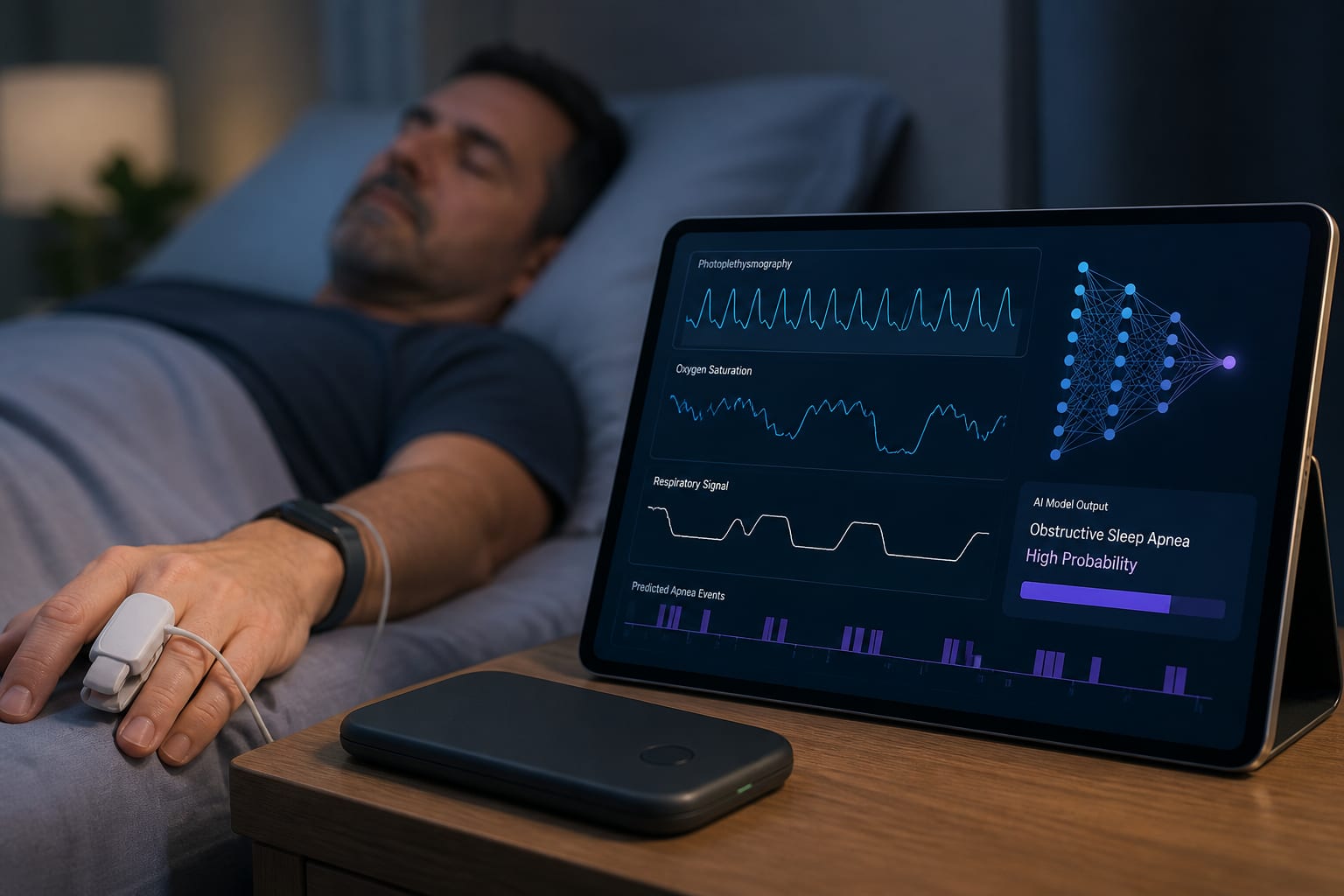
Evaluating the Precision of AI in Diagnosing Obstructive Sleep Apnea Through Photoplethysmography: A Systematic Review and Meta-Analysis

  • By

  • Brian Sheng Yep Yeo

  • Esther Yanxin Gao

  • Joan Ern Xin Tan

  • Jun Yuan Koo

  • Yi Siang Lee

  • Nicole Kye Wen Tan

  • Adele Chin Wei Ng

  • Zhou Hao Leong

  • Thun How Ong

  • Leong Chai Leow

  • Guang-Bin Huang

  • Benjamin Kye Jyn Tan

  • Song Tar Toh

  • September 25, 2026

Share

  • 1

    Obstructive sleep apnea (OSA) affects approximately 1 billion people globally, necessitating effective diagnostic strategies.

  • 2

    Polysomnography (PSG) is the gold standard for diagnosing OSA, but its use is limited by high costs and logistical challenges.

  • 3

    Artificial intelligence (AI) is increasingly applied in medical diagnostics, including the evaluation of OSA through machine learning.

  • 4

    This systematic review and meta-analysis aims to assess the diagnostic accuracy of AI models using photoplethysmography (PPG) for OSA.

  • 5

    The study includes observational investigations of adults that utilize AI for OSA diagnosis, comparing results against established testing methods.

Original Source(s)

Related Content