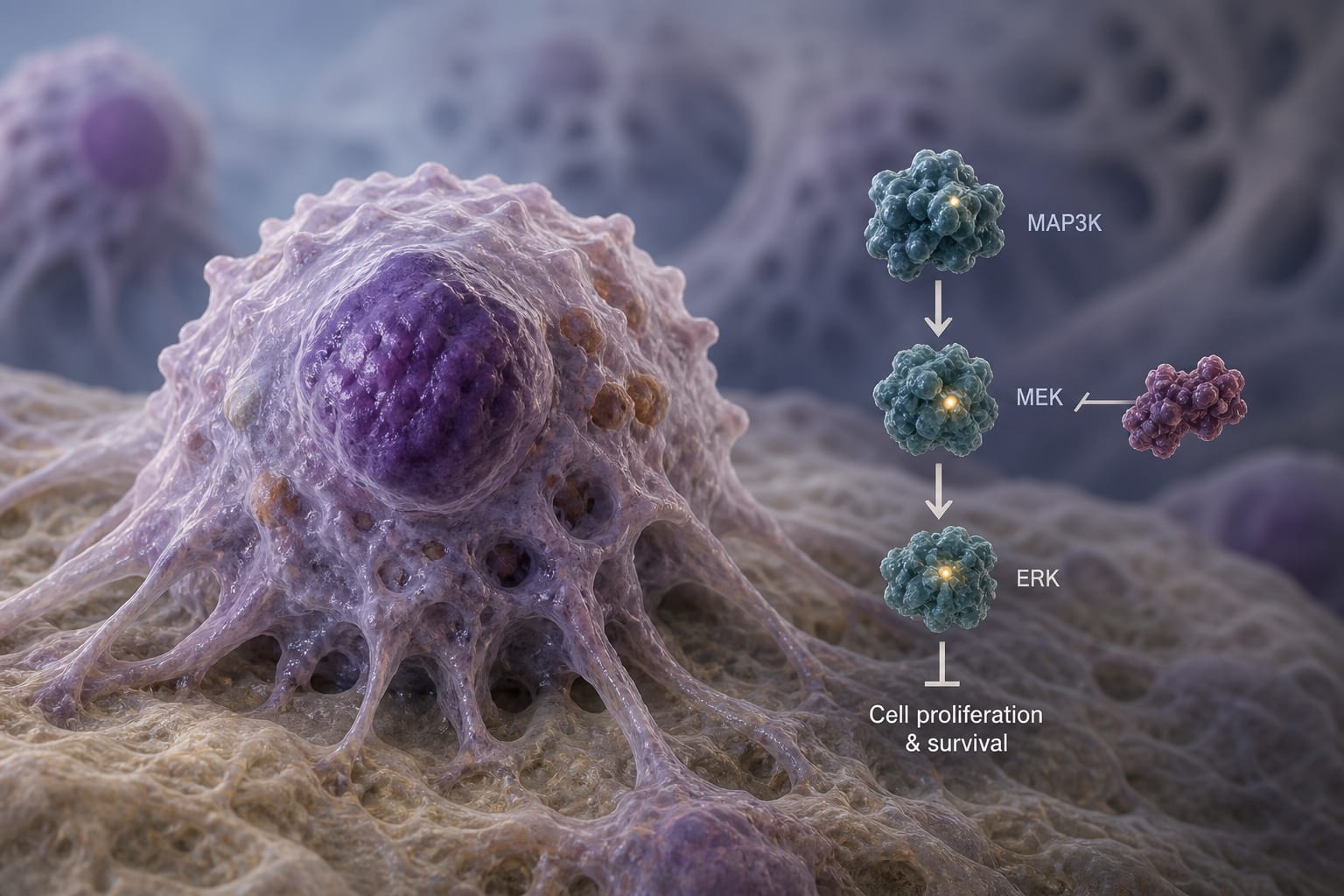
MEK inhibition achieves robust and durable responses in Erdheim–Chester disease - Takeaways - MDSpire
Coming Soon: Introducing MDSpire News. Learn more
Conexiant’s news site is now MDSpire News. Learn more

MEK Inhibitors Produce Strong, Sustained Responses in Erdheim–Chester Disease

  • By

  • Francesco Pegoraro

  • Félicien Triboulet

  • Matthias Papo

  • Francesco Peyronel

  • Anita Argentieri

  • Jerome Razanamahery

  • Ahmed Idbaih

  • Polyzois Makras

  • Ofer Shpilberg

  • Oshrat Hershkovitz-Rokah

  • Michael Girschikofsky

  • Matthew Collin

  • Kristian Bowles

  • Satyen H. Gohil

  • Rodothea Amerikanou

  • Emmanuel Ledoult

  • Tanguy Le Scornet

  • Mathilde de Menthon

  • Etienne Riviere

  • Xavier Boulu

  • Henry Dupuy

  • Achille Aouba

  • Stanislas Faguer

  • Xavier Solanich

  • Elena Sieni

  • Stéphane Barete

  • Chiara Bellino

  • Alessandro Tomelleri

  • Corrado Campochiaro

  • Lorenzo Dagna

  • Zahir Amoura

  • Jean-François Emile

  • Fleur Cohen-Aubart

  • Augusto Vaglio

  • Julien Haroche

  • October 6, 2026

Share

  • 1

    This international study included 170 patients with Erdheim–Chester disease treated with MEK inhibitor monotherapy across eight countries.

  • 2

    The cohort was predominantly male (71%), and 69% had multisystem disease involving more than four sites.

  • 3

    Skeletal involvement was most common (74%), followed by perirenal (66%), large-vessel (55%), cardiac (39%), and central nervous system disease (38%).

  • 4

    Treatment response was assessed using a composite of clinical, radiologic, and metabolic criteria, and adverse events were graded using CTCAE criteria.

  • 5

    The study evaluated long-term efficacy, tolerability, response timing, treatment retention, survival, and baseline features associated with MEK inhibitor response.

Original Source(s)

Related Content