Neurodevelopmental trajectories from birth to childhood and their impairments: insights from passive, spontaneous, and locomotor-like movements - Takeaways - MDSpire

Neurodevelopmental trajectories from birth to childhood and their impairments: insights from passive, spontaneous, and locomotor-like movements

  • By

  • Damiana Rubeca

  • Francesca Sylos-Labini

  • Irina A. Solopova

  • Camilla Gizzi

  • Ambrogio Di Paolo

  • Arthur Dewolf

  • Yury Ivanenko

  • Francesco Lacquaniti

  • June 8, 2026

  • 0 min

Share

  • 1

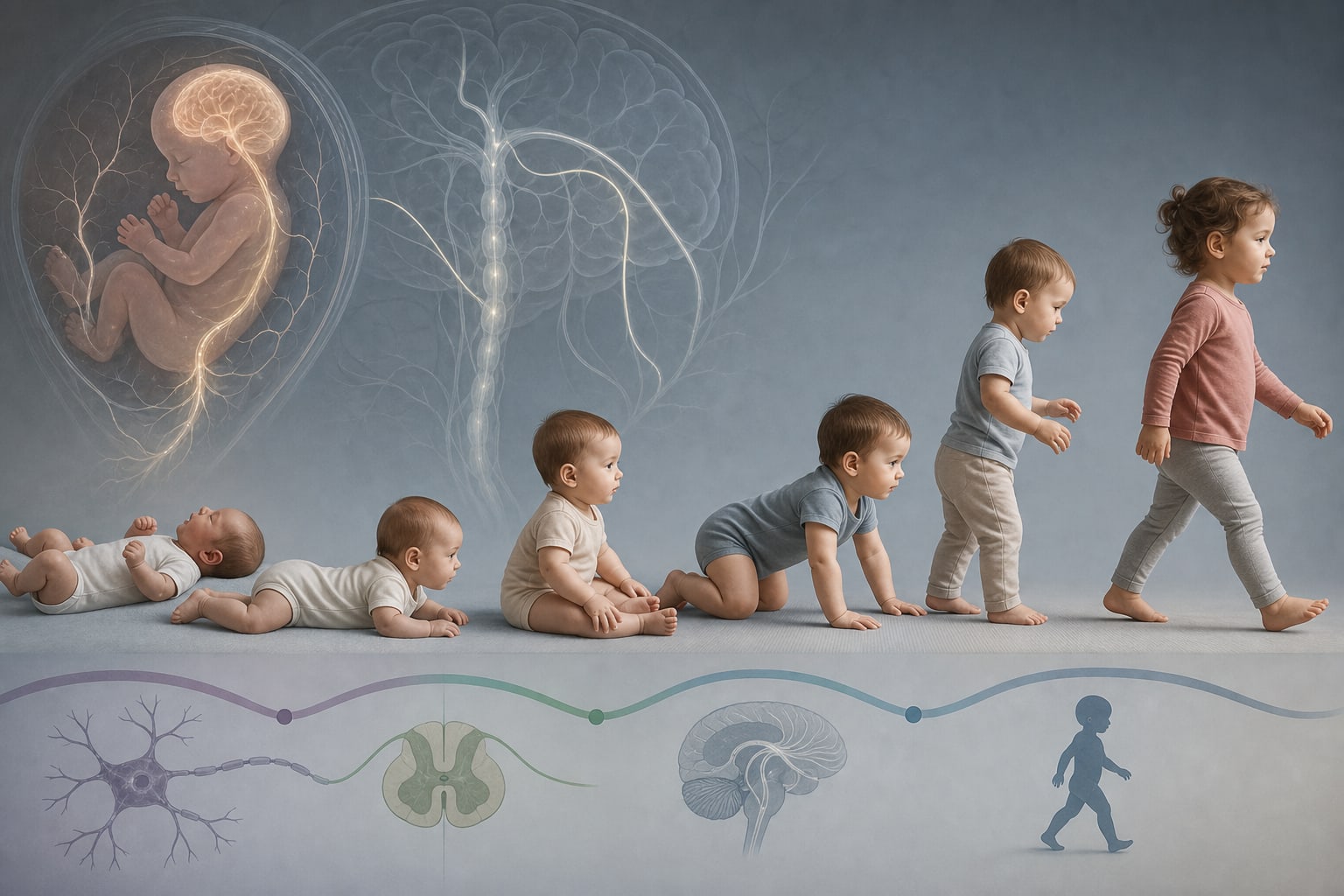
    Human motor behavior develops from prenatal movements to postnatal locomotion, reflecting the maturation of the nervous system and musculoskeletal apparatus.

  • 2

    General movements (GMs) and primitive reflexes serve as sensitive markers of neural integrity in neonates, indicating developmental progress.

  • 3

    The stepping reflex is an early expression of subcortical locomotor circuitry, considered a precursor to voluntary walking.

  • 4

    Independent locomotion emerges from the integration of musculoskeletal maturation, neural refinement, and multisensory feedback.

  • 5

    Early detection of neuromotor disorders is challenging due to subtle deviations in behavior that may overlap with physiological variability.

Original Source(s)

Related Content