Malignant transformation of lower-grade glioma: contrast enhancement, extent of resection, and the natural history under interval-censored analysis - Takeaways - MDSpire
Coming Soon: Introducing MDSpire News. Learn more
Conexiant’s news site is now MDSpire News. Learn more

Transformation of Lower-Grade Gliomas to Malignancy: The Role of Contrast Enhancement, Surgical Resection Extent, and Interval-Censored Analysis of Natural History

  • By

  • Baran Atli

  • Maximilian Wartha

  • Matthias Gmeiner

  • Martin Aichholzer

  • Serge Weis

  • Dominik Vorhauer

  • Helga Wagner

  • Tanja Hauer

  • Carlo Serra

  • Petra Böhm

  • Michael Sonnberger

  • Nico Stroh-Holly

  • Stefan Aspalter

  • Kathrin Aufschnaiter

  • Tobias Rossmann

  • Maria Gollwitzer

  • Jawed Ziai

  • Annette Leibetseder

  • Josef Pichler

  • Wolfgang Thomae

  • Christian Dorfer

  • Andreas Gruber

  • Harald Stefanits

  • Philip Rauch

  • September 22, 2026

Share

  • 1

    Lower-grade gliomas (LGGs) often appear indolent until malignant transformation (MT), impacting prognosis and treatment timing.

  • 2

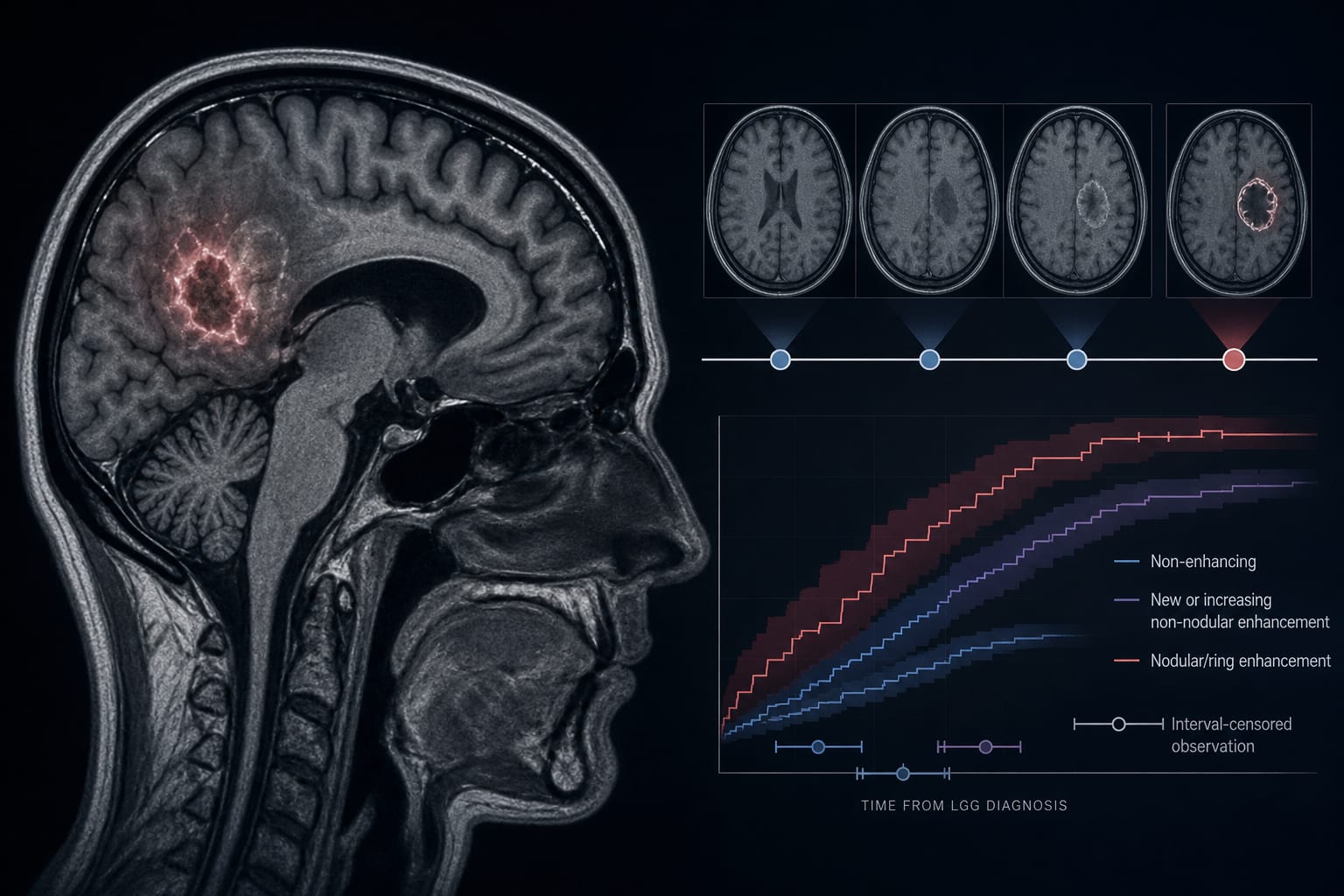
    Preoperative imaging serves as the only risk marker for MT before tissue acquisition, with molecular classification available only post-biopsy.

  • 3

    Malignant transformation has not been evaluated as an interval-censored event, leading to potential biases in previous studies.

  • 4

    The study includes 155 patients with histologically confirmed LGGs, requiring diagnostic-quality preoperative MRI and follow-up.

  • 5

    Contrast enhancement (CE) is assessed visually on MRI, with specific criteria to determine positivity and exclude malignancy.

Original Source(s)

Related Content