Activity-dependent adaptive deep brain stimulation improves gait in Parkinson’s disease - Takeaways - MDSpire

Activity-dependent adaptive deep brain stimulation improves gait in Parkinson’s disease

  • By

  • Stefano Scafa

  • Valeria de Seta

  • Ruijia Wang

  • Paula Sánchez López

  • Andrea Sánchez López

  • Camille Varescon

  • Icare Sakr

  • Nadia Bérard

  • Lea Bole-Feysot

  • Céline Deschenaux

  • Ian Enderli

  • Yohann Thenaisie

  • Morgane Burri

  • Frédéric Merlos

  • Vanessa Fleury

  • Benoit Wicki

  • Ettore Accolla

  • Andria Tziakouri

  • Cécile Hübsch

  • Mayte Castro Jiménez

  • Julien F. Bally

  • Alessandro Puiatti

  • Kyuhwa Lee

  • Henri Lorach

  • Antoine Collomb-Clerc

  • Jocelyne Bloch

  • Eduardo M. Moraud

  • June 15, 2026

  • 0 min

Share

  • 1

    Parkinson's disease causes significant locomotor deficits, with up to 90% of patients experiencing treatment-resistant impairments.

  • 2

    Conventional deep brain stimulation (DBS) often fails to address gait deficits and may worsen symptoms like postural instability.

  • 3

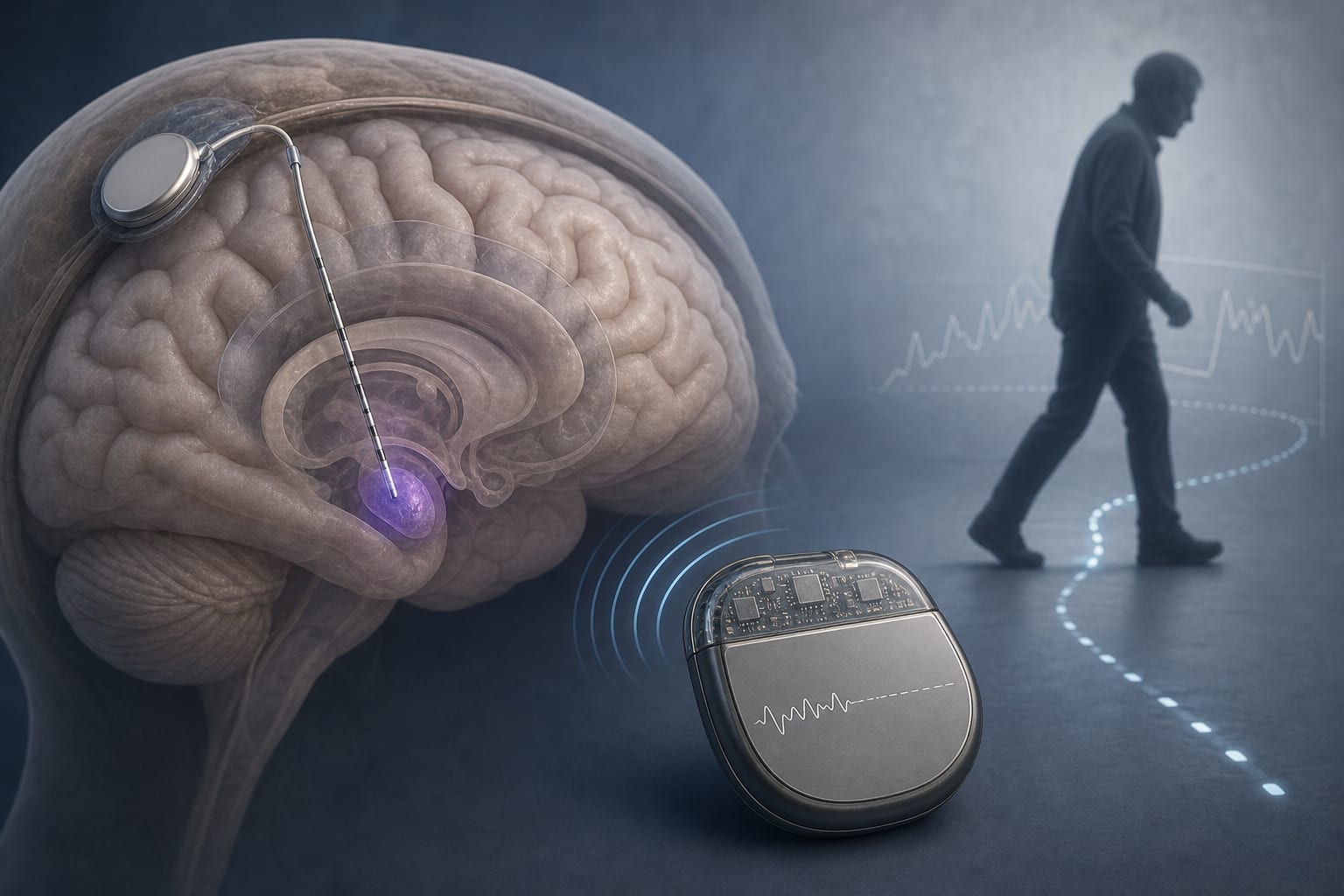
    Adaptive DBS (aDBS) strategies can outperform conventional DBS by dynamically adjusting stimulation parameters based on real-time activity.

  • 4

    The subthalamic nucleus (STN) encodes locomotor activities, enabling personalized aDBS therapies that improve both gait and cardinal motor symptoms.

  • 5

    A multimodal platform was developed to map STN dynamics to mobility activities, enhancing the understanding of therapeutic interactions in Parkinson's patients.

Original Source(s)

Related Content