Self-supervised representation learning reveals explainable physiological structure in high-dimensional magnetocardiography - Takeaways - MDSpire

Self-supervised representation learning reveals explainable physiological structure in high-dimensional magnetocardiography

  • By

  • Dominik D. Kranz

  • Oruç Kahriman

  • Dominic Dischl

  • Sascha Treskatsch

  • André Sander

  • Johannes Brachmann

  • Jai-Wun Park

  • Niels Wessel

  • June 1, 2026

  • 0 min

Share

  • 1

    Magnetocardiography (MCG) records cardiac magnetic fields, offering higher fidelity than traditional surface potentials.

  • 2

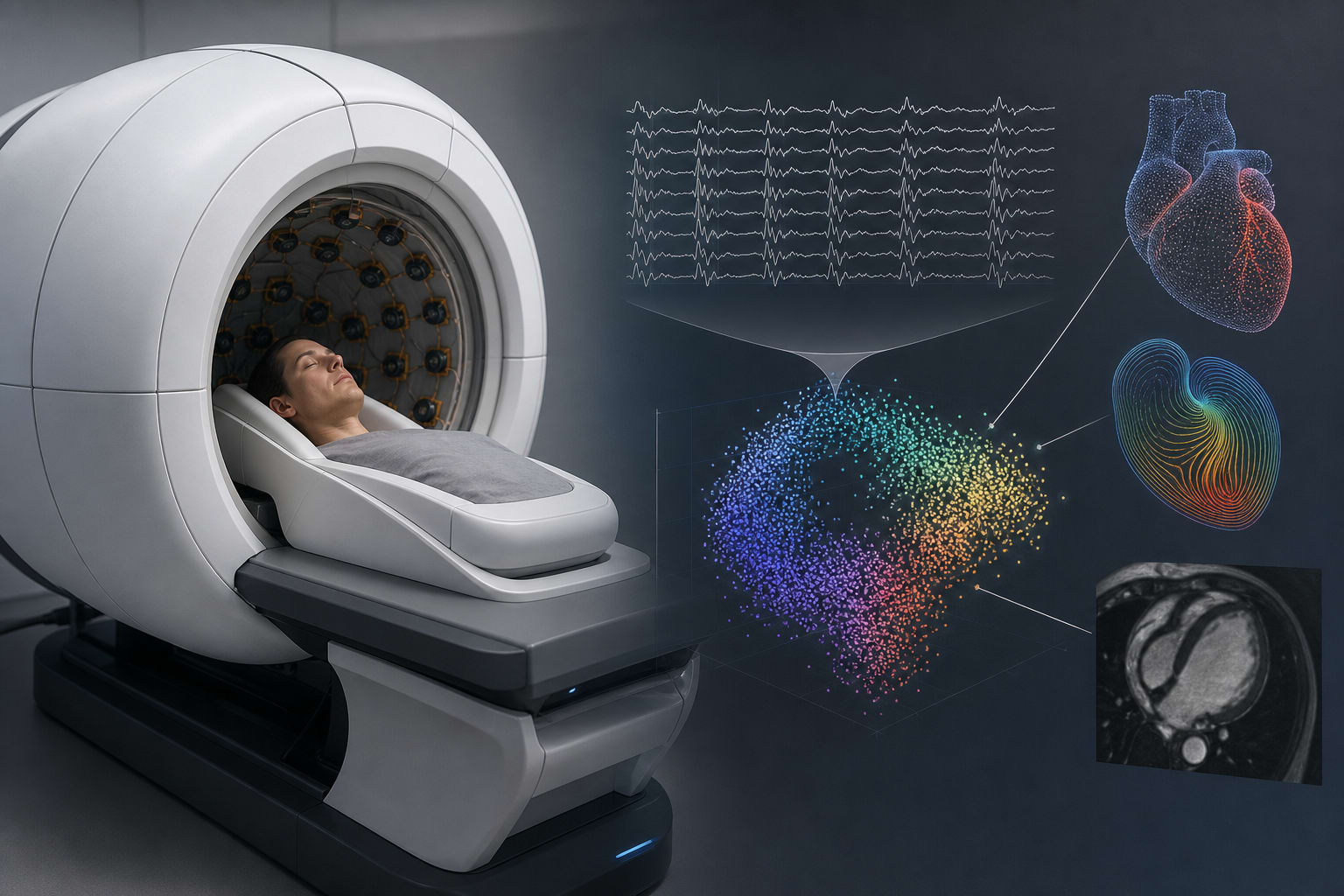
    MCG2Vec, a self-supervised learning model, was developed to analyze raw 64-channel MCG recordings from 1732 patients.

  • 3

    The model achieved AUCs of 0.89 for multivessel coronary artery disease, 0.81 for reduced left ventricular ejection fraction, and 0.77 for atrial fibrillation risk.

  • 4

    Attribution analyses revealed specific temporal and spatial patterns related to cardiac physiology, enhancing interpretability of the MCG data.

  • 5

    The study emphasizes the importance of measurement physics in determining the capabilities of medical AI systems.

Original Source(s)

Related Content