Habitat imaging based on DCE-MRI for differentiating luminal and non-luminal subtypes of breast cancer: a two-center study - Takeaways - MDSpire
Coming Soon: Introducing MDSpire News. Learn more
Conexiant’s news site is now MDSpire News. Learn more

Utilizing DCE-MRI Habitat Imaging to Distinguish Between Luminal and Non-Luminal Breast Cancer Subtypes: Findings from a Dual-Center Investigation

  • By

  • Zhang Qing

  • Qin Xiao-Tao

  • Zhou Xia

  • Zhang Xiu-Lan

  • Peng Jie

  • Li Yun

  • Wang Wei-Bing

  • September 7, 2026

Share

  • 1

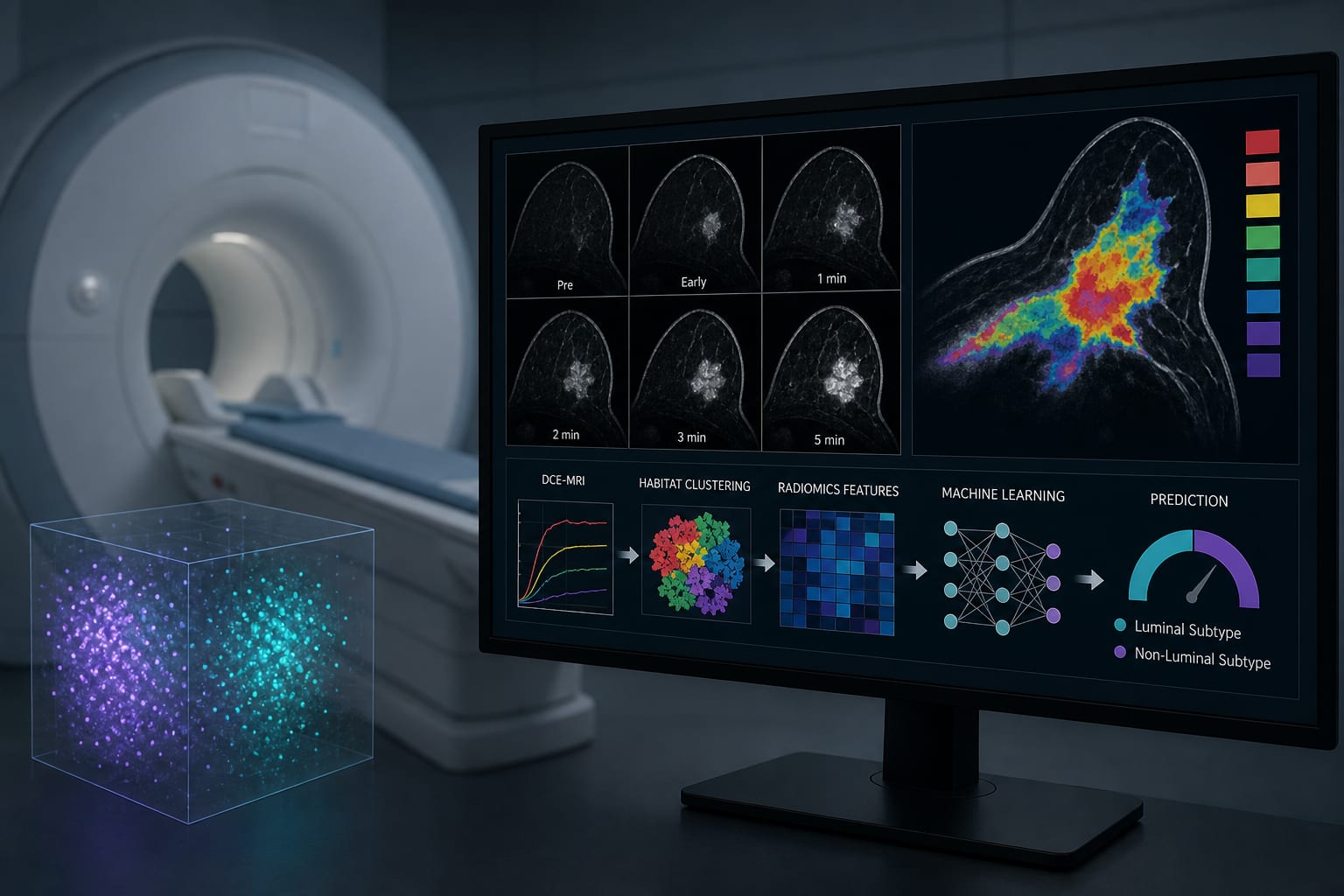
    The study investigated DCE-MRI-based habitat imaging for distinguishing luminal from non-luminal breast cancer subtypes.

  • 2

    Data were collected from 396 breast cancer patients across two centers, with various machine learning models developed for analysis.

  • 3

    The stacking model achieved the highest AUC of 0.840, outperforming habitat and conventional radiomics models.

  • 4

    Calibration curves indicated good calibration for the stacking model, and decision curves showed favorable net clinical benefit.

  • 5

    Habitat imaging enhances the quantification of intratumoral heterogeneity, providing a noninvasive assessment of tumor characteristics.

Original Source(s)

Related Content