Accelerometer-Based Activity Sensing by an Insertable Cardiac Monitor In Ambulatory Patients: A Subanalysis of LUX-Dx TRENDS (LUX-Dx Heart Failure Sensors in an Insertable Cardiac Monitor System Clinical Study) - Takeaways - MDSpire
Coming Soon: Introducing MDSpire News. Learn more
Conexiant’s news site is now MDSpire News. Learn more

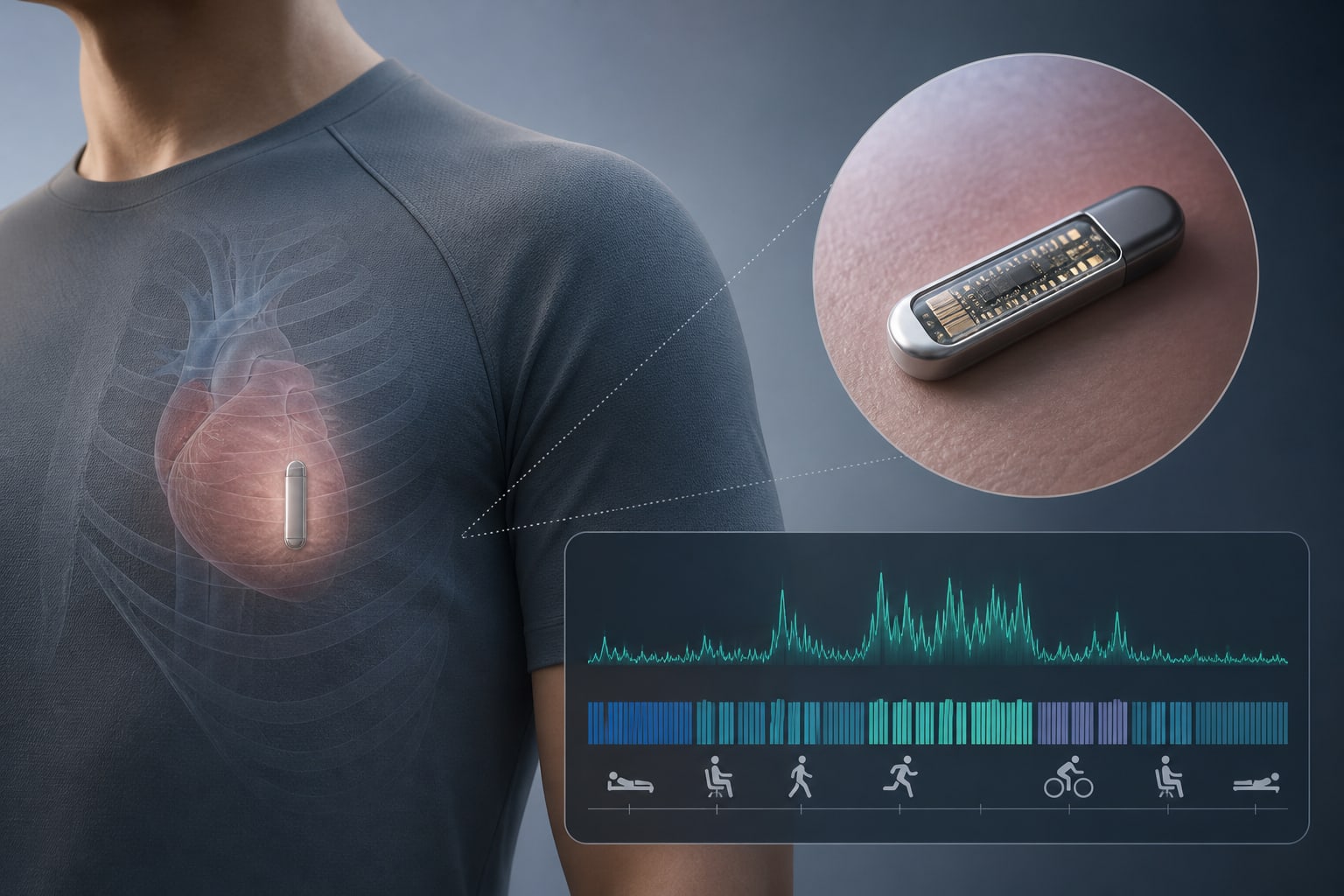
Activity Monitoring With an Insertable Cardiac Monitor in Ambulatory Patients: Subanalysis of the LUX-Dx TRENDS Clinical Study of Heart Failure Sensors

  • By

  • ANDREW J. SAUER

  • E. MATTHEW QUIN

  • KARAN BHALLA

  • SASHI ADIGOPULA

  • BIN MI

  • EMILY THOMPSON

  • DEEPA MAHAJAN

  • MING DUANMU

  • CRAIG M. STOLEN

  • MOLLY E. KUPFER

  • ALYSIA ROSNER

  • SELÇUK ADABAG

  • SCOTT D. SOLOMON

  • ELAINE Y. WAN

  • October 11, 2026

Share

  • 1

    The LUX-Dx TRENDS exercise substudy includes 104 ambulatory patients with New York Heart Association class II or III heart failure at 26 US sites.

  • 2

    Subcutaneous accelerometer activity signals increase by an estimated 33.7 mG per 1-mph increase in treadmill walking speed in dataset 1 and 32.3 mG in dataset 2.

  • 3

    In dataset 2, device activity classification shows near-perfect agreement with the prespecified reference standard (κ = 0.971; 95% CI, 0.947–0.985).

  • 4

    In dataset 2, sensitivity is 0.974, specificity is 0.994, positive predictive value is 0.991, and negative predictive value is 0.982 using the primary reference standard.

  • 5

    The algorithm continues to meet its prespecified performance goal of κ > 0.8 when sensitivity analyses classify treadmill walking at 0.7 mph as either active or inactive.

Original Source(s)

Related Content