-
1
The study describes South Korea as using testing, contact tracing, quarantine, and social distancing to contain COVID-19 without nationwide lockdowns.
-
2
Researchers developed a deterministic, age-structured V-SEIQR compartmental model to simulate SARS-CoV-2 transmission in South Korea.
-
3
The analysis used publicly available KDCA surveillance data covering November 1, 2020, through December 31, 2021, and 2021 population data from Statistics Korea.
-
4
The model incorporated age- and vaccine type-specific daily vaccination counts, waning vaccine-induced immunity, pre-Delta and Delta variants, and the Delta variant’s estimated relative transmissibility.
-
5
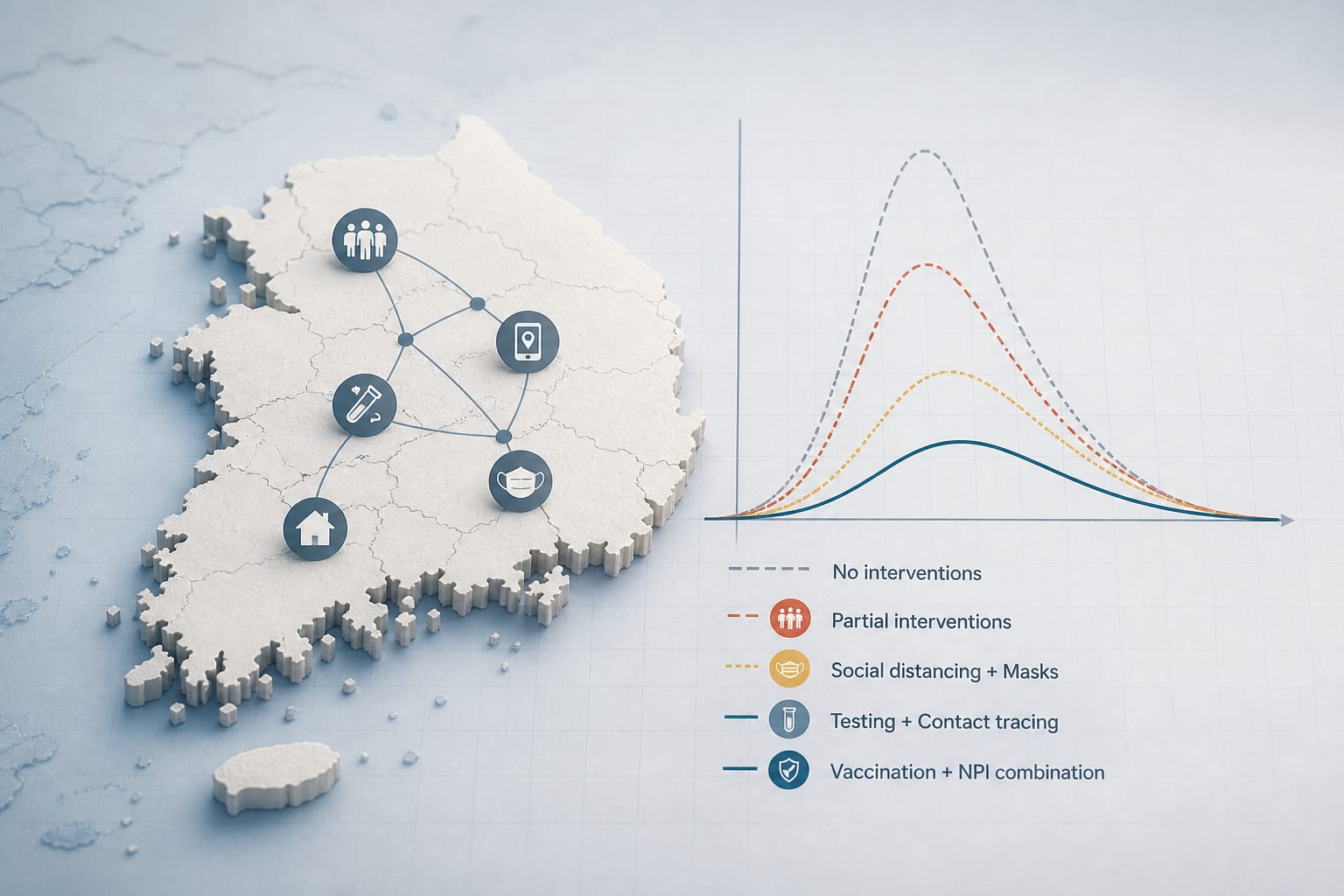
The retrospective modeling study used counterfactual scenarios to estimate how changes in vaccination, testing capacity, contact tracing, and social distancing could have affected cumulative confirmed COVID-19 cases during the pre-Delta and Delta-dominant periods.