Prognostic impact of iliofemoral access-site calcification volume on outcomes after transcatheter aortic valve implantation - Takeaways - MDSpire

Prognostic impact of iliofemoral access-site calcification volume on outcomes after transcatheter aortic valve implantation

  • By

  • Vivian Vij

  • Katja Schauwienold

  • Jasmin Shamekhi

  • Samuel Muli

  • Mustafa Basha

  • Eleftherios Markidis

  • Andreas Zietzer

  • Philip Düsing

  • Muntadher Al Zaidi

  • Marcel Weber

  • Lara Al-Kassou

  • Tobias Zeus

  • Victor Mauri

  • Matti Adam

  • Jörg Schröder

  • Stephan Baldus

  • Malte Kelm

  • Nikolaus Marx

  • Farhad Bakhtiary

  • Enzo Lüsebrink

  • Sebastian Zimmer

  • Georg Nickenig

  • Alexander Sedaghat

  • Baravan Al-Kassou

  • June 11, 2026

  • 0 min

Share

  • 1

    Transcatheter aortic valve implantation (TAVI) is a recognized treatment for severe symptomatic aortic stenosis across various surgical risk levels.

  • 2

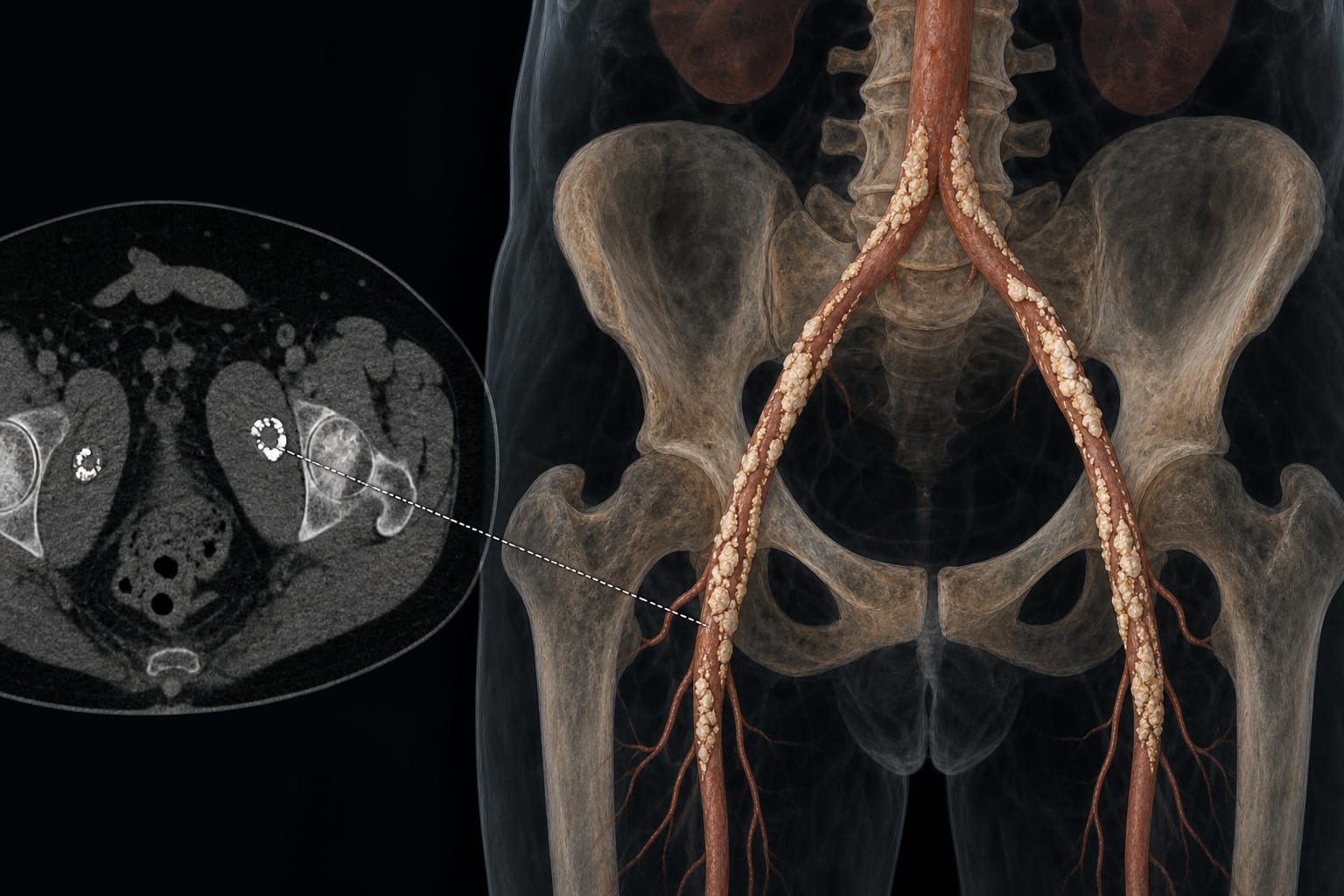
    Pre-procedural multidetector computed tomography (CT) is essential for TAVI planning, assessing vascular anatomy and iliofemoral calcification.

  • 3

    Quantitative assessment of iliofemoral access-site calcification (IASC) volume may provide objective insights into atherosclerotic burden.

  • 4

    The study analyzed 1067 patients undergoing TAVI to evaluate the relationship between IASC volume and mortality outcomes.

  • 5

    Primary endpoints included all-cause mortality at 1, 3, and 5 years, with secondary endpoints focusing on peri-procedural complications.

Original Source(s)

Related Content