Trends in urolithiasis mortality in the United States, 1999–2024: a Joinpoint regression analysis of age, sex, race, and regional disparities - Takeaways - MDSpire
Coming Soon: Introducing MDSpire News. Learn more
Conexiant’s news site is now MDSpire News. Learn more

Analysis of Mortality Trends Associated with Urolithiasis in the United States from 1999 to 2024: A Joinpoint Regression Study Examining Age, Gender, Ethnicity, and Geographic Variations

  • By

  • Li-Li Xu

  • Chu-xuan Lin

  • Xin-yi Lin

  • Qin-ying Zhou

  • Nai-fen Xu

  • Ding-qin Zheng

  • Ran Xu

  • August 21, 2026

Share

  • 1

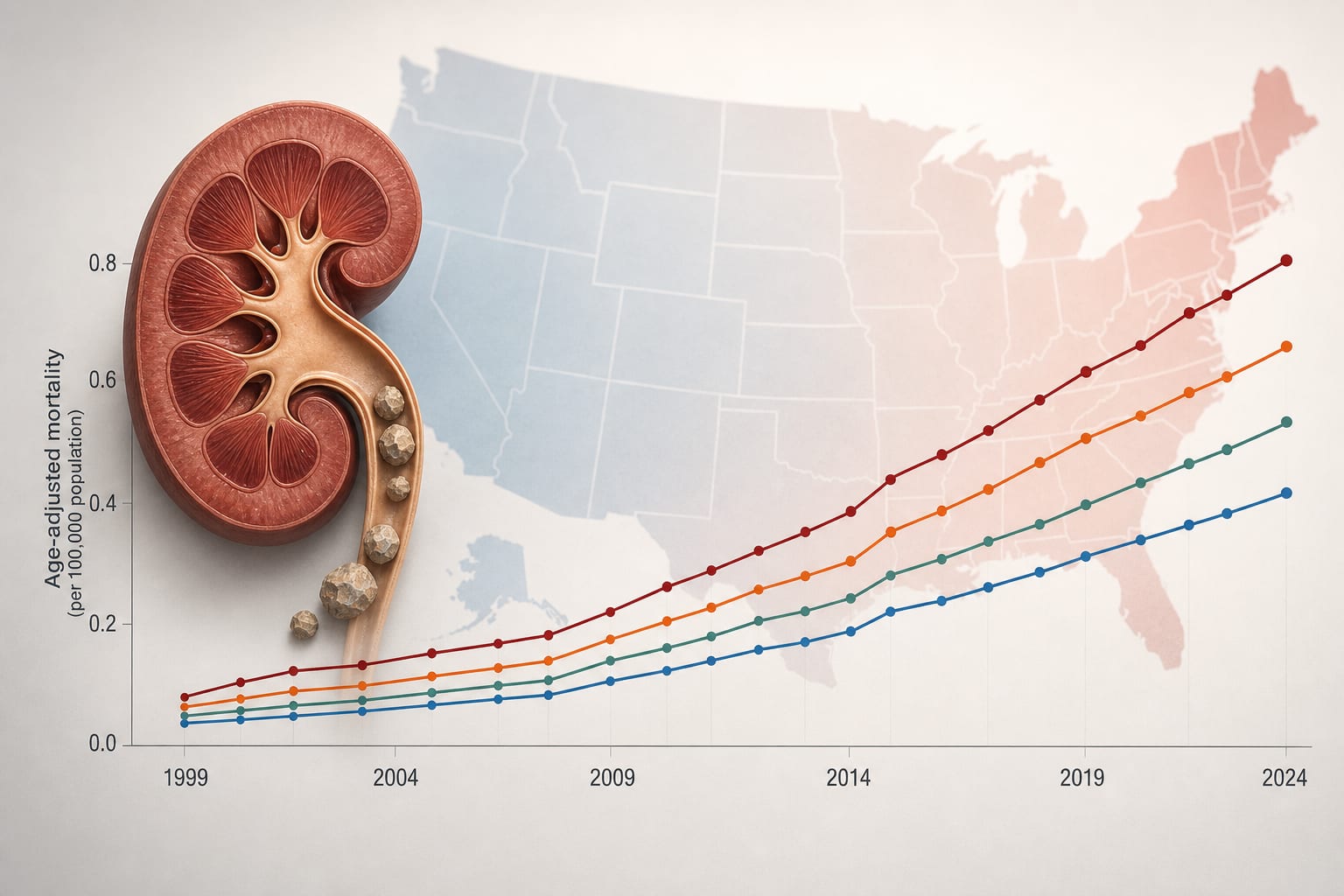
    Urolithiasis mortality in the U.S. increased from 0.22 to 0.72 per 100,000 population between 1999 and 2024 after age adjustment.

  • 2

    The annual percent change in urolithiasis mortality accelerated from 1.94% (1999-2014) to 8.54% (2014-2024).

  • 3

    Females had a higher age-adjusted mortality rate (0.80) than males (0.68) by 2024, with significant regional disparities noted.

  • 4

    Non-Hispanic white individuals experienced the highest mortality rate (0.86) and average annual percent change (5.71%).

  • 5

    The highest mortality rate was among individuals aged 85 and older (5.72), with the steepest increase in the 65-74 age group (4.94%).

Original Source(s)

Related Content