Impact of cerebral small vessel disease burden and systemic clinical phenotypes on short-term neurological outcomes after acute ischemic stroke - Takeaways - MDSpire

Impact of cerebral small vessel disease burden and systemic clinical phenotypes on short-term neurological outcomes after acute ischemic stroke

  • By

  • Lifang Ma

  • Fangtong Liu

  • Jing Deng

  • Fangyuan Cui

  • Jing Bai

  • Bin Ma

  • Lu Tang

  • Xiao Han

  • Li Zhou

  • Ying Gao

  • Yan Li

  • June 4, 2026

  • 0 min

Share

  • 1

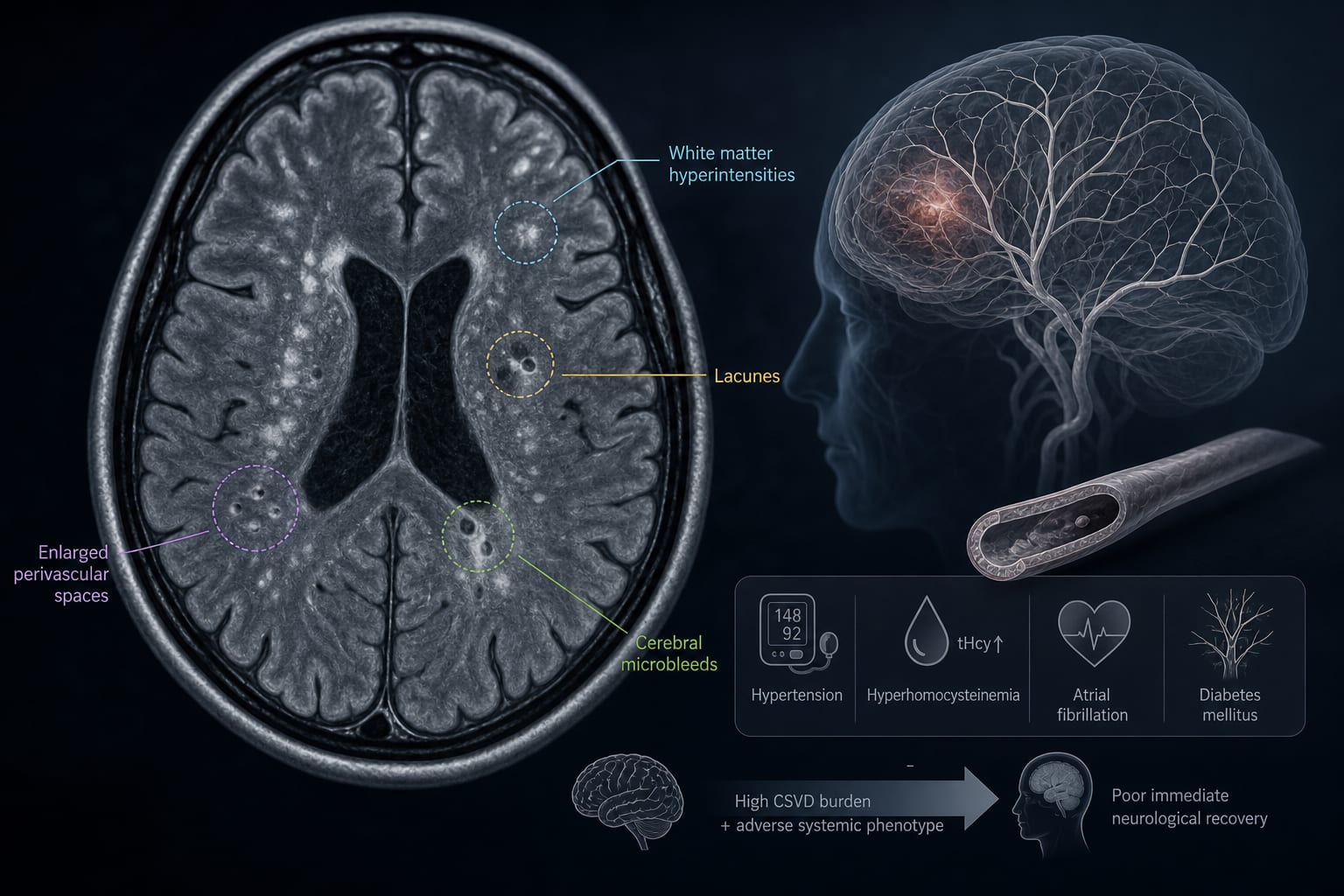
    Cerebral small vessel disease (CSVD) significantly impacts early neurological recovery following acute ischemic stroke (AIS).

  • 2

    Higher total CSVD burden and specific systemic clinical phenotypes are linked to unfavorable neurological outcomes at discharge.

  • 3

    In a study of 474 AIS patients, 6.5% experienced unfavorable outcomes, with lacunar infarction showing the strongest association.

  • 4

    Hyperhomocysteinemia and a TCM-defined Phlegm-Heat Fu-Excess phenotype were independently associated with poor outcomes.

  • 5

    Further research is needed to validate these findings in larger, prospective multicenter studies for better risk stratification.

Original Source(s)

Related Content