Influencing factors of peripheral blood indicators on 30-day mortality risk in children with hemophagocytic lymphohistiocytosis based on weighted quantile sum regression: a single-center retrospective cohort study - Takeaways - MDSpire

Influencing factors of peripheral blood indicators on 30-day mortality risk in children with hemophagocytic lymphohistiocytosis based on weighted quantile sum regression: a single-center retrospective cohort study

  • By

  • Chuncan Wu

  • Xiaoying Zhang

  • Xiang Lan

  • Weijun Huang

  • Zhonglv Ye

  • Lili Liu

  • Chuan Tian

  • July 15, 2026

Share

  • 1

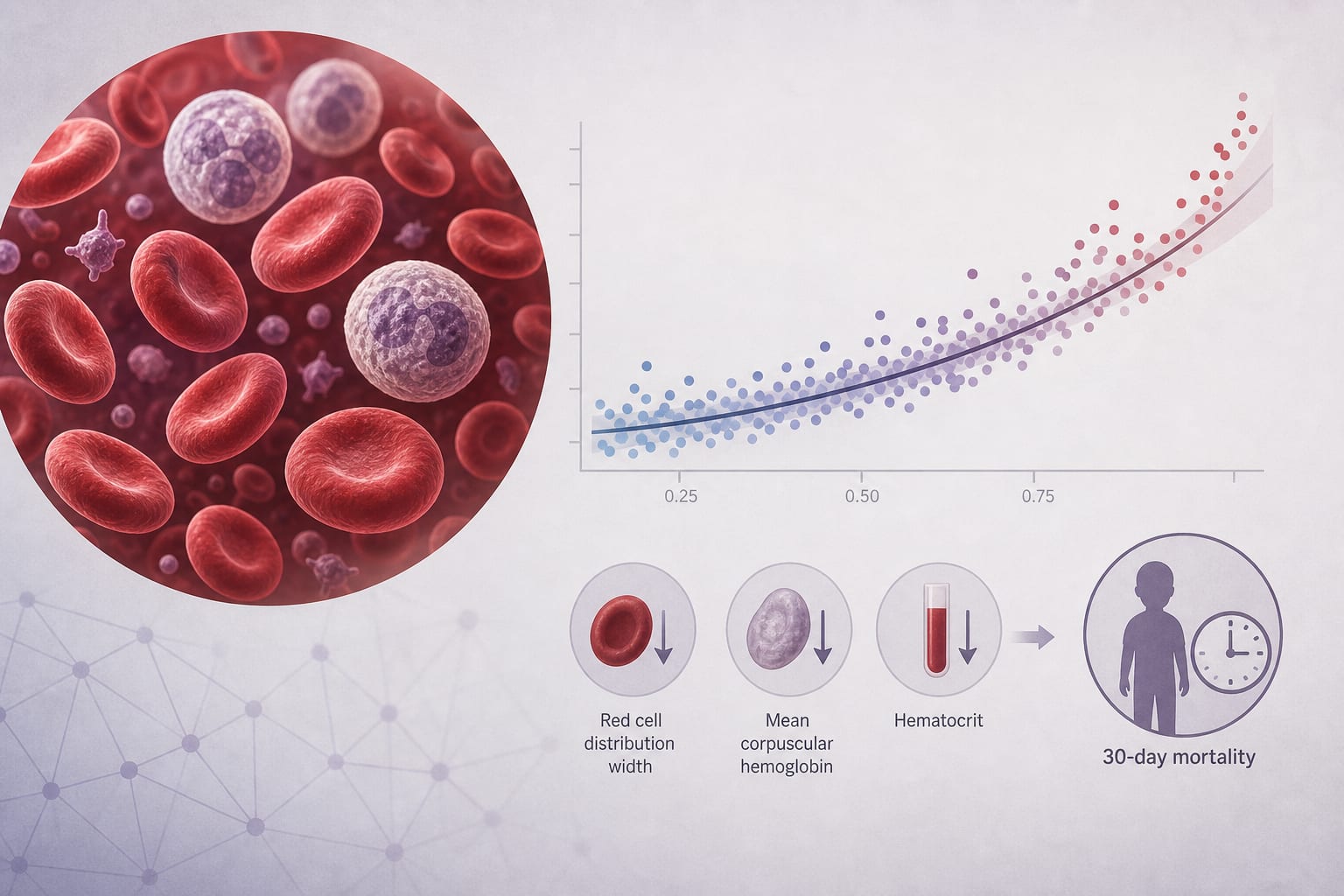
    The study analyzed 133 pediatric HLH patients to assess the impact of peripheral blood parameters on 30-day mortality risk.

  • 2

    Significant associations were found between red blood cell distribution width, mean corpuscular hemoglobin, hematocrit, and early mortality risk.

  • 3

    Weighted quantile sum regression revealed that mean corpuscular hemoglobin and hematocrit had the highest relative weights in predicting mortality.

  • 4

    The combined predictive model using mean corpuscular hemoglobin and hematocrit achieved an area under the curve of 0.728, indicating improved predictive efficacy.

  • 5

    The study highlights the potential of peripheral blood parameters as composite indicators for early mortality risk in pediatric HLH.

Original Source(s)

Related Content