MiR-1a-3p/Fcgr4-dependent osteoclast activation regulates pathological bone loss - Takeaways - MDSpire

MiR-1a-3p/Fcgr4-dependent osteoclast activation regulates pathological bone loss

  • By

  • Jiayao Zhang

  • Yun Zhai

  • Liang He

  • Yunping Song

  • Mingxuan Lu

  • Xuerui Xiang

  • Jiehong Huang

  • Jinyin Huang

  • Weiqing Tian

  • Yue Zhao

  • Shuxian Lin

  • Weicai Liu

  • May 25, 2026

  • 0 min

Share

  • 1

    Osteoporosis results from an imbalance between osteoclast-mediated bone resorption and osteoblast-mediated bone formation.

  • 2

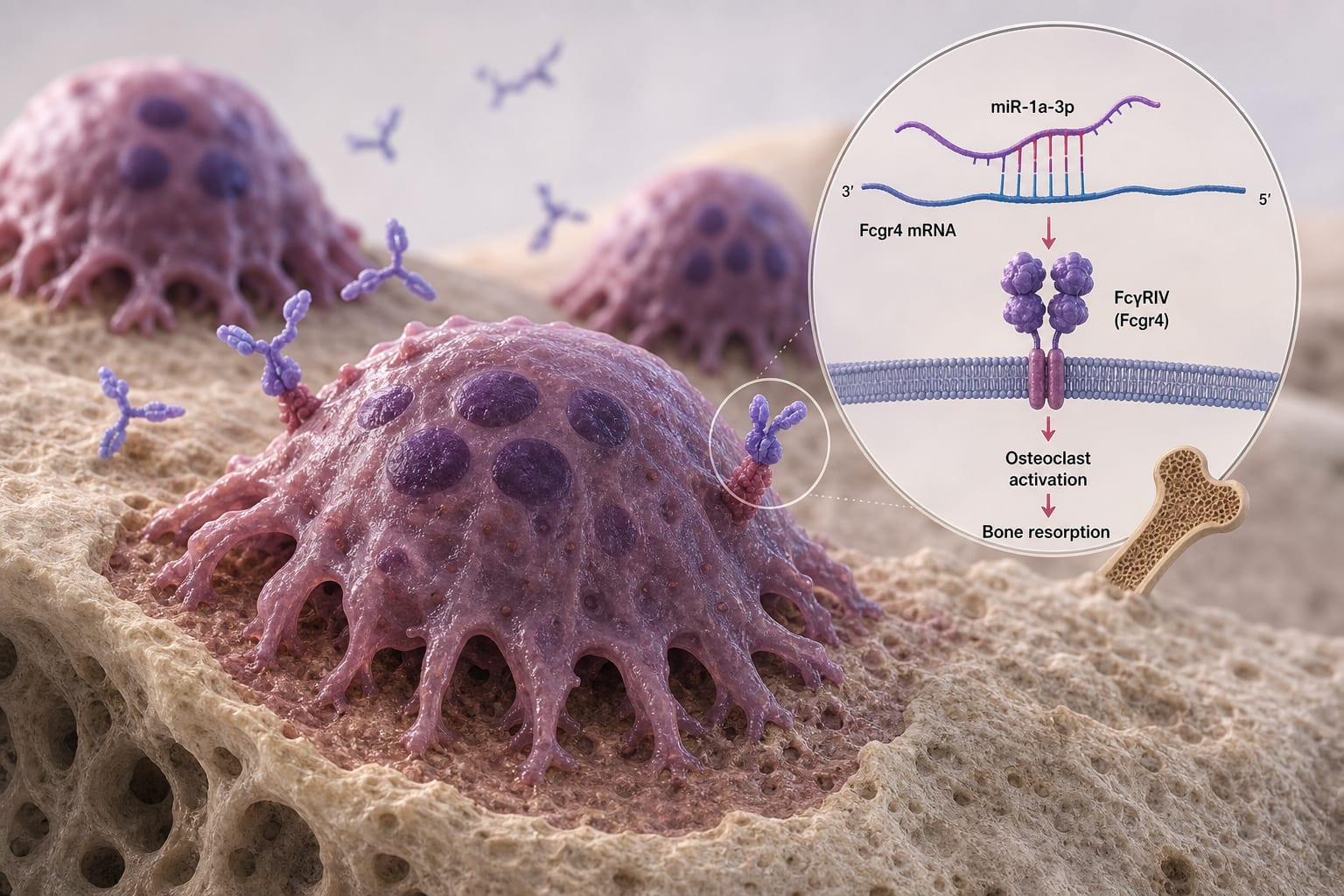
    MiR-1a-3p directly targets Fcgr4, inhibiting osteoclast activity and signaling pathways associated with bone loss.

  • 3

    Reduced expression of miR-1a-3p is observed in human osteoporosis cohorts and animal models of bone loss.

  • 4

    Chronic unpredictable mild stress increases Fcgr4 expression and osteoclast activity, linking stress to bone loss.

  • 5

    The study highlights the miR-1a-3p–Fcgr4 axis as a potential mechanism connecting systemic pathological changes to osteoclast dysregulation.

Original Source(s)

Related Content