Fixation height has a greater biomechanical effect than anterior tilt angle in syndesmotic fixation for weber B ankle fractures: a specific finite element study - Takeaways - MDSpire

Fixation height has a greater biomechanical effect than anterior tilt angle in syndesmotic fixation for weber B ankle fractures: a specific finite element study

  • By

  • Dong Jiang

  • Zhiwei Wu

  • Jianwen Cheng

  • July 14, 2026

Share

  • 1

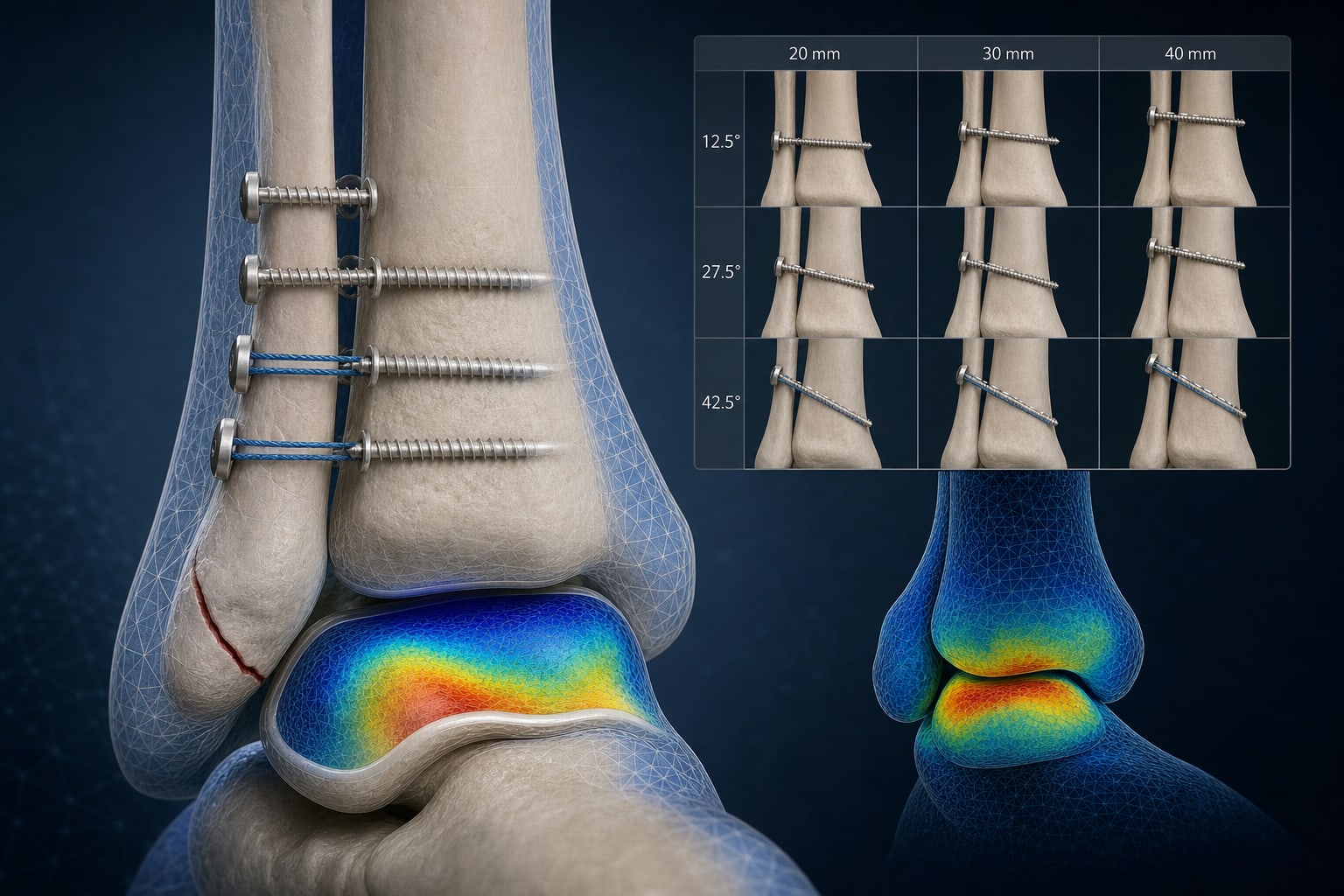
    A 3D finite element model was developed to study the biomechanics of syndesmotic fixation in Weber B ankle fractures.

  • 2

    Eighteen fixation models were tested at different heights and angles, revealing significant effects on tibiotalar contact stress and fibular displacement.

  • 3

    Fixation at 20–30 mm above the tibial plafond restored near-physiologic mechanics, while 40 mm fixation led to biomechanical deterioration.

  • 4

    Tricortical screws provided better restraint against fibular translation compared to suture-buttons, which allowed more micromotion.

  • 5

    The study concluded that fixation height significantly impacts biomechanics more than anterior tilt angle in syndesmotic fixation.

Original Source(s)

Related Content