Development of a MACE risk prediction model based on CCTA-derived quantitative parameters: a proof-of-concept study - Takeaways - MDSpire

Creation of a Risk Prediction Model for Major Adverse Cardiovascular Events Utilizing Quantitative Data from CCTA: A Proof-of-Concept Investigation

  • By

  • Tianyang Gao

  • Mingyu Zou

  • Wei Zhou

  • Yu Zhong

  • Shu Zhou

  • Sen Xu

  • Libo Zhang

  • July 21, 2026

Share

  • 1

    The study analyzed clinical data from 280 CAD patients to identify factors influencing major adverse cardiovascular events (MACE).

  • 2

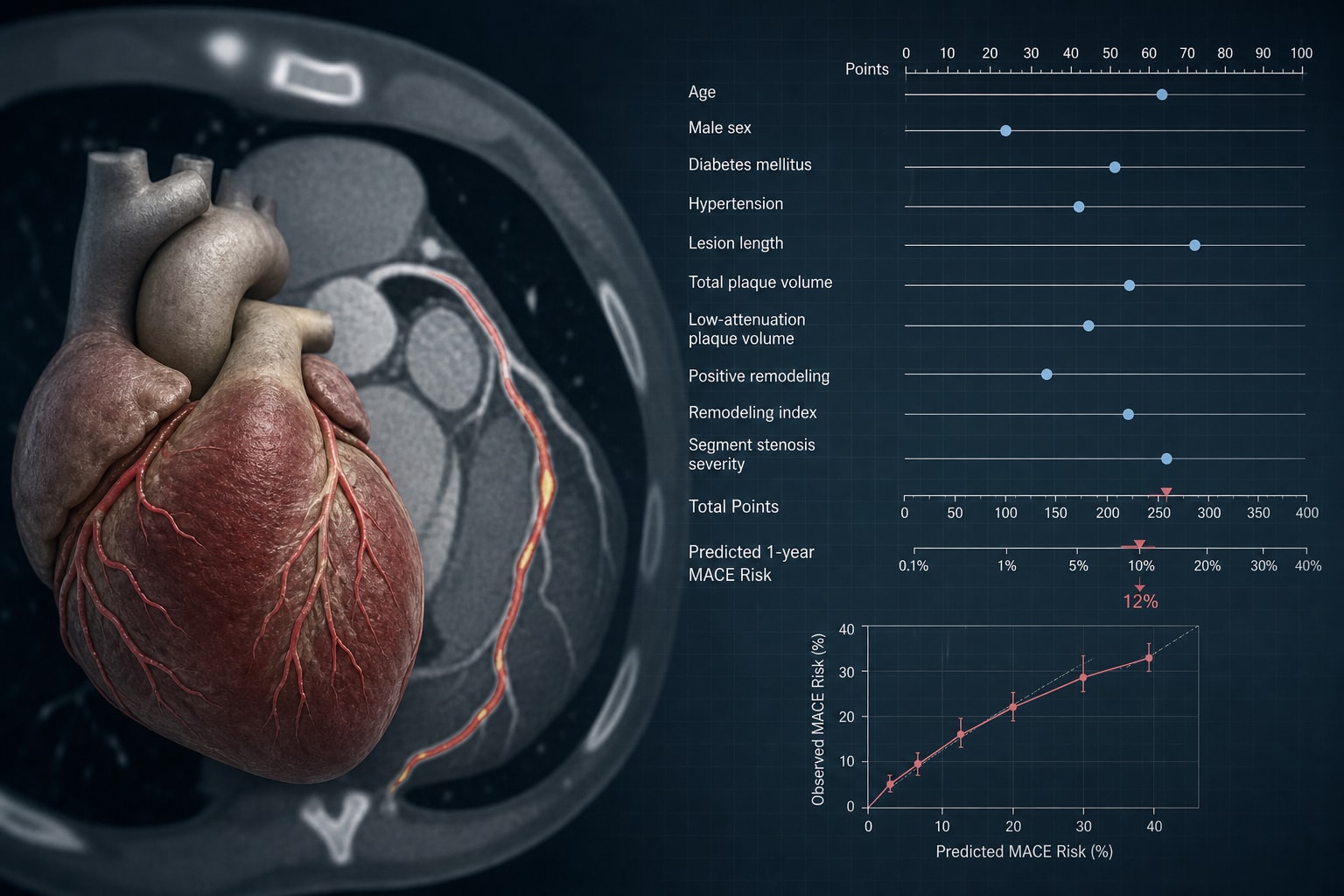
    Independent predictors of MACE included severe stenosis, longer plaque length, larger fibrous plaque volume, and elevated plaque burden.

  • 3

    A nomogram was constructed and validated, achieving an AUC of 0.936, indicating high predictive accuracy for MACE.

  • 4

    External validation confirmed robust discrimination with an AUC of 0.932 and excellent calibration for the risk prediction model.

  • 5

    The study emphasizes the need for longer-term prospective studies to validate the findings regarding hard outcomes.

Original Source(s)

Related Content