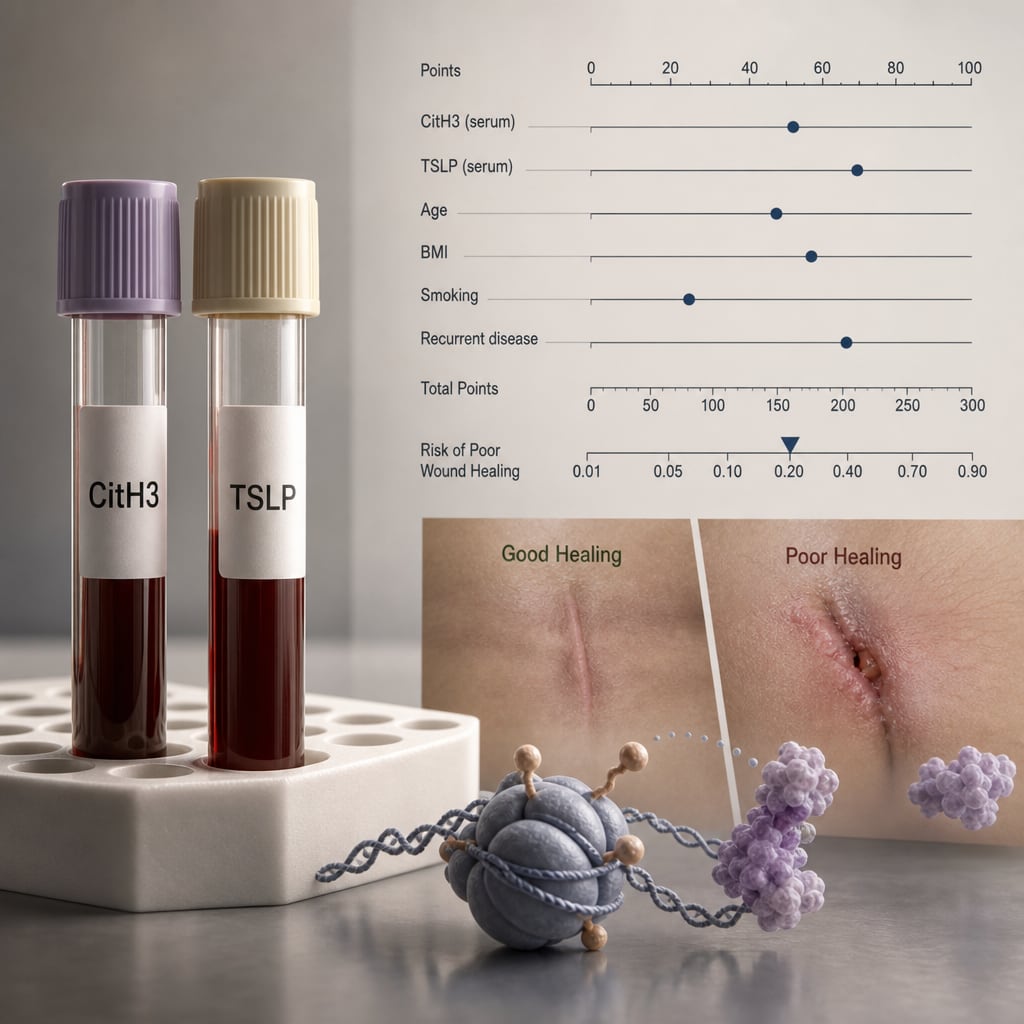
Serum CitH3 and TSLP as predictive biomarkers for impaired wound healing after bascom cleft lift surgery in pilonidal sinus disease: a nomogram-based risk model - Takeaways - MDSpire

Serum CitH3 and TSLP as predictive biomarkers for impaired wound healing after bascom cleft lift surgery in pilonidal sinus disease: a nomogram-based risk model

  • By

  • Junyue Huo

  • Binghui Hu

  • Xiufang Lu

  • Bo Zhang

  • Bingjie Wang

  • May 4, 2026

  • 0 min

Share

  • 1

    Serum CitH3 and TSLP levels are significant predictors of postoperative wound healing outcomes in patients undergoing Bascom cleft lift for pilonidal sinus disease.

  • 2

    The study categorized 181 patients into good-healing and poor-healing cohorts based on wound outcomes at 6 weeks post-surgery.

  • 3

    Poor-healing patients exhibited higher BMI, FBG, CRP, CitH3, and TSLP levels, and lower albumin compared to the good-healing group.

  • 4

    A nomogram developed from the study showed excellent predictive performance with AUC values of 0.958 and 0.970 in training and validation cohorts, respectively.

  • 5

    The findings suggest that CitH3 and TSLP could serve as biomarkers for assessing wound healing risks, warranting further validation in larger studies.

Original Source(s)

Related Content